Showing posts with label message. Show all posts

Tuesday, November 15, 2011

Few things on the case R. J. Reynolds et al v. United States Food and Drug Administration

A district court just ruled on whether the FDA can force cigarette companies to publish graphic anti-smoking images on packs. The Judge, Richard J. Leon, gives a failed rhetorical analysis in his opinion:
Unfortunately for the Government, the evidence here overwhelmingly suggests that the Rule's graphic-image requirements are not the type of purely factual and uncontroversial disclosures that are reviewable under this less stringent standard. Indeed, the fact alone that some of the graphic images here appear to be cartoons, and others appear to be digitally enhanced or manipulated, would seem to contravene the very definition of "purely factual." That the images were unquestionably designed to evoke emotion - or, at the very least, that their efficacy was measured by their "salience," which the FDA defines in large part as a viewer's emotional reaction, see CompI. ~ 58 (citing 76 Fed. Reg. at 36,638-36,639) - further undercuts the Government's argument that the images are purely factual and not controversial, see, e.g., Defs.' Opp'n at 22-29. Moreover, it is abundantly clear from viewing these images that the emotional response they were crafted to induce is calculated to provoke the viewer to quit, or never to start, smoking: an objective wholly apart from disseminating purely factual and uncontroversial information. 18 Thus, while the line between the constitutionally permissible dissemination of factual information and the impermissible expropriation of a company's advertising space for Government advocacy can be frustratingly blurry, 19 here - where these emotion-provoking images are coupled with text extolling consumers to call the phone number "1-800-QUIT" - the line seems quite clear. --Memorandum Opinion, 11/07/2011, R. J. Reynolds et al v. United States Food and Drug Administration
The Judge ruled in favor of tobacco companies by preserving the status quo and the cigarette package's text warning that smokers routinely ignore now. I don't fault his decision (in fact, I tend to agree), but I do hate his remaining faithful to the ideation of  a "purely factual and uncontroversial information"--a quote originating from Zauderer, describing a concept that has been around forever: A pure observation language. Such a language will never be, and can never be.

Anyways, I hope this case goes to the Supreme Court. How do you warn people about a product that, if used as intended, will almost certainly lead to addiction and quite likely a slow, painful death. (And, more to the Government's unspoken point, the resulting deaths exact a heavy cost on taxpayers every year.)

Which of the following are purely factual and uncontroversial information?:
  • Cigarettes cause cancer and death
  • Leaving for work today may result in your dying in an accident
  • Orange juice contains vitamin C
  • Objects in mirror may be closer than they appear

Tuesday, August 09, 2011

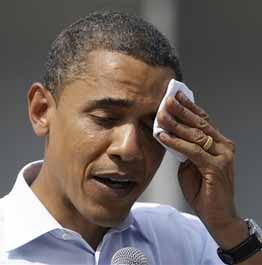
The rhetorically weak establishment politician

Saturday's The New York Times opinion piece "What Happened to Obama?" argues that during this economic crisis President Obama should have been more like Franklin D. Rooselvelt but isn't for the following reasons:
  • His "deep-seated aversion to conflict and his profound failure to understand bully dynamics"
    and, possibly
  • Because "he and his advisers have succumbed to a view of electoral success to which many Democrats succumb — that 'centrist' voters like 'centrist' politicians." Adding that, "Unfortunately, reality is more complicated. Centrist voters prefer honest politicians who help them solve their problems."
  • Or, "he is simply not up to the task by virtue of his lack of experience and a character defect that might not have been so debilitating at some other time in history."
  • Or, "we are a nation that is being held hostage not just by an extremist Republican Party but also by a president who either does not know what he believes or is willing to take whatever position he thinks will lead to his re-election."
A combination of Westen's guesses proposing that Obama is just another establishment politician with no interest in pushing the progressive agenda is probably correct. But his premise in the op-ed piece--that the President has lost the rhetorical battle--is the interesting part.

Responding to Westen, Jonathan Chant at The New Republic issued "Drew Westen's Nonsense", which claims Westen espouses a common Liberal fantasy "fixated on the power of words". Chant writes,
Westen's op-ed rests upon a model of American politics in which the president in the not only the most important figure, but his most powerful weapon is rhetoric. The argument appears calculated to infuriate anybody with a passing familiarity with the basics of political science. In Westen's telling, every known impediment to legislative progress -- special interest lobbying, the filibuster, macroeconomic conditions, not to mention certain settled beliefs of public opinion--are but tiny stick huts trembling in the face of the atomic bomb of the presidential speech. The impediment to an era of total an uncompromising liberal success is Obama's failure to properly deploy this awesome weapon.
In addition to overvaluing rhetoric, Chant also accuses Westen of (1) misunderstanding FDR's tenure and Obama's accomplishments and (2) being misguided in seeing a political connection between the two.

Chant errs in his rebuttal. For example, he refutes Westen's take on Obama's support for "entitlement" cuts by stating that the current agreement has none. But what Obama supported and what we got are different. In any case, had Obama told us a more compelling story to shape our perceptions, we'd have fewer conflicting versions of what happened.

Better yet, had Obama stirred the public by voicing a conviction that jobs mattered more than budgets, he could have gained even more support, in turn pressuring his opponents to get in line or risk losing the next election. Seems to me Chant's rebuttal makes Westen's point beautifully.

The situation could have been different; it could have been: We need to get Americans back to work! Instead it was: We need to start cutting the benefits Americans get for the work they used to do!

The two writers (and there are many others in this debate) engage in a rhetorical reconstruction of Obama, making true fiction. Westen argues that Obama has deprived us of the defining speeches and responses from which we can conjure a thematic abstraction of the man and his vision. The President hasn't created the rhetorical situation to which all writers must respond. In this absence, each writer creates his own rhetorical situation to which his peers must respond, stirring the mixed bag of Obama quotes to marshal a few for and a few against the increasingly popular opinion that Barack Obama is a very weak President.