One night I was up in the middle of the night listening to the radio. I imagined a little story where someone like me is up in the middle of the night listening to the radio, and the radio host starts talking about life, etc. The host turns to an expert who has all the answers. But the expert's voice is garbled static. The questions sound clear enough, but answer after answer is channeled through a bad connection. The host apparently hears every word. The sleepless listener turns the radio off and on, turns it at angles, pulls the antenna, is not understanding that the bad connection is the station.
Showing posts with label truth. Show all posts
Showing posts with label truth. Show all posts
Sunday, April 26, 2026


Saturday, November 10, 2018
something about "On Bullshit" by Harry G. Frankfurt
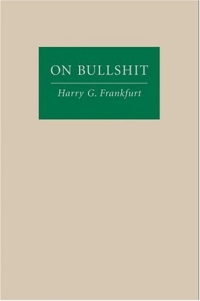 Frankfurt begins this meditation on bullshit by examining the definition offered in Max Black's 1985 essay, "The Prevalence of Humbug": bullshit is the "deceptive misrepresentation, short of lying, especially by pretentious word or deed, of somebody's own thoughts, feelings, or attitudes." Frankfurt gets his footing here, but says this definition fails to adequately capture "the essential character of bullshit." Frankfurt next mines a few bullshit-related anecdotes and quotes to uncover his theoretical understanding of bullshit. The somewhat oversimplified synopsis of that understanding is that what is essential about bullshit is that (1) the bullshitter cares not for what is true or false, like the liar and the honest man (in fact, the bullshitter could be saying things that are more or less true and still be bullshitting) and (2) the bullshitter says whatever suits him at the moment in an attempt to deceive his audience about what he is up to and who he is.
The prose in "On Bullshit" is crisp and graciously plain; Frankfurt's essay, an exploratory philosophical analysis, manages to avoid philosophy jargon and name dropping.
Note: This is good:
One who is concerned to report or to conceal the facts assumes that there are indeed facts that are in some way both determinate and knowable. His interest in telling the truth or in lying presupposes that there is a difference between getting things wrong and getting them right, and that it is at least occasionally possible to tell the difference. Someone who ceases to believe in the possibility of identifying certain statements as true and others as false can have only two alternatives. The first is to desist both from efforts to tell the truth and from efforts to deceive. This would mean refraining from making any assertion whatever about the facts. The second alternative is to continue making assertions that purport to describe the way things are but that cannot be anything except bullshit.
Friday, December 29, 2017
about a post-truth, post-fact age and rhetoric
People are trying to win the argument, not eliminate facts.
Friday, December 08, 2017
something about "There Will be Blood"
"There Will Blood" tells the story of an oilman building his empire during Southern California's oil boom in the early 20th century. This masterful epic (distantly inspired by Upton Sinclair's novel, Oil!) was directed by Paul Thomas Anderson and stars Daniel Day-Lewis as the oilman, Daniel Plainview. The film also features Paul Dano playing Eli Sunday, a charismatic young preacher and Plainview's foil.
 I watched the film again a while back, and considered it as an exploration of the relationship between rhetoric and truth.
Not a word is spoken during the first 15 minutes of the film. During that time, a baby whinnies, Daniel Plainview signs his name to a contract, and later he holds his black-coated finger up to silently signal that he struck oil.
The first spoken dialog in the film comes when Daniel, now with a foothold in the oil business, offers his drilling services to a new oil-struck community. Seated before them, Daniel establishes his ethos: "If I say I am an oilman, you will agree." Throughout the film, characters call attention to their speech acts. Here, Daniel goes on to say he is an experienced oilman with a simple offer: if the town agrees to work with him, he will consume fewer profits than a contractor and be more reliable than a speculator. He points to his young son, H.W., as proof that he runs a family business: honest and trustworthy. But when the town bickers and appears unable to immediately accept Daniel at his word, he leaves and doesn't look back.
Sales pitches--negotiation and manipulation, a play between rhetoric and truth--are heard throughout the film.
The next pitch is Daniel (again with his son at his side) at a kitchen table, an older couple facing him. This time Daniel closes with, "I need you to know what you want to do." This new closing technique is a reaction to the dissolution of his last prospect. The couple acquiesces in silence.
The film establishes that Daniel's voice, with its apparent directness, and the proximity of his young son are a big part of how Daniel communicates. With these tools he signals authority and legitimacy. However, we soon discover that Daniel's plain speaking is not so plain.
In the next pitch scene, roles are reversed, and Daniel finds himself in the role of customer. Paul Sunday (Eli Sunday's twin brother) comes to Daniel looking to sell information: the Sunday family farm is oil-rich: "If I told you I know a place that has oil, what do you think it would be worth?" When Daniel asks questions, poking around at the edges of Paul's secret, Paul flattens: "I'd like it better if you did not think I was stupid." When the cash-for-details trade is done, Paul closes: "The oil is there. I'm telling you."
Again, a character calls attention to his speech act.

With his interest piqued by Paul's revelation, Daniel and his son H.W. visit the Sunday family property posing as quail hunters. H.W. has learned to be the silent partner, and we get the impression that he has some awareness, if only vaguely, that he is a prop in these negotiations and his presence speaks volumes. When Daniel finally gets to negotiate--under the false pretense of buying the land for quail hunting and recreation--Daniel starts in, saying, "I believe in plain speaking." But this is a lie; his plain speaking is anything but. Eli steers the negotiation toward oil, and they all agree to deal.
Again and again, facts are minimized or misrepresented in speech. And with the introduction of Eli, we walk into a rhetorical web-tangling business masking brutality.
Later, when H.W. is alone with Mary, a young Sunday family member, she asks about the money that could be made from the oil pumped out of her family's land. H.W. withholds. After buying up all the nearby land, Daniel makes his pitch to the surrounding community. He appeals to them on the grounds that he comes to them without ceremony or intermediaries; he is there to talk to them "face to face" so that his motives and character are "no great mystery." Again he says, "I like to think of myself as an oilman," and then, "I hope you will forgive old-fashioned plain speaking." Then he describes how he believes family is important, and he enumerates all the benefits he will bring them, including schools, wells, crops, and roads.
As Daniel makes his final preparations to drill, Eli approaches and says he wants to bless the well when the community gathers there at the beginning of operations. Eli's instruction to Daniel is that "When you see me, you will say my name." Then, according to his pitch, Eli will step forward and give a simple blessing that he describes as "just a few words." But when the occasion arrives and the community gathers, Daniel is the demure master of the ceremony: "I'm not good at making speeches." Then Daniel plagiarizes Eli's "simple blessing."
Daniel humiliates others. The rhetorical situation is an opportunity to wield power.
Midway through the film, Daniel's son H.W. loses his hearing (the music in the soundtrack during this scene is all heavy percussion). But during the disaster that robs H.W. of his hearing, Daniel is intoxicated by the thought of all the oil he has found. But he can no longer be heard or understood by his son, H.W.
When Daniel's half-brother Henry arrives unannounced, Henry does not immediately make his intentions clear, and Daniel firmly demands, "I'd like to hear you say you'd like to be here" and Henry obliges. Eventually, Daniel, drunk, tells Henry that he hates people, and that he does not want anyone else to succeed. Daniel claims that he gets all of the information he needs about a person on first sight; yet, Daniel is deceived when he takes Henry's word that they are related.
In exchange for getting the final piece of land he needs to build his oil-carrying pipeline to the sea, Daniel agrees to be baptized in Eli's church. The speech act here is confession. Eli asks Daniel to confess (Eli must make multiple verbal demands: "I'll ask it again!"). Daniel answers, "What do you want me to say?" "Say 'I am a sinner!'" Daniel acquiesces. Eli hammers, "Say it louder!" Amid the church-house fervor, under his breath, Daniel whispers "There's a pipeline!"
As the film draws to a close, H.W. marries Mary Sunday. When he comes to his reclusive father, H.W. tells Daniel of his intention to drill for oil in Mexico. Daniel, enraged, mocks him: "You can't speak, so flap your hands! ... you're killing my image of you as my son." Daniel claims H.W. was adopted and used so Daniel would look more sympathetic and honest during negotiations. H.W.'s inability to speak is Daniel's weapon; Daniel's conception of others can only survive if nurtured by speech.
Eli arrives at the recluse Daniel's mansion during the film's final scene. Eli needs money. Daniel asks Eli to confess aloud that he is a false prophet and say that there is no God. "Say it like you mean it!" Daniel demands. Eli waits for the Lord's Word. In a most undivine ending, Daniel kills Eli by pummeling him to death with a bowling pin. Exhausted from having delivered the beating, Daniel announces, "I'm finished."
Notes:
Additional material:
When Eli asks Daniel about money owed to the church, Daniel physically abuses Eli and shoves his face in the mud. Humiliated, Eli later berates his father, Abel. Abel pleads, "I followed his word" (Daniel's word). Eli says Paul told Daniel about their oil-rich land. These speech acts have built an empire. In speech we see tension between business, brutality, honesty, and religion; we see and hear how voice relates to authority.
Later, Daniel meets with oil executives and they ask about H.W.; Daniel explodes, "Did you just tell me how to run my family?...You don't tell me about my son." The executive responds, "I'm not telling you anything. I'm asking you to be reasonable!" The threat of speech draws violent reaction from Daniel. Daniel takes Henry along on negotiations and business trips. But Daniel discovers that Henry lied. Daniel kills Henry because Henry misrepresented who he was.
Once H.W. is returned to Daniel's custody, the father and son go to lunch and encounter the oil executives. Daniel hides his face under a napkin and barks out so that the executives can hear, "I told you not to tell me how to raise my family ... I told you what I was gonna do." The executives' (implied) speech act is what injured Daniel, and Daniel's spoken vow affected reality.
Friday, September 16, 2016
about regret

In January 2016, US presidential candidate Donald Trump famously boasted that he could shoot someone in the middle of 5th Avenue (a major thoroughfare in Manhattan, New York City) and not lose any voters. Whatever one thinks of his phrasing, the realization he was expressing was powerful: he was a candidate who could take chances. His detractors should view Donald Trump as a missed opportunity rather than a political black swan.
Friday, April 04, 2014
"The Wizard of Oz" and "Mad Men"
The classic film "Wizard of Oz" depicts a young farm girl journeying through the fantasy land of Oz; the highly rated TV show "Mad Men" follows Don Draper, a highly successful executive in the golden age of advertising. What do the two have in common?

Advertising in 1960s-era New York City is widely considered the industry's golden age. Don Draper starts life as dirt-poor Dick Whitman, a farm boy who spent much of his formative years meekly in a whorehouse. But during the Korean War, he takes up the identity of a fellow soldier who, unbeknownst to most of the world, actually died in combat. With this identity, and entering the world of advertising, the new Don has the chance to escape his troubled, humble past and build a new life with his confident good looks and intelligence. But the business of advertising, while high in status and flush with cash, hides a competitive world of illusion, promising a life of fulfillment and happiness that can never be delivered. Don's journey on "Mad Men" is proving to also be one of self discovery in which our protagonist returns to his roots and his family.

So Oz and advertising are both worlds of illusion. Both Dorothy and Don are thought of as something they are not. Both characters journey though a land seeking something that ultimately they had all along. Etc ... you can figure out the rest.
Notes:
- There could be (and probably are) more specific correspondences between the film and TV show. For example, Don's partners could fit the roles of the talking lion, tin man, and scarecrow; Pete Campbell is the Cowardly Lion, Roger Sterling is the Tin Man, and Peggy Olson (and maybe Joan Holloway) is the Scarecrow.
- When we last saw Don Draper, he had returned with his family to the whorehouse-home Dick Whitman grew up in. Similarly, at the end of her journey, Dorothy ends up back home in Kansas, surrounded by the family who loves her.
Friday, February 07, 2014
about "The Courage of Truth" by Michel Foucault
This is another installment in the newly published series of lectures (and lecture notes) given by Michel Foucault at the Collège de France. This one, however, was the last one he gave there before dying. These lectures were recorded during February and March, 1984. He died June 25, 1984.
This book is subtitled "The Government of Self and Others II" because it picks up where his previous string of lectures, "The Government of Self and Others" (published in this same series by Picador), left off. So we begin again with the concept of parrhesia: free-spokeness, or, defined more emphatically, truth-telling. A few high-profile truth-tellers, just to give you an idea, might include Americans Mark Twain or Will Rogers (more recently, some people might include Jon Stewart). But rather than seeing parrhesia in merely the presence of a few pop culture figures, Foucault drills the concept of parrhesia to mine for its broader, deeper significance and implications.
In Foucault's late lectures, he is imparting an ontology of true discourses. First, "The Government of Self and Others" established parrhesia as originally a political notion. But here, through Foucault's reading of Plato (on Socrates) and his study of Cynicism, it expands into philosophy.
Foucault established parrhesia as a necessary component in effective democracies; the best political system will be the one run by virtuous men. In "The Courage of Truth," parrhesia differentiates the man, the leader, from the masses. A leader's truth-telling not only shows his moral/ethical worth, it also is part of the speaker's self conception. So, as established in ancient philosophy, the best political system is run by virtuous men who can uncork the discourse of truth. In this analysis, Foucault is running the technologies of power (and government), knowledge, and subject formation through the gauntlet. These things are intertwined in ancient philosophy, and so they are in most of Foucault's texts.
This lecture's opening focuses on Plato's "Apology," the story of Socrates death, and "Leches," a work exploring courage. With these works, we first find that parrhesia and indeed all of ancient ethics revolve around the care of the self (i.e., self development, self government, self discipline, etc.). Furthermore, parrhesia is bound up in one's existence and formation of self. The latter portions of "The Courage of Truth" examine the Cynics--a people who denied themselves even basic comforts to strip away any artifice that might stand in the way of Truth. This drastic lifestyle eventually showed people that there was another life: an other life, or, the other life (varies by interpreted experience).
Christianity blended the Platonic concept of care of self--the work of purifying the soul ahead of its eventually authentic existence in another world--with the Cynics' quest to defy "temporal customs" in search of basic values.

So you take the two parts of "The Courage of Truth"--the way truth-telling separates the speaker from the masses and the philsophic introduction of the possibility of the other (better) life promised by the Cynics and their successors--and you find that, since the dawn of Western philosophy with the Ancients, the hallmark of the True is Otherness: that which makes a difference and opens the possibility of another reality. This, according to Michael Foucault, is what philosophy is, what it does. There is no establishment of the truth without an essential position of otherness; the truth is never the same; there can be truth only in the form of the other world and the other life.
This is a poignant book; the editor's notes go to lengths to drive this home; Foucault, knowing death would come soon, like Socrates, practiced philosophy and kept his eye on Truth until the end.
Friday, November 15, 2013
Psychology for clicks
This Vanity Fair article, "The Lonely Guy," makes the case that President Obama's strong inward-directedness underpins his political failures. The diagnosis:
Self-containment is not simply Obama’s political default mode. Self-possession is the core of his being, and a central part of the secret of his success. It is Obama’s unwavering discipline to keep his cool when others are losing theirs, and it seems likely that no black man who behaved otherwise could ever have won the presidency.
But this quality, perhaps Obama’s greatest strength in gaining office, is his greatest weakness in conducting it.
Obama’s self-evident isolation has another effect: It tends to insulate him from engagement in the management of his own administration. The latest round of “what did the president know and when did he know it” on the disastrous rollout of Obamacare and the tapping of German chancellor Angela Merkel’s cell phone raised troubling questions: Were Obama’s aides too afraid to tell him?
 The author would have us believe that Obama's self is the issue here. The matter is not poor leadership, carelessness, incompetence, bad delegation practices, or the simple fact that every presidency has some major failures. No, in Obama's case we find a complication of self.
The article then relates a few quotes from Obama's peers who say the man is aloof. Gradually the author shifts his thesis away from Obama's selfhood and toward his character, essentially saying the President is not a team player. "He has quietly purged from his inner circle those most likely to stand up to him." The fix? "Obama has always insisted that he is playing a long game. The problem is that when everyone else in Washington is still playing a short game, the president sometimes has to play on their board." This unsupported claim applies to the reader, too. The article's author renders a judgment that time can't bear out and the reader is supposed to click through.
Thursday, September 12, 2013
something about Michel Foucault, "The Government of Self and Others"
These lectures, delivered by Foucault at the Collège de France in 1982 and 1983, meditate on the concept of truth-telling known as parresia. The bulk of these lectures have Foucault tracing the use, exercise, and implications of parresia through ancient Greek texts.
Foucault starts, however, in the Enlightenment.
 What is Enlightenment? Kant asked, and Foucault restates the question: What is this present?* Foucault finds here not only the beginning of contemporary philosophy but the seed of his own brand of inquiry: a discursive practice of philosophy that collides with its own present reality. The speaker--first, Kant, now, Foucault--is no longer speaking as a member of a philosophical tradition or community, but as a part of the present. And, ever since, philosophy has continued questioning its own present reality.
In his reflections on the Enlightenment, Kant speculated that the human race was making progress. He figured that popular support abroad for the ideals propelling the French Revolution symbolized this progress. Man was leaving an era in which he was unwilling to use his reason. Now, he would reason; and, once free to exercise his reason, he could be obedient. More freedom of thought, more obedience. And this obedience requires a kind of self-governance that Foucault interrogates in much of his work.
After a brief visit with the Enlightenment, Foucault starts to dwell in the ancient texts, starting with the myth of Ion and rounding the final corner with Plato's Phaedrus. In these stories he identifies the roles and implications of courage, politics, rhetoric, and philsosophy in the practice and concept of truth-telling known as parresia.
To my mind, this was so far the least compelling of these newly published Foucault lectures. But my mind is somewhere else now, maybe.
Notes:
* Prior to the Enlightenment, people spoke of the present in terms of periods of prosperity or decadence.
Friday, August 30, 2013
what Big Daddy said
"Truth is dreams that don't come true, and nobody prints your name in the paper 'til you die."
-Cat on a Hot Tin Roof
Thursday, November 22, 2012
about "Psychiatric Power: Lectures at the College de France, 1973-1974" by Michel Foucault

- The appropriation and use of reality as a form of power
- The medicalization of children, and the creation and expansion of the concept of development as it pertains to rationality and moralizing, retardation, madness, and defining the normal and abnormal
- Foucault's redefining the abnormal, the retarded, etc, as individuals who act on instinct
- How psychiatry changed from a practice that confined, controlled, and sometimes corrected madness to a power that defines, controls, and sometimes corrects the abnormal, thereby expanding its power into the domain of normality
- The role of psychiatry and asylum administration in capitalism and maintenance of the workforce
- How medical science provides justification and grounds for power, but does not inform psychiatric practice
- The history of the concept of truth, and truth's development and role in science
Note
- The edition I have does offer some good historical context on psychiatry.
Saturday, November 17, 2012
a thing about the movie "Flight" (with spoilers)
Flight follows William "Whip" Whitaker, a crackerjack airline pilot struggling to admit to his alcohol and drug addictions in the aftermath of a plane crash. Part of the immediate dilemma for the audience and for Whitaker is that (1) the crash resulted from hardware failures, not pilot error, and (2) no other pilot could have negotiated the crash landing with as much skill, and saved as many passengers' lives as he did, sober or otherwise.
 The film is about one man's struggle for redemption, but what we see from our theater seat is a struggle for control of truth. In Whitaker's mind, his functionality, his brilliance excuses the
behavior that so many rush to judge irresponsible. That is his truth. But under threat of litigation and penalty for the lives lost, the airline and Whitaker's other adversaries use the discourse of medical knowledge, appealing to that discipline's knowledge-making authority, which justifies policies that were violated, and deems Whitaker unfit. The co-pilot, who chooses not to reveal Whitaker's drunkenness on record, appeals to the Word of God; God reveals the Truth, and Whitaker must face that truth.
The film is about one man's struggle for redemption, but what we see from our theater seat is a struggle for control of truth. In Whitaker's mind, his functionality, his brilliance excuses the
behavior that so many rush to judge irresponsible. That is his truth. But under threat of litigation and penalty for the lives lost, the airline and Whitaker's other adversaries use the discourse of medical knowledge, appealing to that discipline's knowledge-making authority, which justifies policies that were violated, and deems Whitaker unfit. The co-pilot, who chooses not to reveal Whitaker's drunkenness on record, appeals to the Word of God; God reveals the Truth, and Whitaker must face that truth.Finally, after a slew of verbal confrontations, Whitaker is faced with the most intimidating of rhetorical situations--a hearing by the National Transportation Safety Board, an independent Federal agency "charged by Congress with investigating every civil aviation accident in the United States". Here, Whitaker surrenders control of the truth. He cannot speak another lie, he says. Whitaker's truth goes from belief in himself with a confident rejection of medico-juridical labels to, ultimately, the discourse of confession. He adopts the narratives spun about him by others, and finds himself now a craven denier of truth, and no longer a hero airline pilot.
Notes
- This was a fantastic movie. Every performance is spot on; Whitaker is played to perfection by Denzel Washington, and even John Goodman's over-the-top dealer works well, providing relief from the main character's ongoing struggles and tension. And Wikipedia notes, "Flight is (Robert) Zemeckis' first live-action film since 2000's Cast Away and What Lies Beneath, and his first R-rated film since Used Cars in 1980."
- Above, quoting the NTSB's Web site regarding the agency's purpose.
Thursday, November 15, 2012
Wittgenstein's seven propsitions from "Tractatus Logico-Philosophicus"
- The world is everything that is the case.
- What is the case (a fact) is the existence of states of affairs.
- A logical picture of facts is a thought.
- A thought is a proposition with a sense. (An elementary proposition is a truth-function of itself.)
- A proposition is a truth-function of elementary propositions.
- The general form of a proposition is the general form of a truth function. (formula given) This is the general form of a proposition.
- Whereof one cannot speak, thereof one must be silent.

Friday, August 24, 2012
The ones who say what is

Scientists recently gave the octopus consciousness. What a nice thing to do. Also, they mistook perceived patterns of central nervous system matter for a thing called consciousness, and themselves for the only ones qualified to say what they see.
Thursday, January 12, 2012
More than a stenographer?
 To give us an idea of where journalism is at here in the 21st century, today The New York Times Public Editor, the institution's "readers' representative", asks "Should The Times Be a Truth Vigilante?" Apparently printing every crazy old claim without verifying it has ruffled a few readers' feathers.
"Vigilante" is such a strong word. See the comments--now they're good reading!
Tuesday, November 15, 2011
Few things on the case R. J. Reynolds et al v. United States Food and Drug Administration
A district court just ruled on whether the FDA can force cigarette companies to publish graphic anti-smoking images on packs. The Judge, Richard J. Leon, gives a failed rhetorical analysis in his opinion:
Anyways, I hope this case goes to the Supreme Court. How do you warn people about a product that, if used as intended, will almost certainly lead to addiction and quite likely a slow, painful death. (And, more to the Government's unspoken point, the resulting deaths exact a heavy cost on taxpayers every year.)
Which of the following are purely factual and uncontroversial information?:
The Judge ruled in favor of tobacco companies by preserving the status quo and the cigarette package's text warning that smokers routinely ignore now. I don't fault his decision (in fact, I tend to agree), but I do hate his remaining faithful to the ideation of a "purely factual and uncontroversial information"--a quote originating from Zauderer, describing a concept that has been around forever: A pure observation language. Such a language will never be, and can never be.Unfortunately for the Government, the evidence here overwhelmingly suggests that the Rule's graphic-image requirements are not the type of purely factual and uncontroversial disclosures that are reviewable under this less stringent standard. Indeed, the fact alone that some of the graphic images here appear to be cartoons, and others appear to be digitally enhanced or manipulated, would seem to contravene the very definition of "purely factual." That the images were unquestionably designed to evoke emotion - or, at the very least, that their efficacy was measured by their "salience," which the FDA defines in large part as a viewer's emotional reaction, see CompI. ~ 58 (citing 76 Fed. Reg. at 36,638-36,639) - further undercuts the Government's argument that the images are purely factual and not controversial, see, e.g., Defs.' Opp'n at 22-29. Moreover, it is abundantly clear from viewing these images that the emotional response they were crafted to induce is calculated to provoke the viewer to quit, or never to start, smoking: an objective wholly apart from disseminating purely factual and uncontroversial information. 18 Thus, while the line between the constitutionally permissible dissemination of factual information and the impermissible expropriation of a company's advertising space for Government advocacy can be frustratingly blurry, 19 here - where these emotion-provoking images are coupled with text extolling consumers to call the phone number "1-800-QUIT" - the line seems quite clear. --Memorandum Opinion, 11/07/2011, R. J. Reynolds et al v. United States Food and Drug Administration
Anyways, I hope this case goes to the Supreme Court. How do you warn people about a product that, if used as intended, will almost certainly lead to addiction and quite likely a slow, painful death. (And, more to the Government's unspoken point, the resulting deaths exact a heavy cost on taxpayers every year.)
Which of the following are purely factual and uncontroversial information?:
- Cigarettes cause cancer and death
- Leaving for work today may result in your dying in an accident
- Orange juice contains vitamin C
- Objects in mirror may be closer than they appear
Thursday, August 04, 2011
Honesty!
Just the other day I had been thinking of this passage from On Truth and Lie in an Extra-Moral Sense by Frederich Nietzsche:
And then truth becomes a function of power.Every word immediately becomes a concept, inasmuch as it is not intended to serve as a reminder of the unique and wholly individualized original experience to which it owes its birth, but must at the same time fit innumerable, more or less similar cases—which means, strictly speaking, never equal—in other words, a lot of unequal cases. Every concept originates through our equating what is unequal. No leaf ever wholly equals another, and the concept "leaf" is formed through an arbitrary abstraction from these individual differences, through forgetting the distinctions; and now it gives rise to the idea that in nature there might be something besides the leaves which would be "leaf"—some kind of original form after which all leaves have been woven, marked, copied, colored, curled, and painted, but by unskilled hands, so that no copy turned out to be a correct, reliable, and faithful image of the original form. We call a person "honest." Why did he act so honestly today? we ask. Our answer usually sounds like this: because of his honesty. Honesty! That is to say again: The leaf is the cause of the leaves. After all, we know nothing of an essence-like quality named "honesty"; we know only numerous individualized, and thus unequal actions, which we equate by omitting the unequal and by then calling them honest actions. In the end, we distill from them a qualitas occulta (hidden quality) with the name of "honesty." We obtain the concept, as we do the form, by overlooking what is individual and actual; whereas nature is acquainted with no forms and no concepts, and likewise with no species, but only with an X which remains inaccessible and undefinable for us. For even our contrast between individual and species is something anthropomorphic and does not originate in the essence of things; although we should not presume to claim that this contrast does not correspond o the essence of things: that would of course be a dogmatic assertion and, as such, would be just as indemonstrable as its opposite.

Thursday, July 28, 2011
Edited how
 James O'Keefe's videotaped investigation of ACORN (Association of Community Organizations for Reform Now) circulated in mainstream media and ultimately lead to the government defunding the organization. O'Keefe, now the author of several such pieces, sees himself as embattled and his work undercut by an elite media class too ignorant or dishonest to recognize their own liberal bias. The primary criticism of his work claims that he selectively edits his videos to serve an agenda, ultimately misrepresenting the facts. But he fires back, pointing out that all media is edited; no story runs in The New York Times and no tape rolls on CNN without having been cut to highlight the action, to fit the time allotted, and to hold our interest.
I imagine a Times editor arguing that, in the paper, he edits for clarity, consistency, readability--qualities that serve not to obscure or spin but, rather, to make the facts more accessible, to make them clear. But clarity of narrative is itself a fiction, and order largely an invention of the mind. O'Keefe has a point.
He is currently profiled in The New York Times piece "Stinger: James O'Keefe's Greatest Hits", a well-written, brief and dispassionate study of the young advocate journalist. Its author, Zev Chafets, closes with this question about O'Keefe's investigations:
An interesting and ironic conclusion. The larger, unspoken theme to this story is advocacy in journalism. Media criticism today takes aim at mainstream journalists' unwillingness or inability to call out bullshit where it exists; O'Keefe himself has echoed Liberal media critics by calling journalists "stenographers". Yet, in the very face of that criticism, Chafets casually poses here two charges, detonating neither, leaving readers perhaps less certain of where, how, and if a guy like O'Keefe fits in the fractured snow globe of our doomed national politics.Had the videos revealed a larger injustice, O’Keefe’s stated goal? Had they demonstrated waste and abuse in Great Society initiatives run amok, or were they simply exposing the failures of some well-meaning, low-level bureaucrats in a basically worthy government program? It depends on your perspective. As for James O’Keefe, he is already looking for the next target.
Few people doubt that at times we need journalism that aims to get the facts straight, nothing more, nothing less. But at these times, in cases like this, we need a journalism that does what O'Keefe says he does: Speak truth to Power. No journalist covering O'Keefe should have to ask himself if advocates for the poor constitute Power. If he does, I might ask myself, Is Chafets stupid or just a coward?
Subscribe to:
Posts (Atom)