Showing posts with label Enlightenment. Show all posts
Showing posts with label Enlightenment. Show all posts
Saturday, July 18, 2015
something about "The Great Debate" by Yuval Levin
Politics makes for especially caustic conversation in America these days. We discuss political polarization because we wonder if honest bipartisanship is dead and if we are headed for a point of no return. We sometimes seem violently rabid in our views; then we wonder if we have always been like this.
Whatever the case, Yuval Levin lays down some historical context for today's American Left-Right binary. Representing the founder of conservatism, Levin shows us Edmund Burke (1729-1797), widely credited as the founding philosophical Conservative. Levin briefly introduces the Dublin-born author, politician, and philosopher, then paraphrases Burke's political ideology, drawing largely from Burke's writings on the American and French Revolutions.
Representing the modern American Left is Thomas Paine (1737-1736). Steeped in both the American and French revolutions, the English-born Paine authored the (in)famous pamphlet "Common Sense," which, to many, inspired the rebels' declaration of independence from Britain in 1776. Levin paraphrases Paine, drawing from his American Revolution writings and his defense of the bloody French Revolution.
In The Great Debate: Edmund Burke, Thomas Paine, and the Birth of Left and Right, Levin devotes more time to Burke, largely using Paine to further refine an explanation of Burke's views. But Levin does not misrepresent Paine, exactly, so no real harm done. And Pain's shortchange comes as no suprise--Yuval Levin is a conservative intellectual born in Israel who founded National Affairs.
By the end of The Great Debate, Burke's and Paine's stances were so qualified, excepted, and nuanced as to be ripe for accusations of inconsistency and flip-flopping. Same old, same old.


Saturday, June 28, 2014
about "Candide" by Voltaire

Candide is a novella by Enlightenment writer, historian, and philosopher Voltaire (1694–1778). The witty, outspoken Voltaire was often at odds with the laws, customs, and institutions of his day. Despite--or perhaps because of--his controversies, Voltaire achieved great fame in his lifetime.
First published in 1759, Candide unfolds the adventures of a naive but bright young man who optimistically emerges from an idyllic upbringing only to meet painfully with a world burdened with wrongs, hardships, and evils that invite his disillusionment.
Initially taught that "all is for the best in the best of all possible worlds," the young Candide concludes after contending with the problem of evil that, in life, one should "cultivate our garden." What this philosophical riddle means is much debated.
Voltaire is posing our dilemma: How do we respond faced with the problem of evil? Now, as adults, far, far away from any Garden of Eden, how do we approach the world? This absurd allegory encourages us to be clear-eyed, tireless reformers working toward the good.
Thursday, September 12, 2013
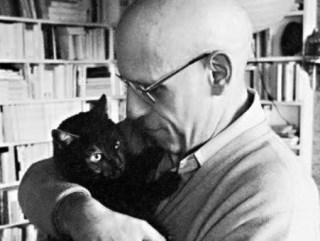
something about Michel Foucault, "The Government of Self and Others"
These lectures, delivered by Foucault at the Collège de France in 1982 and 1983, meditate on the concept of truth-telling known as parresia. The bulk of these lectures have Foucault tracing the use, exercise, and implications of parresia through ancient Greek texts.
Foucault starts, however, in the Enlightenment.
 What is Enlightenment? Kant asked, and Foucault restates the question: What is this present?* Foucault finds here not only the beginning of contemporary philosophy but the seed of his own brand of inquiry: a discursive practice of philosophy that collides with its own present reality. The speaker--first, Kant, now, Foucault--is no longer speaking as a member of a philosophical tradition or community, but as a part of the present. And, ever since, philosophy has continued questioning its own present reality.
In his reflections on the Enlightenment, Kant speculated that the human race was making progress. He figured that popular support abroad for the ideals propelling the French Revolution symbolized this progress. Man was leaving an era in which he was unwilling to use his reason. Now, he would reason; and, once free to exercise his reason, he could be obedient. More freedom of thought, more obedience. And this obedience requires a kind of self-governance that Foucault interrogates in much of his work.
After a brief visit with the Enlightenment, Foucault starts to dwell in the ancient texts, starting with the myth of Ion and rounding the final corner with Plato's Phaedrus. In these stories he identifies the roles and implications of courage, politics, rhetoric, and philsosophy in the practice and concept of truth-telling known as parresia.
To my mind, this was so far the least compelling of these newly published Foucault lectures. But my mind is somewhere else now, maybe.
Notes:
* Prior to the Enlightenment, people spoke of the present in terms of periods of prosperity or decadence.
Monday, April 29, 2013
about selections from "Critical Essays on Michel Foucault"
This collection of essays opens with philosopher Gilles Deleuze rephrasing and re-articulating Foucault's concept of power. There is little new ground here, but the essay is a good opener. The first real bright spot in this collection is "Foucault's Oriental Subtext", in which Uta Liebman Schaub identifies Eastern influences in Foucault's work. Primarily she sees the obliteration of the self in the remedy to Western systems' ceaseless quest to isolate and peg the self, and to tie this knowable self to an identity, as described by Foucault.
The essay "Foucault's Art of Seeing" by John Rajchman opens with Foucault's startling idea that seeing--vision--"structures thought in advance". The visual representation of thought, of how people have seen their world and then accordingly made sense of it, is tied to their age, their time. So seeing yields different concepts and ways of thinking about a given subject. For example, in the classical age, people grouped plants by their character. Now scientists group them primarily by their surface traits.
 Foucault took an interest in how concepts of visualization become embedded in institutional practices, and how ethical and moral judgements of things and people changed with those concepts. It is hard to imagine now that people asked different questions in the past; we tend to think we've always been "logical", that being logical is part of our nature. But being "logical" used to be a moral exercise.
Finally, Rajchman explains how, for Foucault and his philosophical-critical descendents, thinking is a dangerous act. I found this section of Rajchman's essay confusing; is it dangerous because it's always situated and political? because it's tied to moral and ethical consequences? because we, merely by thinking of things, may unknowingly reinforce or change ways of conceiving? Whatever the answer, the aim on the other side of that danger, what Foucault pursued, is a world that is not yet visible.
In "Beyond Life and Death: On Foucault's Post-Auschwitz Ethic", James W. Bernauer addresses Foucault's critics who charge the intellectual giant with advocating an amoral aestheticism. Bernauer begins his defense by recognizing Foucault's resistance to the scientifically-minded life style that presupposes we are knowable and, therefore, decipherable (and, as a consequence, subject to be judged against norms). He seemed to champion humans as sexual, primarily, and so he probed how sexuality came to be thought of as a moral experience. The modern age and its States conceive of citizens as life to be kept alive; Foucault conceived of man as desire.
That power that conceives of us as human souls in a life or death struggle categorizes us, marks our individuality, attaches us to an identity, subjectifies us, and imposes its truth on us. The sciences--the currently dominant producers and venue of true knowledge--"direct both the cognitive enterprise and the technologies for human self-relation". Foucault examined how people "became anxious about this or that," and urges us not to look so hard at what we hope to achieve, but rather what struggles we face.
Again, Foucault's ultimate goal was freedom. He knew there was no escaping knowledge-power-self relations for good, but he also thought that no "configuration" (of thought and power?) should be thought unchangeable.
Sunday, March 18, 2012
On Rameau's Nephew by Denis Diderot
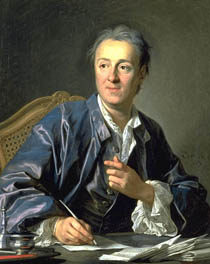
An eccentric hanger-on holds court in Denis Diderot's Rameau's Nephew (Le Neveu de Rameau ou La Satire seconde). This enlightenment-era novella by the French philosopher and critic narrates a lively conversation between two unnamed characters: a narrator, identified as "I", and the nephew of the French composer Rameau, identified as "He".
The nephew, who dominates the discussion, turns out to be frustratingly paradoxical; until now he has been a great high society flatterer and parasite because he acts foolish for them, but his foolishness is by design, and he's debased on principal and shallow only by having achieved a wide breadth of appreciation. Although often inconsistent, the perspectives he shares with us all have a cynical lining. He voices his most vital thesis halfway through the testimony:
And since I can achieve happiness through failings natural to me which I have acquired without toil and retain without effort ... it would be strange indeed for me to torture myself like a soul in hell so as to mutilate myself into something quite different from what I am. I should give myself a character quite foreign to me and qualities most praiseworthy (I grant you that, so as to have no argument), but which would cost a lot to acquire and land me nowhere, because I should be continually satirizing the rich from whom poor devils like me have to make a living.You can hear the bitter results of the author's internal conflict--the desire to do right versus what's expedient, whether to pursue ideals or approach life pragmatically. That he can see no middle ground is almost tragic, as he's forged a nihilistic reality atop his internal anguish, leaving a despicable hypocrite to face in the mirror.
I enjoyed it.
This type of book needs a good translator. The version I read, an old Penguin Classic, has a great one: Leonard Tancock, whose brief front matter bio includes this line: "Since preparing his first Penguin Classic (1949), he has been intensely interested in problems of translation, about which he has written, lectured, and broadcast, and which he believes is an art rather than a science." He's a craftsman! And then in the foreword he quickly notes the difficulties presented him in this very situated, socially contextual dialog, then adds that "Complete notes would be as long or longer than the text."
Note:
- The Wikipedia page is pretty good.
Saturday, April 09, 2011
Enlightening Limits
Sizing up the limits of thought proposed during the Enlightenment and urging us to peek at what lies beyond, Michel Foucault poses a very Foucauldian question to himself about such a brief investigation:
 In other words, Yes, we run the risk. But I have my ways.
These quotes come from his brief 1984 piece titled What is the Enlightenment? The question dates from 1784: That year a German paper posed the question and Immanuel Kant answered. In his response to Kant, Foucault proposes that our modern mode of self-reflection took shape then, and he notes the existence and implications of the shaping mechanisms. The Enlightenment, according to Foucault, is essentially an attitude. Several pages in, though, he tosses off this nugget: "Criticism indeed consists of analyzing and reflecting upon limits".
None of his major points hinge on this statement, but I'm really taken with it.
My first thought is that limits make originality possible. Describing a work of art as "original" is often high praise. But something may be original and not necessarily good; agreed? Critics also often assert that a work of art has value when it advances a conversation--conversations about humanity, time, life, sports, religion, whatever. And advancement means moving beyond where we are at present, being presently at the limit, and as far as we have gotten. But a work of art and its critiques may also center on how the work functions within and comments on pre-established limits. Perhaps a work could even impose limits on itself. In these ways a work of art, be it a song, painting, a dance or film, for example, may not necessarily qualify as original.
Criticism of policy may also concern limits. Who is excluded from the policy? How does the policy work? and, How far reaching are its implication?
Criticism indeed consists largely of analyzing and reflecting upon limits.
If we limit ourselves to this type of always partial or local inquiry or test, do we not run the risk of letting ourselves be determined by more general structures of which we may well not be conscious, and over which we have no control?His answer is priceless:
...it is true ... we are always in the position of beginning again.
But that does not mean that no work can be done except in disorder and contingency. The work in question has its generality, its systematicity, its homogeneity, and its stakes.
In other words, Yes, we run the risk. But I have my ways.These quotes come from his brief 1984 piece titled What is the Enlightenment? The question dates from 1784: That year a German paper posed the question and Immanuel Kant answered. In his response to Kant, Foucault proposes that our modern mode of self-reflection took shape then, and he notes the existence and implications of the shaping mechanisms. The Enlightenment, according to Foucault, is essentially an attitude. Several pages in, though, he tosses off this nugget: "Criticism indeed consists of analyzing and reflecting upon limits".
None of his major points hinge on this statement, but I'm really taken with it.
My first thought is that limits make originality possible. Describing a work of art as "original" is often high praise. But something may be original and not necessarily good; agreed? Critics also often assert that a work of art has value when it advances a conversation--conversations about humanity, time, life, sports, religion, whatever. And advancement means moving beyond where we are at present, being presently at the limit, and as far as we have gotten. But a work of art and its critiques may also center on how the work functions within and comments on pre-established limits. Perhaps a work could even impose limits on itself. In these ways a work of art, be it a song, painting, a dance or film, for example, may not necessarily qualify as original.
Criticism of policy may also concern limits. Who is excluded from the policy? How does the policy work? and, How far reaching are its implication?
Criticism indeed consists largely of analyzing and reflecting upon limits.
Friday, March 25, 2011
How like herrings and onions
The article "Do You Have Free Will? Yes, It's the Only Choice" in Monday's The New York Times discusses results of recent and previous surveys on free will and determinism. Responses showed an acceptance of both concepts, depending on circumstance. While addressing this apparent conflict in opinion, the article quotes a Florida State Professor as saying,

Here, he speculates. But while the author and the surveyors hope to identify majority opinion in this debate, the real story lies in the answer to the following questions: Why and How did respondents develop this binary concept? And why is free will the default?
The article does not address these questions directly, but does mention a correlation between a belief in free will and better job performance and honesty. If the correlation is also causation--if believing in free will leads to better job performance--then consider this: One who believes in free will self-disciplines and self-censors, thereby reducing the will, attacking the will, and deferring to the will of authority. (This civil behavior is not unlike the civil code of conduct proposed by Kant in his answer to What is Enlightenment?) This is mind control.
Later the author, with support from academia, suggests that we're all compatibalists. Then the piece concludes,
Odd conclusion. Neither the research discussed nor the author offer any "good" reasons". If we follow a few leads, we may conclude that believing in free will benefits power; but that is not a good reason. It seems to me the only people "deluding themselves" are the ones who claim to have free will as they wake to their alarm clocks, go to work and login to their machines.
The article discussed above is here: http://www.nytimes.com/2011/03/22/science/22tier.html?pagewanted=1&_r=1
It’s two different kinds of mechanisms in the brain ... If you give people an abstract story and a hypothetical question, you’re priming the theory machine in their head. But their theory might be out of line with their intuitive reaction to a detailed story about someone doing something nasty. As experimenters have shown, the default assumption for people is that we do have free will.
Here, he speculates. But while the author and the surveyors hope to identify majority opinion in this debate, the real story lies in the answer to the following questions: Why and How did respondents develop this binary concept? And why is free will the default?
The article does not address these questions directly, but does mention a correlation between a belief in free will and better job performance and honesty. If the correlation is also causation--if believing in free will leads to better job performance--then consider this: One who believes in free will self-disciplines and self-censors, thereby reducing the will, attacking the will, and deferring to the will of authority. (This civil behavior is not unlike the civil code of conduct proposed by Kant in his answer to What is Enlightenment?) This is mind control.
Later the author, with support from academia, suggests that we're all compatibalists. Then the piece concludes,
Some scientists like to dismiss the intuitive belief in free will as an exercise in self-delusion—a simple-minded bit of “confabulation,” as Crick put it. But these supposed experts are deluding themselves if they think the question has been resolved. Free will hasn’t been disproved scientifically or philosophically. The more that researchers investigate free will, the more good reasons there are to believe in it.
Odd conclusion. Neither the research discussed nor the author offer any "good" reasons". If we follow a few leads, we may conclude that believing in free will benefits power; but that is not a good reason. It seems to me the only people "deluding themselves" are the ones who claim to have free will as they wake to their alarm clocks, go to work and login to their machines.
The article discussed above is here: http://www.nytimes.com/2011/03/22/science/22tier.html?pagewanted=1&_r=1
Subscribe to:
Posts (Atom)