Showing posts with label culture. Show all posts
Friday, April 26, 2019
about zealots
Think of someone you love, whose love for you is such a given that you sometimes take them for granted.
Imagine that person far away, the hostage of a violent zealot. Imagine your loved one, dressed in an orange jumpsuit, forced to their knees. Imagine that person positioned before a high-definition camera in the desert. Imagine, dressed head to toe in black, the zealot crowding in the picture with a highly polished knife.
The zealot speaks to the camera, his hand on your loved one's shoulder, telling you there is no choice. He tells you that forces beyond all three of you have forced this moment. The zealot tells you that your loved one will die, and that, although he will slit your loved one's throat, he did not choose to.
Imagine the zealot puts the knife to the throat of your beloved and cuts through the skin, tears into the muscles, saws through the tendons, and hits bone. Imagine your loved one gurgling, blood urging out. That's how they die.
Friday, November 02, 2018
something on "Here at The New Yorker" by Brendan Gill
Here at The New Yorker is a collection of anecdotes about personalities that contributed to and shaped the The New Yorker. The book also includes some short fiction and nonfiction pieces reprinted in full, as well as cartoons and sketches. This is a book you can keep bedside and leaf through leisurely before sleep. All of it is entertaining; some parts are laugh-out-loud funny.
Note: I enjoyed James Thurber's The Years With Ross a little more than Here at The New Yorker.
Friday, August 04, 2017
about the temp
I am filling in at the front desk this afternoon. A body is needed here. A desk is needed for the body. If someone needs me, they do not belong here.
Labels:
boredom,
culture,
employment,
fulfillment,
jobs,
occupation,
office,
paycheck,
poem,
prose,
work,
writing
Friday, July 28, 2017
something about "Democracy in America" by Alexis de Tocqueville
In 1831, the French government sent Alexis de Tocqueville and Gustave de Beaumont to study the American prison system and American society in general to inform political developments in France. Tocqueville saw virtue in an aristocracy and was skeptical of the egalitarianism preached in the United States.Tocqueville published his findings, De La Démocratie en Amérique, in two parts (1835 and 1840). His commentary, translated today as Democracy in America, is a staggering read. It is at least as insightful as any other wide-scope religious, political, and economic study of American culture (which are all prone to hasty generalizations) produced before or since. Given the fact that Tocqueville spent only nine months in the United States, this is an especially remarkable achievement.
Labels:
1831,
1835,
1840,
Alexis de Tocqueville,
America,
commentary,
culture,
democracy,
economics,
economy,
France,
government,
Gustave de Beaumont,
intelligence,
nonfiction,
political,
politics,
prisons,
religion,
society
Saturday, October 15, 2016
about how "words matter" (part 1)
In August 2016, presidential candidate Donald Trump said the following at a campaign rally:
Hillary wants to essentially abolish the Second Amendment. If she gets to pick her judges, there's nothing you can do, folks. Although the Second Amendment people--maybe there is. I don't know.Many people accused Trump of implying that "Second Amendment people" could react with violence if Hillary Clinton, the Democratic Party candidate, won the election. Clinton acknowledged and condemned the allegedly veiled threat, using the phrase "words matter." (Trump, of course, denied he was making any allusion to violence; he claimed he was referring to the National Rifle Association's considerable lobbying power.)
In August Trump accused President Barack Obama of being the founder of ISIS. These words drew criticism because they were, interpreted literally, untrue. Trump later said that if Obama had not mishandled foreign policy in the Middle East, then ISIS would not exist. So, for Trump, calling Obama the founder of ISIS is an incendiary way of saying the President, because he withdrew American forces and left a vacuum in the region, bears responsibility for the terrorist group's genesis.
In the second example, the problem seems to be that others might only hear what Trump said and would not infer any meaning beyond his words. In the first example, the problem seems to be that the language Trump used was too open to interpretation. What mattered was the words he did not use but others possibly could hear.
In one example, words matter because people take Trump literally. In the other, words matter because people might not take Trump literally enough.
Notes:
- This post is sophistry.
- The phrase "words matter" seems to be popping up a lot lately. Is it?
- The bit about Hillary wanting to abolish the Second Amendment drew no criticism even though that statement, interpreted literally, is also untrue.
- Explore how the phrase "words matter" relates to the concept of "political correctness."
- Explore the example of using the term "illegal" versus "undocumented immigrant" when discussing immigration.
Saturday, January 24, 2015
about being recognized
A lot of super hero movies have hit the screens in the last 12 years or so. Most of these super hero actors will be defined by these roles from here on out, especially among younger generations, and the actors will probably never be in a film that sells more tickets.
Thursday, October 03, 2013
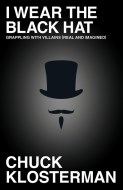
about "I Wear The Black Hat" by Chuck Klosterman
I Wear the Black Hat bounces around the topic of villainy with a collection of deftly written essays by American writer and essayist Chuck Klosterman. The reading flies by thanks to Klosterman's fresh prose. He's at his best when musing over the finer points of individuals and pop culture references; one of the best passages in I Wear the Black Hat finds Klosterman articulating the nuances of his (and many others') intolerance for the classic rock band The Eagles.But, unfortunately, Klosterman too easily gives in to the temptation to sound profound, and the result is a handful of hasty generalizations; a prime example from this book is when he attempts to extrapolate a larger cultural lesson from the decline of 1980's flash-in-the-pan comedian Andrew Dice Clay.* This kind of fallacy is pervasive in the pop culture-centric variety of writing commonly found in sources like The New Yorker, Gawker, and Deadspin among others. Nevertheless, I Wear the Black Hat is an overall agreeable read by an astute observer and talented writer.
Notes:
* There have been so, so many Andrew Dice Clays--performers and artists who seem to suddenly appear but then disappear--that putting any single one of them under a microscope should attract a good measure of skepticism. In the case of the "Diceman," maybe interest in him waned simply because he only had one joke.
Saturday, August 24, 2013
about the book "Suite française" by Irène Némirovsky
Suite française pushes us gently, more or less, into Occupied France, 1940. We shuffle around with members of the upper, middle, and lower classes trying to escape and then settle under the Germans.
This book--alternatively titled Dolce and Captivité--is an incomplete draft of two parts of a war-time epic that the author, Irène Némirovsky, wanted to write. She would never finish.
Born in 1903 in the Russian Empire, Némirovsky fled the Russian Revolution in 1917 and eventually settled in Paris, France. She soon began writing, published a couple books, and achieved wide recognition as an author. But her Jewish ancestry remained an issue--enough so that French citizenship was denied the Némirovskys in 1938. Némirovsky, born Russian-Jewish, converted to Catholicism in 1939; with the pressure on, she wrote for Candide and Gringoire, two magazines with antisemitic tendencies.Nevertheless, by 1940, Némirovsky's books could no longer be published under the spreading occupation. She fled with her husband and two daughters to Burgundy; but in July 1942, Némirovsky, then 39, was arrested by French police under German authority. She ended up in Auschwitz and died a month later of typhus. Later that year, her husband, Michel Epstein, was gassed at Auschwitz.
So, given this backstory, the flaws in the draft Suite française are unimportant. I enjoyed most the domestic drama between a formidable woman named Madame Angellier, a young maiden, Lucile, and Bruno, a German soldier bunking with the women. This is the most developed thread of multiple story lines that Némirovsky never got to tie together. Lucile and the soldier kindle a romance that disgusts Madame Angellier, a proud woman already embittered by loss of family and national pride. In the final pages, the soldier bids the women adieu as he and the other occupying German soldiers are called away to the horrible war on the Eastern Front. Lucile makes her last pathetic request of the soldier:
"... I'm asking you, if you have any feelings for me, to be as careful as possible with your life."And Suite française's narration considers,
"Because it is precious to you?" he asked nervously.
"Yes, Because it is precious to me."
How many Germans in the village--in cafés, in the comfortable houses they had occupied--were now writing to their wives, their fiancée's, leaving behind their worldly possessions, as if they were about to die?In two appendices full of the author's notes and letters from various others in her life at the time, Némirovsky reveals herself to be a very complicated person, veering between philosophical musings, harsh political judgements, vain self-assessments, and composed fear. Némirovsky perhaps intended to indict the French for their lack of answers to the occupation, but what I read is far less localized, and quietly emotes on several universal themes. This is a worthy read.
Labels:
book review,
books,
culture,
France,
Germany,
Irène Némirovsky,
literature,
occupation,
peace,
politics,
prose,
Russia,
Suite française,
war,
World War II
Friday, June 21, 2013
something about "Please Kill Me" by Legs McNeil and Gillian McCain
Billed as "The Uncensored Oral History of Punk", Please Kill Me testifies to punk rock's NYC birth in the mid-1970's. The book organizes quotes from a cast of people who were there--participants and witnesses, and these people describe the scene, say who's who, and, of course, talk about the sex and drugs. But noticeably missing in these quotes is elaboration on the rock and roll.There is no date or period anchoring the end of this telling, but the notable event in the final pages is the death of Johnny Thunders, former guitarist of the New York Dolls and, later, The Heartbreakers. These bands--the Dolls, in particular--dominated the genre's salad days. The Stooges (aka, Iggy and The Stooges) and the New York Dolls are the book's favorites, followed by the Ramones and the mostly derided Sex Pistols. The Dead Boys get minor coverage, too. But the deaths of Sid Vicious, Stiv Bators, and, as noted, Johnny Thunders serve as the conclusion to punk's story--at least in this version, even though Bators and Thunders died 10 years after the core of events described in the book.
If you're really into the music of any three of the above-mentioned bands, then Please Kill Me is sweet, truthy gossip. If you're not, then the quotes and people fast grow petty and irrelevant--the narrators sometimes indulge the "more punk than you" pissing contest that strips punk of its cultural relevance by pretending this raw, resilient music that crackles with energy belongs only to them, those self-important members of their own inertly private country club.
Labels:
1970s,
1980s,
book review,
culture,
Iggy Pop,
Johnny Thunders,
music,
New York,
New York Dolls,
nonfiction,
pop,
punk,
Rock,
Sex Pistols,
Sid Vicious,
Stiv Bators,
The Dead Boys,
The Ramones,
The stooges
Monday, April 29, 2013
about selections from "Critical Essays on Michel Foucault"
This collection of essays opens with philosopher Gilles Deleuze rephrasing and re-articulating Foucault's concept of power. There is little new ground here, but the essay is a good opener. The first real bright spot in this collection is "Foucault's Oriental Subtext", in which Uta Liebman Schaub identifies Eastern influences in Foucault's work. Primarily she sees the obliteration of the self in the remedy to Western systems' ceaseless quest to isolate and peg the self, and to tie this knowable self to an identity, as described by Foucault.
The essay "Foucault's Art of Seeing" by John Rajchman opens with Foucault's startling idea that seeing--vision--"structures thought in advance". The visual representation of thought, of how people have seen their world and then accordingly made sense of it, is tied to their age, their time. So seeing yields different concepts and ways of thinking about a given subject. For example, in the classical age, people grouped plants by their character. Now scientists group them primarily by their surface traits.
Foucault took an interest in how concepts of visualization become embedded in institutional practices, and how ethical and moral judgements of things and people changed with those concepts. It is hard to imagine now that people asked different questions in the past; we tend to think we've always been "logical", that being logical is part of our nature. But being "logical" used to be a moral exercise.Finally, Rajchman explains how, for Foucault and his philosophical-critical descendents, thinking is a dangerous act. I found this section of Rajchman's essay confusing; is it dangerous because it's always situated and political? because it's tied to moral and ethical consequences? because we, merely by thinking of things, may unknowingly reinforce or change ways of conceiving? Whatever the answer, the aim on the other side of that danger, what Foucault pursued, is a world that is not yet visible.
In "Beyond Life and Death: On Foucault's Post-Auschwitz Ethic", James W. Bernauer addresses Foucault's critics who charge the intellectual giant with advocating an amoral aestheticism. Bernauer begins his defense by recognizing Foucault's resistance to the scientifically-minded life style that presupposes we are knowable and, therefore, decipherable (and, as a consequence, subject to be judged against norms). He seemed to champion humans as sexual, primarily, and so he probed how sexuality came to be thought of as a moral experience. The modern age and its States conceive of citizens as life to be kept alive; Foucault conceived of man as desire.
That power that conceives of us as human souls in a life or death struggle categorizes us, marks our individuality, attaches us to an identity, subjectifies us, and imposes its truth on us. The sciences--the currently dominant producers and venue of true knowledge--"direct both the cognitive enterprise and the technologies for human self-relation". Foucault examined how people "became anxious about this or that," and urges us not to look so hard at what we hope to achieve, but rather what struggles we face.
Again, Foucault's ultimate goal was freedom. He knew there was no escaping knowledge-power-self relations for good, but he also thought that no "configuration" (of thought and power?) should be thought unchangeable.
Labels:
Classical Age,
criticism,
culture,
discourse,
Enlightenment,
Holocaust,
Michel Foucault,
philosophy,
positivism,
rhetoric,
science,
thinking,
thoughts,
Western
Friday, February 08, 2013
Saturday, December 22, 2012
Obama's speech at the service in Newtown
The President's December 16, 2012, address in Newtown is one of the more compelling, well-written editions of recent Obama speeches, which is pretty weird considering it argues for a policy he doesn't totally agree with, on an issue he doesn't care much about.
First Obama obligatorily memorializes the occasion by redescribing the tragic events and the redeeming moments within them. Then he says,
We can’t tolerate this anymore. These tragedies must end. And to end them, we must change.This change he refers to is a fundamental one concerning our culture and its relation to guns, individualism, and violence--something not easily changed. So how does a President / lawyer / legislator start us on the road towards such a change? Through legislation:
We will be told that the causes of such violence are complex, and that is true. No single law, no set of laws can eliminate evil from the world or prevent every senseless act of violence in our society, but that can’t be an excuse for inaction. Surely we can do better than this.The kind of legislation he has in mind, gun control, was not previously on his agenda, so to him it isn't the most appealing option, and he seems to doubt that it will even be all that effective; but he sees it as a means, the most obvious place to begin effecting a cultural change immediately:
If there’s even one step we can take to save another child or another parent or another town from the grief that’s visited Tucson and Aurora and Oak Creek and Newtown and communities from Columbine to Blacksburg before that, then surely we have an obligation to try.
... We know that, no matter how good our intentions, we’ll all stumble sometimes in some way.
We’ll make mistakes, we’ll experience hardships and even when we’re trying to do the right thing, we know that much of our time will be spent groping through the darkness, so often unable to discern God’s heavenly plans.There you have it: although it may not work as intended, new gun control legislation is something he thinks he can start on now, but he hopes other, better options will be revealed in the days ahead. Of course, though he's not the first, last, or only person to ever float such a message, Obama's talk of cultural change fuels his many detractors, those Conservatives whose ideological allegiance grows with their sense that policies traditionally deemed Liberal are now destroying their way of life.
Notes:
- It does seem strange that he would be arguing policy at a memorial service.
- My favorite part of this is far and away the following:
You know, someone once described the joy and anxiety of parenthood as the equivalent of having your heart outside of your body all the time, walking around.
With their very first cry, this most precious, vital part of ourselves, our child, is suddenly exposed to the world, to possible mishap or malice, and every parent knows there’s nothing we will not do to shield our children from harm. And yet we also know that with that child’s very first step and each step after that, they are separating from us, that we won’t -- that we can’t always be there for them.
They will suffer sickness and setbacks and broken hearts and disappointments, and we learn that our most important job is to give them what they need to become self-reliant and capable and resilient, ready to face the world without fear.
Tuesday, October 02, 2012
Glitzy craps all over the dinner table
The TV show "Here Comes Honey Boo Boo" strings together footage of a lower-class family in the Southern state of Georgia, US. These are rednecks and white trash. The youngest daughter, a frequent child beauty pageant contestant, and her the mother are the center of attention; altogether, the family shown on TV is devoid of manners nearly to the point of being uncivilized. I've only watched maybe 10 minutes of this show but enjoy reading the internet/news articles about it, which are mostly negative. The negativity is partly snobbery but, more so, I think it's evidence of the dominant truth-making discourses in the culture.
The main criticisms run along the following lines:
- The family is being exploited (which underscores the lack of opportunity in this country)
- The show rewards bad behavior (such as laziness, poor health, and having kids by multiple fathers starting at a young age)
- The show ridicules the family (and, by extension, people like them)

The exploitation claim provokes an interesting debate, but it first assumes the other critiques are valid. The other criticisms--I've seen many variants of them--spur from the public assumption and promotion of medical, psychological, and economic discourses that generate knowledge about life. The criticism is drawn from that knowledge: the family's steady diet of junk food will sicken them, reduce their quality and quantity of life, and ultimately create costs to be absorbed by the rest of the population; the sudden fame and the emphasis on pageantry, the patriarchal confusion, and the laissez-faire parenting will prove emotionally crippling. All this might bear out for various reasons, but the widespread condemnation of the show for these reasons shows the power of these discourses in our culture. Society assumes these discourses and polices itself with their truths. It says, "Do not reward this behavior! Society must be defended!"Notes:
1. Critics who've defended the show use the same discourses, saying the family's emotional health is OK because they are in on the joke and seem like they are happy and have decent familial relationships, etc.
2. Other critics have derided the show's quality, slamming it because it appeals to the lowest common denominator. This judgement, when pursued to its ends, justifies itself in the same discourses.
3. A show, especially one on a cable channel like TLC, doesn't need that many viewers to be a "hit". The standards for calling a show a hit have plummeted the last 20 years.
4. One well-written critique is this one from the AV Club, of which the highlight for me is the following:
We’re meant to laugh at the poor manners that Alana and her sister Pumpkin exhibit when an etiquette teacher comes to help make them more ladylike. It’s not the pair failing to transform into princesses after one session that is depressing. It’s that the show presents even the very idea of them being able to reach a point at which not farting at the table is even possible as a totally improbable idea.Ah, the coup d'etat of the family's dignity. Now, turn that around: when we train a monkey to roller-skate, we're meant to laugh at the monkey on roller-skates. There's no joke when the animal is untrainable. But, when these girls shrug off attempts to train them in formal behavior, it's a disgrace. (And AV Club comments suck.)
5. The author of the Gawker article, "The Perfect Level of Fame", makes the case that the show and celebrity attached haven't seem to hurt the family, at least. But what gives this piece distinction is the following comment from maryannmom:
- Wow. This is a really long article. I started with the first couple paragraphs, then started skimming, then scrolled to see how much more there was, then read the comments, which were disappointing. So I guess I never will no exactly what the Honey BooBoo phenomenon is, but then this cultural stuff is so depressing, it is starting to make me feel kinda unibomberish, in that hide-yourself-in-a-cabin-without-electricity-kind of way. Feel me?
- Am I evil for hating on those Pinkett-Smiths? And being super annoyed by their tiny starlet baby fake rapper kids?
- I agree. The pressure! You must have to have a thick skin to take all those second guesses and negative opinions and comments. I loved this dress for being feminine. pretty and sexy and showed off her beautiful shoulders and arms. (girl crush!). Yeah, it blows that a guy just gets a suit and is done, but then that is why women are so much cooler. I just saw the Democratic women of the Senate at the DNC and it as great that they had a variety of outfits, sizes, hair and make up. Vive la difference (of style)!
Labels:
children,
criticism,
culture,
discourse,
Here Comes Honey Boo Boo,
media,
parenting,
power,
rhetoric,
television
Tuesday, August 07, 2012
about Jonah Lehrer, making meaning, not making sense
Recently, audiences were disappointed to learn that author-journalist Jonah Lehrer fabricated and misrepresented quotes and self-plagiarized. His crime spurred a couple soul-searching response pieces, most of which are summed in Salon's "Jonah Lehrer throws it all away". Here, Roxanne Gay hits a few angles and floats the hypothesis that a guy like Lehrer "fits the narrative we want about a boy genius" because he can "make us feel smarter for finally being able to understand the complexities of the human mind"; he is the product of, and answer to, "a cultural obsession with genius, a need to find beacons of greatness in an ordinary world".
Because there must be some deeper reason he did what he did. Symptomatic of some disease rooted in our culture and in our souls that caused this thing. This fucking thing.
Doesn't this kind of ponderous speculation, this pathologizing, just create, replicate, and self-serve our need for meaning and significance in this "ordinary world"? Or our need for a need for meaning? Couldn't it just be that Lehrer is dishonest? Or that maybe he got lazy? Or that he tried to produce too much too soon? Or maybe we don't know. And it doesn't matter.
Finding the work of guys like Jonah Lehrer and Malcolm Gladwell interesting is one thing, but to mistake these pop-sci/pop-soc writers for preeminent thinkers of relevance and genius undermines the fearlessness, moral courage, and intellectual vigor of the better writers (and artists) who act as critics, stewards, and producers of culture.
Note:
- I'm not convinced self-plagiarism is a thing or that, if it is, it should be so damnable an offense. But in Lehrer's case, if nothing else, it's sort of ironic considering his big theme was creativity.
Thursday, August 02, 2012
About "Going Solo: The Extraordinary Rise and Surprising Appeal of Living Alone" by Eric Klinenberg
Klinenberg's revelation is that, rather than worry about this increased atomization making a nation of shut-in brats, we should see this as a neutral or even ultimately positive thing because these singletons are healthy, happy, and engaged. Indeed one of the book's big goals is to dispel myths and assumptions about people who choose to be alone. In support the book rallies scores of miniature profiles of singletons, quoting and amassing their differing and converging impressions and reasons. These mini bios also try and humanize the subject, to make flesh and blood out of a growing mass of loners.
The book's message is inherently anti-climactic: Hey, this is happening but it's OK (as long as we govern accordingly). I guess this is why I found the book so dull.
Labels:
alone,
book,
book review,
community,
criticism,
culture,
documentary,
Eric Klinenberg,
Going Solo,
isolation,
loneliness,
non-fiction,
politics,
review
Friday, April 27, 2012
About "Understanding Media: The Extensions of Man" by Marshall McLuhan

As much as an intellectual can, Marshall McLuhan caused a stir when he proposed that "the medium is the message" in Understanding Media (1964), the thorough analysis of media--not its content but media itself and its effects on how we think and act and make culture. It's a big, heavy subject, and McLuhan chips away at it on a great many fronts. Too many. For me, Understanding Media reads like a brilliant, nearly consumed man's mind dump rather than an organized argument. Gets tiresome.
Not to mention that often terrible writing style so prominent in the 1960's when authors of all stripes employed a scientific-ish vocabulary, needlessly obscuring their ideas in the bid for legitimacy. (Lots still do this!) For example: "Clothing, as an extension of the skin, can be seen both as a heat-control mechanism and as a means of defining the self socially" (chapter 12). But sometimes one of McLuhan's many crackerjack wisdoms splash water on your face, like this gem: "Language extends and amplifies man but it also divides his faculties. His collective consciousness or intuitive awareness is diminished by this technical extension of consciousness that is speech" (chapter 8).
Labels:
1960s,
analysis,
book review,
books,
criticism,
culture,
literature,
Marshall McLuhan,
media,
medium,
non-fiction,
philosophy,
popular science,
rhetoric,
television
Friday, April 06, 2012
Something on "The Late Shift: Letterman, Leno, & the Network Battle for the Night" by Bill Carter

In the early 1990's, late night television is owned by NBC's staple "The Tonight Show" starring Johnny Carson. But as the much-revered host neared his 30th year, the program's static offerings and rapidly aging audience sent murmurs of discontent through NBC's corporate offices. Carson, for whatever reasons, offered no resistance and abruptly announced his retirement just ahead of his anniversary season. Meanwhile, Jay Leno, with his unmatched work ethic and consistent performance, rose from leader of the new generation of stand-up comedians to frequent guest host of "The Tonight Show". And David Letterman, with wits and an innate and cultivated gift for entertaining, earned his way to hosting a late show that aired after Carson. In The Late Shift, Bill Carter details--and I mean details--the personalities and the drama, decision-making, and the consequences surrounding "The Tonight Show" hosting change of 1992.
Carter seems to respect Leno, but it's Letterman he admires as a talent. Leno comes off as a nice but also very repressed, complicated guy who excels at stand-up and had a pit bull for a manager. Letterman sounds like an under-appreciated star who's also stubborn, fickle, and plagued by self-doubt.
I mostly enjoyed The Late Shift, though the first half is better than the last. This story includes a lot of characters and the audit of who said and thought what can be exhausting.
Wednesday, March 28, 2012
A thing on Paul Goodman's "Growing Up Absurd"

The full title, Growing Up Absurd: Problems of Youth in the Organized Society, explains it: this is writer and intellectual Paul Goodman's inventory of social ills leading kids to rebel, drop out, and be generally dysfunctional in the 1950s. Nothing escapes his criticism: poor city planning, the lack of meaningful work, kids' intellectually starved education, churches born of hierarchy and dogma rather than community--he calls out each and every failed institution and stunted revolution as he defends the angry and resigned.
I read Growing Up Absurd at the same time I took an interest in "Leave it to Beaver" reruns. Watching June Cleaver fret over young Theodor arriving home from school ten minutes late or Wally changing his hairstyle shows, I think, the kind of anxiety Goodman was responding to--anxiety egged on by starched social pundits in horn-rimmed glasses cautioning middle class parents about the troubled young man in the black leather jacket that might emerge from their own child. To these parents Goodman essentially says, Of course you don't understand them; they reject everything you've spent your life dealing with, negotiating, rationalizing, and accepting. And for good reason!
Goodman assumes the audience shares his progressive views, and some sections are confusing, as if written hastily. Plus, the negativity made this a pretty tough read. I found greater value in its being a historical document more so than spot-on social criticism.
Thursday, February 16, 2012
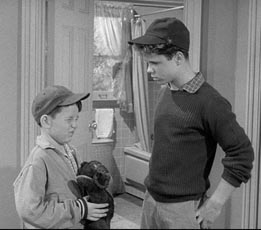
About the TV show "Leave It to Beaver" (1957-1963)
Compared to "grittier", more recent television shows like Norman Lear's work in the 1970's and early "Rosanne", "Leave It to Beaver" is often critically dismissed for three reasons: (1) it's bourgeoisie idealism, a show (often seen as representative of other shows of the era) whose producers were either too disconnected or too disinterested to deal with darker, more important themes and problems; (2) the parenting it portrayed set too high a bar for those in the real-life business of parenting; (3) it oversimplified life with cut-and-dried narrative archs. (An example of this last criticism lies in the IMDB plot summary for the show: "Unlike real life, these situations are always easily resolved to the satisfaction of all involved and the Beaver gets off with a few stern moralistic words of parental advice.")After watching the show the last several weeks, these critical write-offs seem way too hasty.
That the setting is a middle class suburb, that Ward and June can make it look pretty easy, and that problems arise and see resolution within the episode are all arguable enough. But none of these issues are unique to "Leave It to Beaver" or shows of its era. Moreover, consider the show's context: first, the middle class was booming then, so upward mobility was real (more so than now); second, the show was aimed at families, so its arch and content were built accordingly.
So those criticisms are a little unfair. Worse, they are conventional. They are conversation enders that cut off any real consideration of the show's merits. And it definitely had merits.
It wasn't like Beaver would just drop his lollipop in the mud and learn to be careful. No, the conflicts and themes could be substantial. Beaver might learn about the nature of trust--that trust is often necessary, that trust can be betrayed, and that trust can redeem the trusted and the trustee. He might learn about making choices by feeling regret. He might learn about responsibility after being disappointed or disappointing others. He might learn that there can be more to a person than the impression they make. And there were episodes in which he saw and met people outside his privileged suburban middle class world. Jealousy, money, status, honesty, popularity, peer pressure--all covered, and not always "to the satisfaction of all involved". In some episodes it was Ward and June whose eyes were opened.
Not every episode hit a home run but "Leave It to Beaver" deserves way more credit than it usually gets.
Note:
- In one stellar episode called "Eddie Spends the Night", Eddie Haskel, whose parents are out of town, is invited to stay at the Cleavers. That evening he and Wally fight and in protest Eddie goes home to an empty house. At first the Cleavers are relieved, but soon Ward and June remember their responsibility and lobby Wally to re-invite Eddie. Wally finds Eddie home alone and evidently a little scared of being by himself, though he tries not to show it. After first pretending (for Wally's benefit) to demand his father allow him to return, Eddie rejoins Wally. The next day Eddie confesses to Beaver that he hates being alone because, even though he acts like a big shot all the time, he can't pretend to himself that he's as confident and popular as he wants to be.
Labels:
"Leave It to Beaver",
bourgeoisie,
culture,
ethics,
family,
idealism,
idealistic,
media,
middle class,
morals,
parenting,
quality,
sitcoms,
television,
TV,
values
Saturday, January 14, 2012
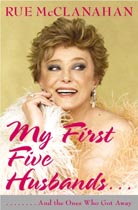
Rue McClanahan's autobiography "My First Five Husbands ... And the Ones Who Got Away"
Although she spent much of her career on the theater stage, sitcom acting earned Rue McClanahan the most fame, having played Vivian on "Maude" and Blanche on "The Golden Girls". Her autobiography is like a chronology of lovers--she had a panicky need for male companionship likely brought on by her distant father. But hers is not a tale of dysfunction or sadness; instead she admits to only a few recurring mistakes within in a lifetime happiness. She ends with this:Even as a child I had the strong feeling that life was good. I had a passion for work, an openness to love, and a penchant for joy. In a word, I had hope.
I still have it.The prose is light and bubbly, probably true to McClanahan's personality. The woman herself sounds like her trademark character, Blanche--slept around a lot but had a strong independent streak and beamed positivity, charming those in her company. But, the story goes, she succeeded purely on her acting chops.
I expected more gossip about television actors, but she offers almost none aside from acknowledging that Estelle Getty was not very good and Bea Arthur was an intimidating personality prone to dispensing harsh judgements. Although published in 2006, just four years before her death at age 76, the book isn't some old worldly woman's book of truisms. Mostly she cautions readers about marriage, lamenting that love alone isn't enough. Despite that minor key note, the book is a fast, fresh read.
Labels:
acting,
autobiography,
criticism,
culture,
non-fictio,
review,
Rue McClanahan,
sitcoms,
television
Subscribe to:
Posts (Atom)