Showing posts with label Russia. Show all posts

Wednesday, August 31, 2022

something about dynasties and Great Men

A few months ago, former President George W. Bush delivered a speech during an elbow-rubber’s wine-and-cheese event held at his presidential library in Dallas. The occasion should have gone by unnoticed, but W's remarks drew unexpected attention because of a Freudian slip. Intending to condemn Russian President Vladimir Putin's invasion of Ukraine, W instead decried "a wholly unjustified and brutal invasion of Iraq." In 2003, of course, W invaded Iraq on the claim that Iraqi President Saddam Hussein's regime had weapons of mass destruction and was pursuing a nuclear weapon. The claim proved untrue.

But the part of W's remarks that got me came just before that nauseating gaffe, when W noted that “the Ukrainian people elected Volodymyr Zelenskyy, with whom I Zoomed the other day, by the waycool little guy—the Churchill of the 21st century."

President George W. Bush gave people nicknames and made little jokes that sometimes, like this “cool little guy” quip, showed how removed rather than how normal W was. After all, he was a Bush, and a Bush is not like other people. To W, Zelensky, a little man with broken English from a strange land, is just another amusing accident of history. Not like a Bush.

Note: Would a Bush have stayed in Kyiv while most of the world was saying the Russians would conquer in a few days?


Sunday, May 15, 2022

something about lending support

The woman opened the package—the Ukraine flag had arrived from Amazon. She remembered ordering it on Saturday or Sunday and was grateful that she had not picked the big one, having chosen instead the tasteful 18"x27". She still had to find a place for it outside.

The blue and yellow colors were pure and signaled to neighbors that she is informed and feels passionately about the issues—that she, too, stood with the people of Ukraine.

Some weeks later, returning from her walk, the woman paused and counted three other Ukraine flags on her block. How long, she wondered, do we keep these up?


Friday, January 08, 2021

something about "Diary of a Madman" by Nikolai Gogol


"Diary of a Madman," a short story by Nikolai Gogol, documents the warping of thought in an impoverished civil servant. The diary's author is incurably insecure and envious; his entries reveal his deepening delusions. This work, written in 1835, attacks Russia's class structure. I did not enjoy this read. Most of the Russian literature I have read dealt with these themes in some way but with better jokes.

Saturday, May 11, 2019

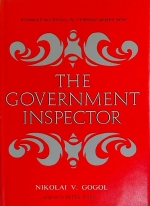
something about "The Government Inspector" by Nikolai Gogol


Nikolai Gogol's play, "The Government Inspector," satirizes political corruption in Imperial Russia. Russia is incurably corrupt, so while the play, published in 1836 (and revised in 1842), is presumably set in the mid-19th century, it remains relevant—and not just in Russia. In the play, small-town corrupt local officials receive news that a high-ranking, undercover inspector general will investigate the town's corruption problem. The locals mistake a pathetic, lowly civil servant, Khlestakov, for the inspector. Khlestakov and his servant take full advantage.

I read a version that included stage adaptation notes written by director Michael Langham. Langham's introduction emphasizes, among other things, that the corrupt mayor, rather than Khlestakov, is the central figure. I appreciate book editions that include notes like this. Sure enough, the mayor has the best lines. I found the work a quality read.


Notes: It is understood that corruption threatens all nations. Populist movements are perhaps most susceptible.

Saturday, May 26, 2018

something about "The Death of Ivan Ilych" by Leo Tolstoy


This remarkable novella drags a well-heeled federal judge through the ultimate crisis.

Tolstoy does not flatter our protagonist in The Death of Ivan Ilych. In an efficient account of Ilych's professional and social advancement, we learn that the man is shallow, conceited, and vain; he is a social climber and, having climbed, immediately became condescending (though not unkind) in his privilege.

One of the remarkable things about this novella is that these traits do not make Ivan Ilyich a villain; instead, they make him average.


In the story, Ilyich's health declines and he suffers exquisite pain in his illness. Incapacitated, the pointlessness of his life imposes on him. And the degree of suffering mystifies him because he has only ever done what he thought he was supposed to do: develop a career, get married, have kids, get established. But doing what was expected could not spare him an agonizing, slow death. In the end, the inauthenticity of his life leaves him lifeless.

My favorite parts--all of these include a comment on averageness and unoriginality:

On Ivan Ilych's parentage:

He was the son of an official who had worked his way through various ministries and departments in Petersburg, carving out the kind of career that brings people to a position from which, despite their obvious incapacity for doing anything remotely useful, they cannot be sacked because of their status and long years of service, so they end up being given wholly fictitious jobs, anything from six to ten thousand a year, and this enables them to live on to a ripe old age.
On Ivan Ilych decorating his fine new house:
But these were essentially the accoutrements that appeal to all people who are not actually rich but who want to look rich, though all they manage to do is look like each other: damasks, ebony, plants, rugs and bronzes, anything dark and gleaming--everything that all people of a certain class affect so as to be like all other people of a certain class.
On Ivan Ilych's trip to the doctor early in his mysterious illness:
He was made to wait, the doctor was full of his own importance--an attitude he was familiar with because it was one that he himself assumed in court--then came all the tapping and listening, the questions with predetermined and obviously superfluous answers, the knowing look that seemed to say, "Just place yourself in our hands and we'll sort it out, we know what we're doing, there's no doubt about it, we can sort things out the same way as we would for anyone you care to name."
Note: The Death of Ivan Ilych was published in 1886. Tolstoy was supposedly suffering a personal crisis of meaning.

Friday, January 20, 2017

about choosing a Russia-friendly oilman for Secretary of State


Under the guise of a supercoalition, the US can outsource to Russia some of the intervention grunt work in the Middle East; this would permit more US time and resource investment in Asia. The oil-rich lands of Russia and the Middle East represent the past; Asia will be a larger part of the future. 


Note: Not the actual reasoning behind President Donald Trump's pick for Secretary of State, Rex Tillerson.


Saturday, October 03, 2015

about "Tinker, Tailor, Soldier, Spy" by John Le Carre


Have you seen the movie? I did, and before I read the book. Memories of the film flooded my reading experience. The novel includes lots more detail and expands the cast. I enjoyed the film more because the reveal--who is the spy?--is done with greater effect. And of course, the Julio Iglesias overdub at the end is magnificent.

Tinker, Tailor, Soldier, Spy is the story of a forcibly retired senior officer of British intelligence, George Smiley, getting informally recruited back into service. His mission is to identify a Soviet mole in the head office. The story is a study in the play between loyalty and identity. I found the narrative thread difficult to follow in both film and print. Fans of the film who have never read the book can do without the read. But my opinion is that the reverse is not true.


Note:
The British spy jargon created problems for me. A lexicon appendix would have helped.


Saturday, June 06, 2015

Children


There is nothing more atrociously cruel than an adored child.
—Vladimir Nabokov, Lolita

Monday, November 03, 2014

about "Travels in Siberia" Ian Frazier


Ian Frazier, humor contributor to The New Yorker, developed a Russia fetish traveling there and, in 2010, published Travels in Siberia. This hefty travel log relays all kinds of details about Frazier's experiences with his guides, with locals, the climate, terrain, and culture. As made clear by the title, this book focuses on his times in Siberia, the massive symbol that accounts for the bulk of Russian territory (about three quarters of it). The travel-log part that makes for most of the book plodded aimlessly, and the narrative's pace stalled; the best parts relate some fascinating history lessons.

Saturday, June 07, 2014

about "Crime and Punishment" by Fyodor Dostoyevsky


In a Russian a literary journal in 1866, Fyodor Dostoyevsky published Crime and Punishment, a  novel that follows a young man named Rodion Raskolnikov immediately before and after he murders an unscrupulous pawnbroker and her feeble sister. The motive, which does not seem fully and explicitly formed even for our protagonist, develops through Dostoyevsky's narrative. It seems altogether an act of desperate poverty, self-empowerment, and destiny.

In those forlorn, guilt-infected postmurder days spent adrift among a diverse cast of emotional string-pulling supporting characters, Raskolnikov remains under suspicion but not arrest. The action turns when a coy police inspector reminds Raskolnikov of an essay the would-be murderer wrote as a college student; the essay suggests a slight perversion of the Great Man theory--that great men use their power, be it charisma, intelligence, political and military wits, what have you, to transcend conventions and change the world. So, we come to understand, Raskolnikov's act of murder is a test of his own greatness (though he simultaneously thinks himself a slug). But, ultimately, crushed with guilt, self-doubt, and facing inevitable arrest, Raskolnikov confesses and begins his sentence in Siberia.

Among other things, Crime and Punishment dives into Dostoyevsky's personal philosophy that suffering and degradation bring salvation. The novel turns on our ideas of law, crime, morality, reason, and society and the individual. It asks, What is the difference between the man who transgresses boundaries to achieve his ambitions and the man who defies conventions to achieve greatness?


Notes:
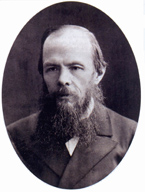
  • One of the most noted events in Fyodor Dostoyevsky's biography is his 1849 arrest for his association with some liberal utopians; he was condemned to death, but then spared moments before his execution and re-sentenced to four years' hard labour in Siberia. He later traveled through Europe, but developed epilepsy and a nasty gambling addiction. Hard times followed, but also some great literature.
  • Besides exploring universal themes, Fyodor Dostoyevsky's novels are also very Russian, set in 19th-century Russia during the nation's never-ending, clumsy push to modernize.


Saturday, August 24, 2013

about the book "Suite française" by Irène Némirovsky


Suite française pushes us gently, more or less, into Occupied France, 1940. We shuffle around with members of the upper, middle, and lower classes trying to escape and then settle under the Germans.

This book--alternatively titled Dolce and Captivité--is an incomplete draft of two parts of a war-time epic that the author, Irène Némirovsky, wanted to write. She would never finish.

Born in 1903 in the Russian Empire, Némirovsky fled the Russian Revolution in 1917 and eventually settled in Paris, France. She soon began writing, published a couple books, and achieved wide recognition as an author. But her Jewish ancestry remained an issue--enough so that French citizenship was denied the Némirovskys in 1938. Némirovsky, born Russian-Jewish,  converted to Catholicism in 1939; with the pressure on, she wrote for Candide and Gringoire, two magazines with antisemitic tendencies.

Nevertheless, by 1940, Némirovsky's books could no longer be published under the spreading occupation. She fled with her husband and two daughters to Burgundy; but in July 1942, Némirovsky, then 39, was arrested by French police under German authority. She ended up in Auschwitz and died a month later of typhus. Later that year, her husband, Michel Epstein, was gassed at Auschwitz.

So, given this backstory, the flaws in the draft Suite française are unimportant. I enjoyed most the domestic drama between a formidable woman named Madame Angellier, a young maiden, Lucile, and Bruno, a German soldier bunking with the women. This is the most developed thread of multiple story lines that Némirovsky never got to tie together. Lucile and the soldier kindle a romance that disgusts Madame Angellier, a proud woman already embittered by loss of family and national pride. In the final pages, the soldier bids the women adieu as he and the other occupying German soldiers are called away to the horrible war on the Eastern Front. Lucile makes her last pathetic request of the soldier:
"... I'm asking you, if you have any feelings for me, to be as careful as possible with your life."
"Because it is precious to you?" he asked nervously.
"Yes, Because it is precious to me."
And Suite française's narration considers,
How many Germans in the village--in cafés, in the comfortable houses they had occupied--were now writing to their wives, their fiancée's, leaving behind their worldly possessions, as if they were about to die?
In two appendices full of the author's notes and letters from various others in her life at the time, Némirovsky reveals herself to be a very complicated person, veering between philosophical musings, harsh political judgements, vain self-assessments, and composed fear. Némirovsky perhaps intended to indict the French for their lack of answers to the occupation, but what I read is far less localized, and quietly emotes on several universal themes. This is a worthy read.


Tuesday, August 14, 2012

About a Dostoevsky short story


In Fyodor Dostoevsky's short story, "A Disgraceful Affair", we're introduced to a hoity-toity General having drinks with his buddies and running his mouth about how Russia will thrive in an age of what he calls "idealism". That, he imagines, is everyone respecting and caring for one another regardless of class. After one too many, he starts for home. Finding that his coachman isn't there waiting for him, he cusses a storm and forgoes a cab, content to hoof it all the way, mostly to spite his missing servant.
While straying through the ghetto he passes one of his lowly, wretched clerk's wedding receptions. The stewed General daydreams about classing up the party with his presence, in the process blowing everyone's mind with what a kindly superior human being he is. Sounds like a plan, so he stumbles in and, after the initial awkwardness, he settles himself, and even sees a few other underlings in attendance. But soon he is swilling vodka and champagne until he finally gets too drunk and passes out. But not until after making an ass of himself, rambling about idealism and spitting all the time.

At this point we learn the groom--the lowly clerk--shoulders all kinds of misery in his quest to make his way.

Anyway, the party breaks up, and the General thrashes and pukes a little until finally an old boarder woman assumes the job of cleaning him up. In the process, the General promptly sobers up enough to hightail it home where he stays in bed for eight days, laid out with a bad case of humiliation.

On the ninth day, no longer able to bear not knowing how much he's damaged his reputation, the General returns to the office where he finds, to his amazement, that nothing appears to have changed!

At the story's end, we find the General sitting pretty in his office, reflecting on the fact that, not only will he come through with reputation intact, but he's had a pretty awesome productive day to boot. Just then another clerk enters with the day's final paperwork and a transfer request from the new groom. Rather than grant the transfer immediately, the General actually says he'll forgive the young man. At this news, the clerk blushes and excuses himself. This inspires in the General the greatest wound, as
He felt more shame, more heaviness at heart, than he had experienced even during the most unbearable moments of his eight days of illness.
"I have failed to live up to my own ideals!" he said to himself, and sank into his chair--helpless.
I see this conclusion at least two ways: (1) I think there's a triple move there, a series of realizations: first, the General realizes his reputation is shot; second, he realizes that, by party crashing, he only added to the groom-clerk's misery, of which, until then, he had been completely unaware; and third, he realizes that, just now, at the moment when he could have spared the injured groom-clerk the insult of having to work for such a cruel boss, he instead chose to humor the prideful delusions of his own reputation. Or, (2) the General remains oblivious to the sufferings of the inferior folk, and is concerned with his own problems.


Notes:
  • I told this guy at work about Dostoevsky's life and themes and he said it sounds like "Tales from the Hood" but earlier. An awesome comparison. But "Tales from the Hood" somehow seems like an older reference point than Dostoevsky does.