"Diary of a Madman," a short story by Nikolai Gogol, documents the warping of thought in an impoverished civil servant. The diary's author is incurably insecure and envious; his entries reveal his deepening delusions. This work, written in 1835, attacks Russia's class structure. I did not enjoy this read. Most of the Russian literature I have read dealt with these themes in some way but with better jokes.
Tom Perrotta excels at combining middle-class drama and satire. His stories, including Mrs. Fletcher, sprout from small sagas in American suburbs. The titular character is Eve, a fifty-something divorcée and mother of an entitled, popular, teenaged son named Brendan. Brendan is starting college, and Eve is starting life in an empty nest. The coming year defies expectations because it is Eve rather than Brendan who begins to dabble and explore. Perrotta's easily digestible novel sets up tension between a mature woman starting a new chapter in her life and her immature son's struggle in a new environment in which he is no longer at center. This is an enjoyable story of contemporary sexual politics.
Notes:
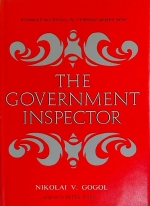 Nikolai Gogol's play, "The Government Inspector," satirizes political corruption in Imperial Russia. Russia is incurably corrupt, so while the play, published in 1836 (and revised in 1842), is presumably set in the mid-19th century, it remains relevant—and not just in Russia. In the play, small-town corrupt local officials receive news that a high-ranking, undercover inspector general will investigate the town's corruption problem. The locals mistake a pathetic, lowly civil servant, Khlestakov, for the inspector. Khlestakov and his servant take full advantage.
I read a version that included stage adaptation notes written by director Michael Langham. Langham's introduction emphasizes, among other things, that the corrupt mayor, rather than Khlestakov, is the central figure. I appreciate book editions that include notes like this. Sure enough, the mayor has the best lines. I found the work a quality read.
Notes: It is understood that corruption threatens all nations. Populist movements are perhaps most susceptible.
Nikolai Gogol's play, "The Government Inspector," satirizes political corruption in Imperial Russia. Russia is incurably corrupt, so while the play, published in 1836 (and revised in 1842), is presumably set in the mid-19th century, it remains relevant—and not just in Russia. In the play, small-town corrupt local officials receive news that a high-ranking, undercover inspector general will investigate the town's corruption problem. The locals mistake a pathetic, lowly civil servant, Khlestakov, for the inspector. Khlestakov and his servant take full advantage.
I read a version that included stage adaptation notes written by director Michael Langham. Langham's introduction emphasizes, among other things, that the corrupt mayor, rather than Khlestakov, is the central figure. I appreciate book editions that include notes like this. Sure enough, the mayor has the best lines. I found the work a quality read.
Notes: It is understood that corruption threatens all nations. Populist movements are perhaps most susceptible.


