Showing posts with label values. Show all posts

Saturday, September 18, 2021

about when alley driveway gates went up

Jeremy had his big driveway gate installed after someone broke into his car and stole his golf clubs. His wasn’t the first gate in the alley, but it was a little different because his family lived next door to mom and dad. Every time I was around, I would see their SUV pull in and out, the 8-foot fence open and close, grinding the same, coming or going.

The first time I saw a gate like that in the neighborhood was probably 10 years earlier—on one of the houses in the alley opposite the field belonging to the public elementary school. Is that the one that started it all? Today, those alley driveway gates are everywhere. Whatever neighbors value is stored away safely now, along with whatever value neighbors have.


Saturday, May 26, 2018

something about "The Death of Ivan Ilych" by Leo Tolstoy


This remarkable novella drags a well-heeled federal judge through the ultimate crisis.

Tolstoy does not flatter our protagonist in The Death of Ivan Ilych. In an efficient account of Ilych's professional and social advancement, we learn that the man is shallow, conceited, and vain; he is a social climber and, having climbed, immediately became condescending (though not unkind) in his privilege.

One of the remarkable things about this novella is that these traits do not make Ivan Ilyich a villain; instead, they make him average.


In the story, Ilyich's health declines and he suffers exquisite pain in his illness. Incapacitated, the pointlessness of his life imposes on him. And the degree of suffering mystifies him because he has only ever done what he thought he was supposed to do: develop a career, get married, have kids, get established. But doing what was expected could not spare him an agonizing, slow death. In the end, the inauthenticity of his life leaves him lifeless.

My favorite parts--all of these include a comment on averageness and unoriginality:

On Ivan Ilych's parentage:

He was the son of an official who had worked his way through various ministries and departments in Petersburg, carving out the kind of career that brings people to a position from which, despite their obvious incapacity for doing anything remotely useful, they cannot be sacked because of their status and long years of service, so they end up being given wholly fictitious jobs, anything from six to ten thousand a year, and this enables them to live on to a ripe old age.
On Ivan Ilych decorating his fine new house:
But these were essentially the accoutrements that appeal to all people who are not actually rich but who want to look rich, though all they manage to do is look like each other: damasks, ebony, plants, rugs and bronzes, anything dark and gleaming--everything that all people of a certain class affect so as to be like all other people of a certain class.
On Ivan Ilych's trip to the doctor early in his mysterious illness:
He was made to wait, the doctor was full of his own importance--an attitude he was familiar with because it was one that he himself assumed in court--then came all the tapping and listening, the questions with predetermined and obviously superfluous answers, the knowing look that seemed to say, "Just place yourself in our hands and we'll sort it out, we know what we're doing, there's no doubt about it, we can sort things out the same way as we would for anyone you care to name."
Note: The Death of Ivan Ilych was published in 1886. Tolstoy was supposedly suffering a personal crisis of meaning.

Saturday, July 08, 2017

another opinion


This week USA Today published an opinion by the Heritage Foundation's John Malcolm supporting the presidential authority behind Executive Order 13769 ("Executive Order Protecting The Nation From Foreign Terrorist Entry Into The United States"), the so-called "travel ban." President Trump may have the authority, but Malcolm's argument in support is flawed. He writes, "Presidential authority to protect our homeland should not be second-guessed by courts based on some hidden intent divined from tweets and statements made by surrogates in the heat of a presidential campaign." First, Malcolm's attempt to attribute to surrogates Trump's Muslim ban campaign rhetoric is wrong. In December 2015, during the campaign, candidate Trump said at a rally, “Donald J. Trump is calling for a total and complete shutdown of Muslims entering the United States until our country's representatives can figure out what the hell is going on.” Second, and worse still, Malcolm tries to nullify the intent behind campaign promises. Of course candidates make false promises, but we still have to pretend the promises are true.


Notes:
  • At issue is the scope of presidential power over the border. The Supreme Court has allowed parts of President Trump's travel ban to go into effect and will hear oral arguments on the case this fall.
  • The "he did not mean it" argument was once part of the legal defense.
  • Every previous President made an empty promise.
Source: "Travel ban is president's authority," USA Today, July 5, 2017


Saturday, April 16, 2016

something about the film "American Beauty"


American Beauty is a confused but rich film.


The film's narrator and main character is Lester Burnham. Lester begins the film feeling like there is no place for him: he is unnecessary at work and irrelevant and home. But Lester, a reliable narrator, breaks free. He quits his job, blackmails his boss, and secures a cushy severance package. Then he takes a minimum-wage job with little responsibility and buys his dream car. He devotes his recreational time to smoking pot and working out. Lester asks, What do I have to lose?

Lester's compliment in the film is a neighborhood high schooler, Ricky Fitts. Ricky is a successful dealer of expensive high-end pot (Lester becomes a customer). Through interactions with peers and the adults who supposedly run the world, we learn that Ricky transcends common insecurities. Ricky taps into a life force and finds spirituality in his appreciation of "real" beauty.

Lester's foil is his wife, Carolyn--an ambitious but frustrated real estate agent. She values possessions. She crafts and frets over her image. She covets professional success. She is not happy about Lester's reckless disregard for the "normal" path. She has grown too much concerned with projecting the image of well being, and she forgot how to be well. 

Ricky's foil is his father, Col. Frank Fitts, USMC (retired). Colonel Fitts is a hardline and hard-nosed disciplinarian. He is also a bigot and closeted homosexual. He cannot accept being gay because that is not what he thinks a man is supposed to be. His wife is trapped in a world of interiority. She is scared of falling short of her husband's expectations, thereby making him angry. In one scene, she reflexively apologizes to a house guest for the home's appearance even though the place is immaculate.

Subtext Analysis

The Colonel represents structure, rules, and discipline. Disdain for rules and for being normal are themes in American Beauty. However, this disregard is the driving force behind the commercial market. Are Lester and Ricky heroes? Each of their ego indulgences causes destruction. What are they rebelling against? Being normal.

The film ends up promoting traditional values. Lester first rebels from the trappings of suburban American normalcy and lives to indulge his own ego. But then he chooses traditional values, seeking the warm, blissful familiarity of his family in his final moments.


Friday, January 01, 2016

something about "Dangling Man" by Saul Bellow

 
Our Dangling Man keeps a journal in which he agonizes over the gaps between his past and present selves. His encounters with people sound largely antagonistic.

The voice of the journal belongs to Joseph, a young man living in Chicago. At this moment in his life, Joseph is unemployed, and
1942 America is at war. Joseph's voice captures truths that are universal (or, at least national), temporal, and personal. Frustration over his compulsion to drill and drill himself for value taint Joseph's reflections. Although determined to unleash these thoughts, Joseph is an unwilling participant in a culture that increasingly casts every self in the lead role.

At the time of his writings, Joseph, Canadian by birth, has been waiting for word on his acceptance into the American army during World War II. He surrenders his personal freedom to end this suffering. He closes his journal with the words,

Hurray for regular hours!
And for the supervision of the spirit!
Long live regimentation!

Notes:
Dangling Man, written in 1944, is Saul Bellow's first published work. I thought
Dangling Man had interesting moments, but I did not enjoy reading it.

Friday, July 04, 2014

anything but about idealism


Countries speak to ideals, but are never kind to idealists.


Saturday, November 09, 2013

something about "The Elementary Particles" by Michel Houellebecq


Michel Houellebecq's "The Elementary Particles" diagnosis society with irreversible decline brought on by failing social values and an addiction to the promises of technology and positivism. The social-sexual revolutions of the 1960s implanted an unwavering allegiance to individuality, and this in turn cost us community and the possibility of intimacy among friends and lovers. This trend coupled with cold, hard science pushed us all apart, leaving a developed world of lonely, desperate, frustrated people. Isolation, depression prevail.

This tale of shifting value systems is played out in the lives of half-brothers Michel and Bruno. Their mother was a sexually liberated woman who had no time or interest for children. Being an easy target for bullies, Bruno led a difficult childhood; Michel fared better, being brilliant but clearly withdrawn and romantically oblivious. Bruno grows into a sexually frustrated and obsessed adult, Michel into a molecular biologist. Late in life they each find a sad but redeeming relationship with women but even this last hurrah only underscores our doom--both women die, leaving the half-brothers half whole and forced to recollect the pieces of their already broken lives. Bruno finds not-unhappiness medicated in a sanitarium while Michel goes on to ensure the death of humanity by pioneering asexual reproduction.

Not a bad book. But I wouldn't call it good.

Monday, November 04, 2013

Thursday, February 16, 2012

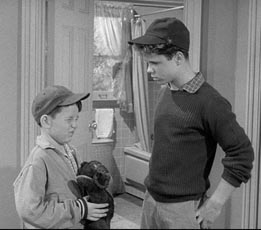
About the TV show "Leave It to Beaver" (1957-1963)

Compared to "grittier", more recent television shows like Norman Lear's work in the 1970's and early "Rosanne", "Leave It to Beaver" is often critically dismissed for three reasons: (1) it's bourgeoisie idealism, a show (often seen as representative of other shows of the era) whose producers were either too disconnected or too disinterested to deal with darker, more important themes and problems; (2) the parenting it portrayed set too high a bar for those in the real-life business of parenting; (3) it oversimplified life with cut-and-dried narrative archs. (An example of this last criticism lies in the IMDB plot summary for the show: "Unlike real life, these situations are always easily resolved to the satisfaction of all involved and the Beaver gets off with a few stern moralistic words of parental advice.")

After watching the show the last several weeks, these critical write-offs seem way too hasty.

That the setting is a middle class suburb, that Ward and June can make it look pretty easy, and that problems arise and see resolution within the episode are all arguable enough. But none of these issues are unique to "Leave It to Beaver" or shows of its era. Moreover, consider the show's context: first, the middle class was booming then, so upward mobility was real (more so than now); second, the show was aimed at families, so its arch and content were built accordingly.

So those criticisms are a little unfair. Worse, they are conventional. They are conversation enders that cut off any real consideration of the show's merits. And it definitely had merits.

It wasn't like Beaver would just drop his lollipop in the mud and learn to be careful. No, the conflicts and themes could be substantial. Beaver might learn about the nature of trust--that trust is often necessary, that trust can be betrayed, and that trust can redeem the trusted and the trustee. He might learn about making choices by feeling regret. He might learn about responsibility after being disappointed or disappointing others. He might learn that there can be more to a person than the impression they make. And there were episodes in which he saw and met people outside his privileged suburban middle class world. Jealousy, money, status, honesty, popularity, peer pressure--all covered, and not always "to the satisfaction of all involved". In some episodes it was Ward and June whose eyes were opened.

Not every episode hit a home run but "Leave It to Beaver" deserves way more credit than it usually gets.

Note:
  • In one stellar episode called "Eddie Spends the Night", Eddie Haskel, whose parents are out of town, is invited to stay at the Cleavers. That evening he and Wally fight and in protest Eddie goes home to an empty house. At first the Cleavers are relieved, but soon Ward and June remember their responsibility and lobby Wally to re-invite Eddie. Wally finds Eddie home alone and evidently a little scared of being by himself, though he tries not to show it. After first pretending (for Wally's benefit) to demand his father allow him to return, Eddie rejoins Wally. The next day Eddie confesses to Beaver that he hates being alone because, even though he acts like a big shot all the time, he can't pretend to himself that he's as confident and popular as he wants to be.

Friday, January 27, 2012

Kenneth Feinberg's worth

Kenneth Feinberg is an interesting figure. Conceptually, anyway. After the BP Gulf oil spill, the Federal government negotiated creation of a payout fund and President Obama appointed Feinberg to assign the compensation due to each disaster victim based on losses and projections. Feinberg had done the same for victims' families after 9/11 and the 2007 Virginia Tech massacre, and, prior to that, he participated in Agent Orange-related litigation.

After the oil spill, I watched him testify on CSPAN at a series of Federal oversight committee hearings about the payout fund's administration. He is an animated performer, and his unrehearsed answers to panel inquiries were a clinic in articulation. I was thinking of him today and found an article from the Washingtonian, March 01, 2008, called "What I've Learned: Kenneth Feinberg". It's an interview, and features this:
Interviewer: Is it hard to shed the role of lawyer? 
Feinberg: I think being a lawyer and administering the 9/11 fund was at best a wash—and actually may have been a hindrance. It’s been said that perhaps a better qualification to do what I did with 9/11 and Virginia Tech is divinity school rather than law school. You certainly become more of a psychologist and a rabbi or a priest than a lawyer. It has made me a better listener.
Neat answer because (1) we can consider how his administration would have looked and sounded under other value systems and power matrices (medical/psychological or spiritual as opposed to lawful justice); (2) he stresses listening as essential, rather than previous experience, wisdom, or disinterest, for example. But I wonder if he is distancing himself from these points by starting off with "It’s been said "?

Might add to the reading list his book What is Life Worth?: The Unprecedented Effort to Compensate the Victims of 9/11.

Wednesday, January 25, 2012

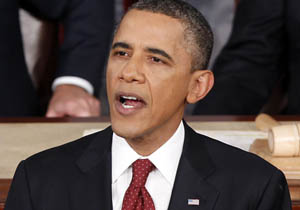
President Obama's State of the Union address, January 24, 2012

President Obama put a lot on our plate with this SOTU speech. The highlights were (1) the forceful, almost impassioned delivery early in the speech, during his invocation of the optimism and teamwork of America's post-war years, and (2) his pointed remarks at his rivals, including the following:
  • "But I intend to fight obstruction with action, and I will oppose any effort to return to the very same policies that brought on this economic crisis in the first place."
  • "Now, you can call this class warfare all you want. But asking a billionaire to pay at least as much as his secretary in taxes? Most Americans would call that common sense."
  • "The greatest blow to confidence in our economy last year didn't come from events beyond our control. It came from a debate in Washington over whether the United States would pay its bills or not. Who benefited from that fiasco?"
  • "The differences in this chamber may be too deep right now to pass a comprehensive plan to fight climate change. But there's no reason why Congress shouldn't at least set a clean energy standard that creates a market for innovation. So far, you haven't acted. Well tonight, I will."
The themes were Destiny and Teamwork and Fairness, all of which he anchored in the nation's past accomplishments. Since becoming President, Obama has summoned the past time and again in his speeches, which serves multiple ends: (1) this situates himself within American history, minimizing the foreignness and otherness attributed to him by his detractors; (2) the past offers comfort, the future is scary and unknown; (3) the past is a canvas on which he can depict values he wants to promote and call on; (4) the past also inspires confidence in our ability to achieve (largely through living and acting on the aforementioned values). In 2008, of course, he encouraged us to look ahead and, using the language of transformation to make himself a change agent in our eyes. No more of that.

Anyway, the play-by-play:
  1. President Obama opened by acknowledging military troops and the end of full engagement in Iraq; this also drew attention to his foreign policy success. Then, the first major theme: the military is exemplary, he said, because of their teamwork. He then invoked the optimism of America's post-war years, framing that generation's successes as a product of teamwork. Here he also introduced the concept of fairness, coupled by a reference to the income gap.
  2. But he left this theme for a while as he hit a litany of program initiatives: manufacturing, high tech, job training, education, higher education tuition, immigration, gender equality, and small, new businesses. This allowed him to say at least one thing that resonates with almost every listener in the audience. Here he also appeared ambitious, confident in himself and in the country's ability to meet any challenge. Optimism is key. However, he also risked losing the momentum he built early, leaving his audience restless and overwhelmed--a feeling that may ultimately have left them underwhelmed.
  3. Next, his major policy points: on energy, he touted an "all of the above" strategy; for infrastructure, he recalled America's greatest engineering achievements (Hoover dam), using them as inspiration for the troubled construction industry; he endorsed a mortgage relief plan and stronger financial regulations, mentioning the consumer watchdog he recently appointed; then on to tax policy where the hook was his "Buffet Rule", essentially providing some tax relief to lower income brackets and raising taxes for the very wealthy.
  4. Although by now he'd probably already cowed, wowed, or disgusted you, depending on your POV, he here switched gears by almost launching into his Republican rivals. But before it registered, before he risked attracting the pundits' criticism for being overly-partisan, he generalized the problem of government intransigence, offering support for an insider trading ban tailored to members of Congress. He then chastised Congress for doing nothing before, almost in the same breath, appealing to Conservatives by touting his policy initiatives that encourage "competition", less regulation, and streamlined government.
  5. Finally, he returned to foreign policy, fashioning his conclusion out of the military strike on bin Laden, the bi-partisan Executive team that ordered it, and the American flag given to him by the soldiers who carried out the mission.
Teamwork and cooperation have remained themes in his speeches as stratagems for contrasting himself with the partisanship of his rivals. Selling these themes has not gotten easier, however; Americans are used to self-identifying as independent, as individuals.

Tuesday, December 13, 2011

Race and politics

The Los Angeles Times article "One black woman's personal mission to reelect Obama" uses a couple of big economic facts to say that blacks remain faithful to the President despite their worsening economic condition. The facts lack context, however, and this larger premise is a tremendous over-simplification and it's short-sighted.

The piece profiles grassroots Obama booster Gerri Hall, a retired black woman in Flint, MI. Note the difference in values that emerges at the outset when the article comments on changes since Hall's youth:
Fifty years later, there is a black man in the White House and Hall is firmly rooted in the middle class, with a nice home in a leafy neighborhood, a pension from her 30-year job at General Motors and enough savings to help her grown son buy a starter place of his own. 
"Things have definitely gotten better," she allows, "in terms of tolerance and coexistence and people getting along."
Note that the author speaks in economic terms, whereas Hall refers to social progress. The article reflects market-oriented values, but its subject, social values.

Then the article posits that black Americans see themselves reflected in Obama as he battles Republicans: "The sentiment may explain why Obama still enjoys commanding support among African Americans, even though blacks have suffered the worst of the deep recession that soured so many others on the incumbent." And again a few paragraphs later:
The statistics are grim. The poverty rate for African American children has increased under Obama, along with black joblessness. Nationally, black unemployment was 15.5% in November, almost twice the overall rate. For black teenagers it was just under 40%. 
Even so, African Americans remain far more upbeat than the rest of the country.
The article assumes--or, more likely, plays along with the assumption--that what happens during a President's term is attributable to him. Next, the black unemployment rate is given without any historical context. What was the unemployment rate for blacks under Bush? Under Clinton? What role does Congress play in all this?

Another misdirect comes on the heels of the previous quote. The article text says:
An NBC/Wall Street Journal poll done with theGrio.com, a black-oriented website, found that 49% of African Americans felt the country was on the right track, compared with nearly 3 in 4 overall who felt otherwise. Most African Americans blamed congressional Republicans, rather than Obama, for the country's economic ills.
The article treats the tendency to blame congressional Republicans ambiguously; one could read this as a feature exclusive to the black community. What is the overall trend? Could this be a party issue rather than a race issue?

This article dumbs down the whole discussion. The author is owing to black allegiance or camaraderie what's more likely long-term developments of political power relations within areas ranging from economics to social status, and education to faith.

Continuing on the unemployment argument, the article states: "Unemployment is officially 16.5% in Flint, where fortunes soared and, for the last several decades, plummeted with the near collapse of the auto industry." Has the auto industry really collapsed? What role does outsourcing in this industry play in local (and national) unemployment? And what are the politics behind that?

The point isn't that the writer hasn't done his job. It's that readers must evaluate what they read.

I did read one line I liked for its well-writteness: "To this day, Hall has the manner of one accustomed to being in charge: her diction precise, her dress fastidious and her case for Obama outlined in PowerPoint and carefully sorted fact sheets."

Wednesday, November 30, 2011

Don't Look Back

Recently The New York Times moderate Conservative political columnist David Brooks asked readers over age 70 for a "gift":
...write a brief report on your life so far, an evaluation of what you did well, of what you did not so well and what you learned along the way. You can write this as a brief essay or divide your life into categories — career, family, faith, community, and self-knowledge — and give yourself a grade in each area.
A morbid request, I think, but people obliged. Brooks' sampling will in the end lack diversity, but so far it volunteers interesting narratives. Any pattern of self-judgement is elusive. Some writers regret disastrous decisions because of their consequences, while others disregard effects, choosing instead to emphasize the values symbolized in the decision, like courage. In all, the essays offer no real surprises. The source of greatest fulfillment and greatest regret was usually love and family. Failed marriages were a common theme, inspiring regrets, except in the case of one man who remained friends with his exes. Estranged children caused pain, while relationships with adult children bring rewards.

The current of familial autopsies denotes an irony Brooks will likely miss or ignore: His respondents don't reflect the success of moral-majority ideals Brooks would like to impart. Rather, with their multiple marriages, estranged children, and indifference (or, sometimes, bitterness) towards religion, these folks represent a reality the self-righteous can't acknowledge--that however well-meaning one may be, we all suffer personal shortcomings and from circumstances that make strict adherence to value codes all but impossible. Sometimes we fail. Sometimes we need help and second and third chances.

Brooks thinks self-reflection is valuable and not performed often enough. That's a debatable if not dubious claim. He also thinks these essays might prove a good resource for the young. Could they instead prove harmful and confusing? Seeing ourselves as subjects fit for analysis comes so naturally.

Tuesday, November 22, 2011

Science, society, and responsibility

The Time magazine editorial "Was Jared Loughner In Control of His Actions?" interests me because it addresses the issue without dumbing it down too much. The author, psychology professor Michael Gazzaniga, answers his question with both a Yes and No, but probably thinks the better answer is Yes.

Gazzaniga refers to emerging cognitive science-related research that says we are not as in control and not as rational as we like to think we are. Framed as a re-evaluation of our decision making, this conclusion has been gaining media traction, highlighted right now in discussions with and/or about economist Daniel Kahneman's book, Thinking, Fast and Slow. I see this discussion as a resurrection of Descartes' mind-body problem, but using the language of science instead of philosophy. The knowledge holders now preface their statements with something like "The research tells us ..." when really they are interpreting research, disavowing assumptions, then they're telling us.

Nevertheless, returning to the editorial, Gazzaniga tenderly leaves the recognition of responsibility to society, not science.

Tuesday, July 26, 2011

A quick review of President Obama's "Make your voice heard" speech

President Obama made excellent use of plain language during last night's speech about the budget debate. Although the use of plain language has spread through most government offices, Presidents are still expected to sound "presidential". Obama--oratorically gifted almost to a fault--managed to break through that "presidential" wall of tone momentarily early in the speech when he prefaced his apposing of two budgetary visions with this: "I won't bore you with the details of every plan or proposal". This translates as a favor to the audience; he is suddenly about to do you a favor by interrupting your evening with a summarized account of the budget debate.

Speech content was well organized. He first portrayed the deficit as everyone's problem, giving concrete examples of how it affects both private transfers of capital and monies within social programs. He then laid out the two visions that reflect the mindsets of each side of the debate: The first plan is "balanced"--like its planners. "The only reason this balanced approach isn't on its way to becoming law right now is because a significant number of Republicans in Congress are insisting on a cuts-only approach--an approach that doesn't ask the wealthiest Americans or biggest corporations to contribute anything at all." I had not heard Obama call out Republicans by party name before.

Next he recruited John Boehner and Ronald Reagan, and counted them among the balanced. I imagine he hoped this move, made only minutes before the Speaker's rebuttal, would lead some of the audience to doubt Boehner. Then Obama tried to explain the meaning and risks tied to the debt ceiling: "Understand--raising the debt ceiling does not allow Congress to spend more money." But this proved to be the low point of the speech; while his first discussion of risks concerned the debt, and this later portion of the speech covered the debt ceiling, Obama failed to differentiate the two and, as a result, sounded repetitive to me.

The President then argued against a short-term solution by saying, "Based on what we've seen these past few weeks, we know what to expect six months from now." Sure: Another ridiculous, stressful, embarrassing, frustrating, and dangerous debate. Then he appealed to American Exceptionalism: "That is no way to run the greatest country on Earth. It is a dangerous game we've never played before, and we can't afford to play it now. Not when the jobs and livelihoods of so many families are at stake. We can't allow the American people to become collateral damage to Washington's political warfare."

A common rhetorical move for politicians now is to conjure the divide between Washington and the rest of the country. And this is the only divide politicians recognize. Obama followed suit, portraying the voting public as united. He tried to tap into peoples' frustrations: "But do you know what people are fed up with most of all? They're fed up with a town where compromise has become a dirty word ... all they see is the same partisan three-ring circus here in Washington. They see leaders who can't seem to come together and do what it takes to make life just a little bit better for ordinary Americans. They are offended by that. And they should be." He never used the word Democrat; he positioned himself with bipartisan support as the familiar, allied with the fed up people, and he positioned the new Republicans as the other.

President Obama concluded with an interesting appeal: "History is scattered with the stories of those who held fast to rigid ideologies and refused to listen to those who disagreed. But those are not the Americans we remember. We remember the Americans who put country above self, and set personal grievances aside for the greater good. We remember the Americans who held this country together during its most difficult hours; who put aside pride and party to form a more perfect union."

There are two American values that seem to conflict with each other: Self-sacrifice vs. self-reliance. Each is perpetuated by its own myths, and each must be invoked carefully. Self-sacrifice surfaces during war and economic struggle: It promoted rationing during WWII, and Truman recognized later it after the German surrender: "Let us not forget, my fellow Americans, the sorrow and the heartache which today abide in the homes of so many of our neighbors -- neighbors whose most priceless possession has been rendered as a sacrifice to redeem our liberty." He followed this with his formal proclamation: "The Allied armies, through sacrifice and devotion and with God's help, have wrung from Germany a final and unconditional surrender." I don't know that this appeal translated here in the President's speech; he said, "America, after all, has always been a grand experiment in compromise". I image some Americans would not give ground on that.

Tuesday, May 03, 2011

Kids today

In The New York Times article "A Generation’s Vanity, Heard Through Lyrics", the author says that today's lyrics are a different animal from those of the past, but he stops just short of explicitly agreeing with Dr. Dewall's conclusion that “Late adolescents and college students love themselves more today than ever before". But he indicates his willingness to accept this claim by giving final say to a researcher who supports it.

At best, this study might yield a very loose hypothesis. But adopting this hypothesis requires a tremendous leap because the assumptions behind it are many. Among them are that (1) the Billboard charts accurately reflect listener demographics and (2) lyrics to popular songs reflect listeners' state of mind, thoughts, and attitudes. These two assumptions, which are chief among the many, are themselves deeply flawed.

So why give precious column space to this?

What privileged generation hasn't put subsequent generations under the spotlight and declared them immoral, worthless, and devoid of any real substance? Hey, generation who reads the NYT, it's your turn.

The article: http://www.nytimes.com/2011/04/26/science/26tier.html

Sunday, April 24, 2011

The Memory of Running by Ron McLarty

Currently reading The Memory of Running by Ron McLarty. The protagonist, Smithy Ide, loathes himself, but with an "Aw shucks" stripe. He alternates attempts at modesty with self recriminations. His intelligence and weight make his two favorite targets.

Smithy's obtuseness might reflect his stunted confidence more so than real stupidity. Time will tell, though, as he's clearly on an arc, at this point in the novel being halfway across the country on a bicycle trip.

This journey will no doubt lead him back to the skinny body he inhabited in his youth. Smithy's overweight adult body seems foreign to him. He negotiates his fat legs like they were a prosthesis and recoils at his gut as if he's found himself dressed in some sad Christmas sweater. Emotionally, he's no better off. He demonstrates zero self-awareness, often repeating things that other people say to him as if he is unsure he understood them and can't access his response.

This can be grating, in a way; Smithy's attempts to talk to Norma, a crippled neighbor woman who has lived trapped in her own house since about age ten, are nearly insufferable strings of non sequiturs, aborted statements, and long-suppressed confessions. I think these dialogs chronicling their budding love are meant to be touching. Somehow.

The book reads pretty easy but isn't all that enjoyable. Smithy operates off some deeply ingrained values and assumptions, and I wish he'd pause to consider this consciously. Anyway, holding out hope for a good twist.