Showing posts with label campaign. Show all posts
Showing posts with label campaign. Show all posts
Friday, January 25, 2019
something about "Believer: My Forty Years in Politics" by David Axelrod
David Axelrod emerged on the national political scene as Barack Obama's invaluable strategist during the 2008 campaign. After the campaign, Axelrod stayed on as Obama's senior advisor for half of the first term. He returned to the campaign trail for Obama in 2012. While these events, covered in Axelrod's memoir, Believer, are momentous, I enjoyed the beginning of Axelrod's story most of all.
When he was a child, the future strategist, born in New York City, witnessed a John F. Kennedy campaign speech. Axelrod cites that moment as a formative experience. He had caught and internalized the political optimism of the day. He recalls the experience with undiminished sincerity.
I also enjoyed his brief recount of Chicago's modern political history. This memoir also offers a little of the guilty pleasure of gossipy criticism, such as when Axelrod criticizes Elizabeth Edwards for micromanaging the 2004 presidential campaign of her husband, John.
Axelrod went to college in Chicago, then started as a journalist investigating Chicago politics and corruption. He had his own column in a city paper by age 18. Axelrod was friends with Obama long before they campaigned together, both having built careers out of Chicago politics.
Axelrod keeps the narrative moving. He could have written a whole book on just the first week in the White House, with the whole country groaning under the weight of the the financial crisis. But Axelrod gives those monumental days only the standard highlight reel. His writing is crisp, clever, and often funny. His forty-year career goes by too fast at times. He is an underrated and undervalued figure in our national politics. His enduring belief in the promise of America is precious.


Saturday, July 08, 2017
another opinion

Notes:
- At issue is the scope of presidential power over the border. The Supreme Court has allowed parts of President Trump's travel ban to go into effect and will hear oral arguments on the case this fall.
- The "he did not mean it" argument was once part of the legal defense.
- Every previous President made an empty promise.
Saturday, April 22, 2017
something about "I Should Be Dead: My Life Surviving Politics, TV, and Addiction" by Bob Beckel

Note: I was hoping for more of a political memoir.
Monday, February 20, 2017

Thursday, November 08, 2012
This you already know
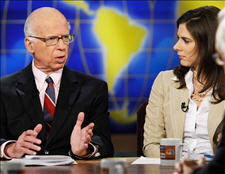

Pre-election coverage foregrounds and makes estimations. The pundit sits in the middle of a mass of cross-talk, intercepting, expounding and proliferating meanings within the discourse that flows between and among candidates and the audience. In this analysis, the audience is parsed, filtered, separated out into segments that each have their own traits and values that call for individualized treatment from the candidates.
Then, after the big night, post-election coverage sets about interpreting new, limited sets of meanings, and projects them into the near and distant future. This analysis diagnoses the population using the tools of cohesion and normalization. The segments of people are recognized as key segments, but their numbers add up to a whole.
All this coverage depicts a scene in which, prior to election day, the candidates' message descends and swirls down within the electorate. Post-election, the message is sent from below, up to the risers on which sit the podiums and punditry chairs.
Who is the pundit? Who is qualified to be a pundit? Generally, a pundit must be someone who either (1) practices journalism for a publication of certain status, (2) someone who previously held a high-ish public office, or (3) someone who attained some celebrity while incorporated in a political campaign or party. As currently used, the word "pundit" appears to be a term of soft derision that depersonalizes the speaker, and casts them as coincidentally filling a seat that could be filled by so many. To call someone a pundit is to say, "Take their words with a grain of salt". In effect, this can serve to disqualify them while situating them within a dysfunctional machine.
But we have different kinds of pundits who serve different functions. Some speak for voters and are allegiant to one side. Others attempt to refocus, summarize, and speak of political events, trends, and developments when prompted. And now there is an elite.
First in 2008 but more so in 2012, Nate Silver of 538 emerged from the pundit crowd. The left has endowed him with a version of the Author function. His predictions (which cannot account for the unpredictable) draw credibility both from his name and from the nameless science purportedly behind him. The author name means nothing on a scientific paper; but Silver's work has his name, and seems to live on the weight of his name and on the namelessness of his numbers.
Notes:
In the middle of his victory speech, Obama, in his general, high rhetorical way, espoused a a key principal and belief that undergirds whatever his political philosophy is:
America’s never been about what can be done for us. It’s about what can be done by us together through the hard and frustrating, but necessary work of self-government. That’s the principle we were founded on.
This country has more wealth than any nation, but that’s not what makes us rich. We have the most powerful military in history, but that’s not what makes us strong. Our universities, our culture are all the envy of the world, but that’s not what keeps the world coming to our shores.
What makes America exceptional are the bonds that hold together the most diverse nation on earth. The belief that our destiny is shared; that this country only works when we accept certain obligations to one another and to future generations. The freedom which so many Americans have fought for and died for come with responsibilities as well as rights. And among those are love and charity and duty and patriotism. That’s what makes America great.
Wednesday, January 25, 2012
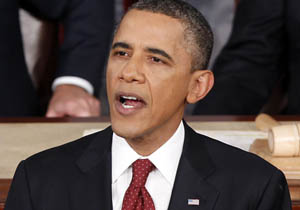
President Obama's State of the Union address, January 24, 2012
President Obama put a lot on our plate with this SOTU speech. The highlights were (1) the forceful, almost impassioned delivery early in the speech, during his invocation of the optimism and teamwork of America's post-war years, and (2) his pointed remarks at his rivals, including the following:
Anyway, the play-by-play:
- "But I intend to fight obstruction with action, and I will oppose any effort to return to the very same policies that brought on this economic crisis in the first place."
- "Now, you can call this class warfare all you want. But asking a billionaire to pay at least as much as his secretary in taxes? Most Americans would call that common sense."
- "The greatest blow to confidence in our economy last year didn't come from events beyond our control. It came from a debate in Washington over whether the United States would pay its bills or not. Who benefited from that fiasco?"
- "The differences in this chamber may be too deep right now to pass a comprehensive plan to fight climate change. But there's no reason why Congress shouldn't at least set a clean energy standard that creates a market for innovation. So far, you haven't acted. Well tonight, I will."
Anyway, the play-by-play:
- President Obama opened by acknowledging military troops and the end of full engagement in Iraq; this also drew attention to his foreign policy success. Then, the first major theme: the military is exemplary, he said, because of their teamwork. He then invoked the optimism of America's post-war years, framing that generation's successes as a product of teamwork. Here he also introduced the concept of fairness, coupled by a reference to the income gap.
- But he left this theme for a while as he hit a litany of program initiatives: manufacturing, high tech, job training, education, higher education tuition, immigration, gender equality, and small, new businesses. This allowed him to say at least one thing that resonates with almost every listener in the audience. Here he also appeared ambitious, confident in himself and in the country's ability to meet any challenge. Optimism is key. However, he also risked losing the momentum he built early, leaving his audience restless and overwhelmed--a feeling that may ultimately have left them underwhelmed.
- Next, his major policy points: on energy, he touted an "all of the above" strategy; for infrastructure, he recalled America's greatest engineering achievements (Hoover dam), using them as inspiration for the troubled construction industry; he endorsed a mortgage relief plan and stronger financial regulations, mentioning the consumer watchdog he recently appointed; then on to tax policy where the hook was his "Buffet Rule", essentially providing some tax relief to lower income brackets and raising taxes for the very wealthy.
- Although by now he'd probably already cowed, wowed, or disgusted you, depending on your POV, he here switched gears by almost launching into his Republican rivals. But before it registered, before he risked attracting the pundits' criticism for being overly-partisan, he generalized the problem of government intransigence, offering support for an insider trading ban tailored to members of Congress. He then chastised Congress for doing nothing before, almost in the same breath, appealing to Conservatives by touting his policy initiatives that encourage "competition", less regulation, and streamlined government.
- Finally, he returned to foreign policy, fashioning his conclusion out of the military strike on bin Laden, the bi-partisan Executive team that ordered it, and the American flag given to him by the soldiers who carried out the mission.
Saturday, January 21, 2012
We all were appalled
Right off, last night CNN's Republican debate moderator John King asked Newt Gingrich about his ex-wife's new claim that he asked for an open marriage. Newt answered,
 Despite his admitting to having a weak imagination, this morning's coverage calls Newt's reply brilliantly calculated. What made it a hit was not so much Newt's words but rather (1) the timing of the exchange, (2) Newt's delivery, (3) King's freezing up, and (4) the audience's enthusiasm.
No doubt King thought his opening rhetorical situation a golden opportunity; he hoped to start with fireworks, embarrassing Newt by capitalizing on the big ABC tabloid interview with the ex-wife. But doing so created an even bigger rhetorical situation for Newt, one he seized with his customary bluster by rejecting the question on moral grounds. That he got to do so right in the beginning, at the moment when anticipation and energy were peaking and ratings were highest, only magnified the exchange and created an immediate emotional outlet for the audience, who cheered Newt on as he chastised the media, the moderator.
Here we have a politician who publicly preaches values, from the party that owns family values, caught violating those values, claiming that he is morally above public inquiry into his values and his personal life.
The hypocrisy is plain as day, yet King fumbles on the opportunity, and Gingrich looks brilliant because he gets away with it.
Gingrich holds aloft his righteousness in his staccatoed indignation. He summons the dignity of the moment--a Presidential debate (a Primary debate)--a dignity due to such an event in abstraction, but not often felt in practice.
King could have countered along another route: Gingrich faults "the destructive, vicious, negative nature of much of the news media" while enjoying the destructive, vicious, negative nature of attacks hurled at candidate Romney by him and his Super PAC.
All this aside, what to make of Gingrich's appeal to "personal pain"? What pain? The pain of the divorce? And whose pain? His? The ex-wife's?
The answers don't matter. What matters is, What does the pain speak of? I'd venture that, for Gingrich, "pain" in this context is the pain we inflict and feel ourselves when confronted by personal failings. Gingrich has them in spades, but a candidate can't say so. Instead, "pain" is a code, a signifier of the unspeakable. Pain communicates to us without words and carries its own meaning. I'd venture further and say most his audience understands this, personal failings, even if they don't know it.
And if I'm right about what Gingrich is saying, I'd be tempted to see this as a product of his recent conversion to Catholicism, as his statement has in it an element of Confession.
I think the destructive, vicious, negative nature of much of the news media makes it harder to govern this country, harder to attract decent people to run for public office. And I am appalled that you would begin a presidential debate on a topic like that. Every person in here knows personal pain. Every person in here has had someone close to them go through personal things. To take an ex-wife, and make it two days before the Primary, a significant question in a Presidential campaign, is as close to despicable as anything I can imagine.
No doubt King thought his opening rhetorical situation a golden opportunity; he hoped to start with fireworks, embarrassing Newt by capitalizing on the big ABC tabloid interview with the ex-wife. But doing so created an even bigger rhetorical situation for Newt, one he seized with his customary bluster by rejecting the question on moral grounds. That he got to do so right in the beginning, at the moment when anticipation and energy were peaking and ratings were highest, only magnified the exchange and created an immediate emotional outlet for the audience, who cheered Newt on as he chastised the media, the moderator.
Here we have a politician who publicly preaches values, from the party that owns family values, caught violating those values, claiming that he is morally above public inquiry into his values and his personal life.
The hypocrisy is plain as day, yet King fumbles on the opportunity, and Gingrich looks brilliant because he gets away with it.
Gingrich holds aloft his righteousness in his staccatoed indignation. He summons the dignity of the moment--a Presidential debate (a Primary debate)--a dignity due to such an event in abstraction, but not often felt in practice.
King could have countered along another route: Gingrich faults "the destructive, vicious, negative nature of much of the news media" while enjoying the destructive, vicious, negative nature of attacks hurled at candidate Romney by him and his Super PAC.
All this aside, what to make of Gingrich's appeal to "personal pain"? What pain? The pain of the divorce? And whose pain? His? The ex-wife's?
The answers don't matter. What matters is, What does the pain speak of? I'd venture that, for Gingrich, "pain" in this context is the pain we inflict and feel ourselves when confronted by personal failings. Gingrich has them in spades, but a candidate can't say so. Instead, "pain" is a code, a signifier of the unspeakable. Pain communicates to us without words and carries its own meaning. I'd venture further and say most his audience understands this, personal failings, even if they don't know it.
And if I'm right about what Gingrich is saying, I'd be tempted to see this as a product of his recent conversion to Catholicism, as his statement has in it an element of Confession.
Thursday, January 05, 2012
The substance of style
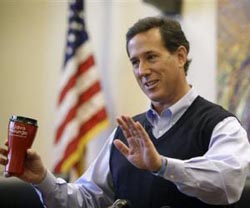 The New York Times article "Sleeveless and V-Necked, Santorum’s Sweaters Are Turning Heads" notes a recent meme from the Republican campaign: Rick Santorum's sweaters. Here, the candidate's fashion is playfully called the "sensible, traditional choice of grandfathers and college football coaches". I think this as astute an observation as any made about the campaign so far.
The larger discussion here is about image--Santorum's self-image, the image he has of his perspective supporter, and the self-image of that supporter. The Santorum staff's enthusiasm for the sweater is not entirely in jest; the sweater vest is indicative of their message and target audience.
As the last standing hardline social conservative in the field, Santorum appeals to swaths of mature voters ("grandfathers") and strict disciplinarians ("football coaches")--disciplinarians in the sense that these people emphasize self-discipline as key to one's ability to support oneself and manage life's affairs. This is the person who most heartily nods in agreement while reading the Forbes article "If I Were A Poor Black Kid"; his appreciation for discipline shows in his brand of faith, his military support, his politics, and many of his habits and much of his work. The "football coach" conjures many other qualities and values attributable to Santorum's perspective supporter.
But what about the other candidates' images?:
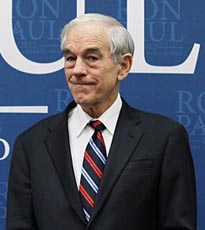
Mr. Santorum’s rivals are biased toward sleeves. Mitt Romney likes his crisply pressed oxford shirts, often under a blazer. Ron Paul is partial to suits, albeit ill-fitting ones. And Michele Bachmann, who has said her fashion icons are Jacqueline Kennedy Onassis and Audrey Hepburn, is almost always carefully turned out ...
 Romney messages about the economy, and he appeals to fiscal conservatives. Members in this crowd see themselves primarily as responsible, business-minded people ready for wealth and status. With his style, Romney communicates this economy of success, but opts for business casual over suits so as to appear accessible, his elbows ready to rub.
Besides being one of the few options left to a man his age, Ron Paul's suits reflect his own desire to be taken seriously. Afterall, what else is a suit but a man hoping to be taken seriously? Ditto for Michele Bachmann, more or less, although I vaguely recall reading she wore only dresses or skirts at public appearances which, if so, would communicate a traditional brand of femininity, a servile sort as opposed to the "bossy" pant suits of Hillary Clinton.
Thinking back to Barack Obama's campaign, seems like he adopted several looks, even allowing/releasing photos of his basketball practice. Perhaps he welcomed being seen in a variety of ways, sending the message that he is a dynamic (young) candidate.
Thursday, September 08, 2011
Another transcript
 The New York Times piece Huntsman Warns That GOP Can't Win the White House by Denying Climate Science offers only a summarized transcript of environment-related content spoken during last night's Republican debate. This pointless article quotes a bold assertion by Huntsman, then makes no attempt at verifying his figure. Unbelievable. Here is the only authentic moment from the debate--a potentially historically significant moment in the evolution of the GOP--starring Huntsman and left alone by the NYT:
When you make comments that fly in the face of 98 out of 100 climate scientists, to call into question the science of evolution, all I am saying is that in order for the Republican Party to win, we can't run from science ... By making comments that basically don't reflect the reality of the situation, we turn people off.
Subscribe to:
Posts (Atom)