Showing posts with label style. Show all posts

Saturday, April 26, 2025

someone else's *good* poem

Bringing My Son to the Police Station to be Fingerprinted
—Shoshauna Shy

My lemon-colored
whisper-weight blouse
with keyhole closure
and sweetheart neckline is tucked
into a pastel silhouette skirt
with side-slit vents
and triplicate pleats
when I realize in the sunlight
through the windshield
that the cool yellow of this blouse clashes
with the buttermilk heather in my skirt
which makes me slightly queasy
however

the periwinkle in the pattern on the sash
is sufficiently echoed by the twill uppers
of my buckle-snug sandals
while the accents on my purse
pick up the pink
in the button stitches

and then as we pass
through Weapons Check
it's reassuring to note
how the yellows momentarily mesh
and make an overall pleasing
composite

Saturday, May 13, 2023

character idea number 8

Vain Dad. He dresses trendily. Tailored fits. Wears noticeably thick-rimmed glasses. Head shaved to the part. Tries hip activities with his average, comfortable son, like riding "public" electric scooters and shouting out because it's so fun.


Saturday, October 29, 2016

About being capable of feeling great affection


I hate everything about the way this guy looks: the golf shirt tucked into his "nice jeans," leaving just enough give to hip-swivel 20 degrees (engineered and tested before leaving the house); his low-profile sunglasses; and his perma-shape pompadour, three shades above black, a bubble blown from a sharp part. This turd aspires to fitness without strain. Jeremy. Jeremy thinks calling his boss "boss" boosts his ego, and Jeremy likes exercising that little bit of control over his superior's emotions. Doing so also, he thinks, curries favor.


Thursday, January 05, 2012

The substance of style

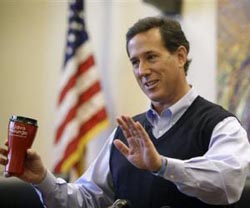
The New York Times article "Sleeveless and V-Necked, Santorum’s Sweaters Are Turning Heads" notes a recent meme from the Republican campaign: Rick Santorum's sweaters. Here, the candidate's fashion is playfully called the "sensible, traditional choice of grandfathers and college football coaches". I think this as astute an observation as any made about the campaign so far.

The larger discussion here is about image--Santorum's self-image, the image he has of his perspective supporter, and the self-image of that supporter. The Santorum staff's enthusiasm for the sweater is not entirely in jest; the sweater vest is indicative of their message and target audience.

As the last standing hardline social conservative in the field, Santorum appeals to swaths of mature voters ("grandfathers") and strict disciplinarians ("football coaches")--disciplinarians in the sense that these people emphasize self-discipline as key to one's ability to support oneself and manage life's affairs. This is the person who most heartily nods in agreement while reading the Forbes article "If I Were A Poor Black Kid"; his appreciation for discipline shows in his brand of faith, his military support, his politics, and many of his habits and much of his work. The "football coach" conjures many other qualities and values attributable to Santorum's perspective supporter.

But what about the other candidates' images?:
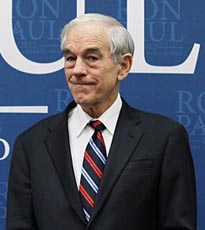
Mr. Santorum’s rivals are biased toward sleeves. Mitt Romney likes his crisply pressed oxford shirts, often under a blazer. Ron Paul is partial to suits, albeit ill-fitting ones. And Michele Bachmann, who has said her fashion icons are Jacqueline Kennedy Onassis and Audrey Hepburn, is almost always carefully turned out ...
Romney messages about the economy, and he appeals to fiscal conservatives. Members in this crowd see themselves primarily as responsible, business-minded people ready for wealth and status. With his style, Romney communicates this economy of success, but opts for business casual over suits so as to appear accessible, his elbows ready to rub.

Besides being one of the few options left to a man his age, Ron Paul's suits reflect his own desire to be taken seriously. Afterall, what else is a suit but a man hoping to be taken seriously? Ditto for Michele Bachmann, more or less, although I vaguely recall reading she wore only dresses or skirts at public appearances which, if so, would communicate a traditional brand of femininity, a servile sort as opposed to the "bossy" pant suits of Hillary Clinton.

Thinking back to Barack Obama's campaign, seems like he adopted several looks, even allowing/releasing photos of his basketball practice. Perhaps he welcomed being seen in a variety of ways, sending the message that he is a dynamic (young) candidate.

Thursday, December 15, 2011

The times, they are a-changin'

In the Vanity Fair piece "You Say You Want a Devolution?", Kurt Anderson argues that fashion and design--art, music, movies, television, clothes, cars, etc.--looks much the same as it did 20 years ago. This fashion freeze is our collective response, Anderson offers, to the unparalleled rapidity of change in other areas such as economics and technology.

It's an interesting thesis. Well argued and written, too. But to totally buy into his idea, you have to share Anderson's vision: Anderson sees fashion as a collective bundle of popular trends, and the evolution of these trends looks something like a line on a graph surging upward as trends continue evolving. Over the last 20 years, though, that line has leveled off, according to his view.

This picture needs complicating, so I suggest an alternative model.

First, sticking with our graph: I think fashion includes at least a few lines, not just one, that have historically surged upward. And rather than leveling off, I see these lines splintering over last 20 years--even more so the last ten--as social groups subdivide into ever smaller subcultures of like-minded people.

While most of these lines keep trending upward over time, in my splintered model there could indeed exist some mainstream line hovering between and below these subcultures--a mainline that appears to level off and soldier on. But rather than see this grouping as having stagnated, it could be they just dropped their fidelity to fashion altogether. In this sense, their line simply stops. For them--the designers and the consumers--fashion has moved from the aesthetic realm to the political. (Note that fashion continues to demarcate affiliations.)

What the mainstream wears and what they listen to means less (or at least means something different) to them now than it did 20 years ago. So, for example, if you wore a new pair of Nike sneakers in 1993, you were saying something: Nike was synonymous with Michael Jordan and basketball supremacy, and the label was expensive so a new pair of kicks was a sign of status. If you're wearing a new pair of Nike shoes today, it's probably because your old ones wore out. More likely you wear New Balance because you've chosen comfort and practicality--the politics of personal choice--over glamour and status--the fidelity to fashion.

Anderson too briefly discusses changes in how we consume fashion. He's right here, of course, but doesn't take it far enough. He says,
The only thing that has changed fundamentally and dramatically about stylish objects (computerized gadgets aside) during the last 20 years is the same thing that’s changed fundamentally and dramatically about movies and books and music—how they’re produced and distributed, not how they look and feel and sound, not what they are.
Yes, technologically production, distribution, and consumption has changed. But these facets have changed in meaning, too. How and what we make and consume is now a political matter: Toyota Prius or Hummer? File sharing and torrents or iTunes? Walmart, Whole Foods, or local?

-Other Notes:
  • Anderson noted the tendency towards nostalgia one minute and then pointed to the outright freeze on design the next. This muddled his point. But his words ring clearly when he hypothesizes about the institutional and market forces at work.
  • Certainly not all but many successful artists (designers, trend setters) from all fields in every age have kept an eye on the past. Designers and architects who worked in the Georgian period of the 18th century drew from the Classical Age just as their descendants in the age of Art Deco did in the 1930s.
  • In the 1990's we referenced the 1970's. Right now (2011) the 1980's seem popular; the post-hippie feel of the Grunge era has been replaced by the post-New Wave kids of today.
  • There is nothing totally new under the sun.