Showing posts with label image. Show all posts

Saturday, April 26, 2025

someone else's *good* poem

Bringing My Son to the Police Station to be Fingerprinted
—Shoshauna Shy

My lemon-colored
whisper-weight blouse
with keyhole closure
and sweetheart neckline is tucked
into a pastel silhouette skirt
with side-slit vents
and triplicate pleats
when I realize in the sunlight
through the windshield
that the cool yellow of this blouse clashes
with the buttermilk heather in my skirt
which makes me slightly queasy
however

the periwinkle in the pattern on the sash
is sufficiently echoed by the twill uppers
of my buckle-snug sandals
while the accents on my purse
pick up the pink
in the button stitches

and then as we pass
through Weapons Check
it's reassuring to note
how the yellows momentarily mesh
and make an overall pleasing
composite

Friday, October 27, 2017

Friday, August 12, 2016

about Michael Phelps


The image of the most decorated Olympian of all time has shifted.

Michael Phelps arrived on the world stage after winning six gold medals at the 2004 Summer Olympics in Athens, Greece. The spotlight on him intensified as he won a record eight gold medals in Beijing in 2008.

The image of Phelps formed at these games was filtered through the all-American-making lens of Olympic US media coverage. But the caricature folded into the coverage inadvertently mirrored
the contentious view of America--that of a voracious consumer (commentators marveled at Phelps' caloric intake--they almost celebrated it) and a spectacle of industrial scale and dumb dominance, owing much of its success (measured in number of medals accrued) more to physicality than character.

But this time around, in the 2016 Summer Olympics in Rio de Janeiro, Phelps has helped to build a new identity. Now he is someone who appears to be dominant when challenged
, and in the absence of challengers, is continually engaged in a struggle within.


Notes:
  • Obviously people in the public spotlight will get covered and depicted in a variety of ways in different venues. But I have been finding rhetoric in media coverage and the formation of conventional views extremely interesting lately.
  • The "contentious" perception of America described above is sometimes voiced by people in politically left-leaning circles. The attributes listed are only interpretive.
  • "I'm about to make history ..."


    Friday, October 18, 2013

    about "Believing Is Seeing" by Errol Morris


    In Believing Is Seeing, Errol Morris investigates our relationship with photos--how we view them and what they mean to us. He uses several well-known photographs to flesh out some solid insights. One of the first insights is that we tend to look for motivations in a picture. What was the photographer trying to say? What is the guilt or innocence of the person in the picture? But Morris dismisses such attempts to infer anything beyond what the picture shows. Photos, he says, merely record data. But because we privilege vision, we imagine that photos provide a door to the truth. And in our imagining, we make false inferences and draw hasty, faulty conclusions.

    Morris also questions and ultimately dismisses the idea that posed photos cannot serve as documentation and are inauthentic; the fact that something is always excluded from view (intentionally or not) while other things are included means that all pictures are posed to some degree. (This vein of discussion mirrors parts of modern rhetorical theory.)

    Most of Believing Is Seeing is a super interesting read. My only complaint is that Morris strayed too far into the weeds in the last section when he forensically examines a set of documentary photos and their related documentation from public works projects of the Depression. 


    Note:
    The book's full title is Believing Is Seeing: Observations On the Mysteries of Photography.


    Tuesday, August 14, 2012

    About a Dostoevsky short story


    In Fyodor Dostoevsky's short story, "A Disgraceful Affair", we're introduced to a hoity-toity General having drinks with his buddies and running his mouth about how Russia will thrive in an age of what he calls "idealism". That, he imagines, is everyone respecting and caring for one another regardless of class. After one too many, he starts for home. Finding that his coachman isn't there waiting for him, he cusses a storm and forgoes a cab, content to hoof it all the way, mostly to spite his missing servant.
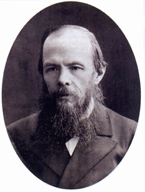
    While straying through the ghetto he passes one of his lowly, wretched clerk's wedding receptions. The stewed General daydreams about classing up the party with his presence, in the process blowing everyone's mind with what a kindly superior human being he is. Sounds like a plan, so he stumbles in and, after the initial awkwardness, he settles himself, and even sees a few other underlings in attendance. But soon he is swilling vodka and champagne until he finally gets too drunk and passes out. But not until after making an ass of himself, rambling about idealism and spitting all the time.

    At this point we learn the groom--the lowly clerk--shoulders all kinds of misery in his quest to make his way.

    Anyway, the party breaks up, and the General thrashes and pukes a little until finally an old boarder woman assumes the job of cleaning him up. In the process, the General promptly sobers up enough to hightail it home where he stays in bed for eight days, laid out with a bad case of humiliation.

    On the ninth day, no longer able to bear not knowing how much he's damaged his reputation, the General returns to the office where he finds, to his amazement, that nothing appears to have changed!

    At the story's end, we find the General sitting pretty in his office, reflecting on the fact that, not only will he come through with reputation intact, but he's had a pretty awesome productive day to boot. Just then another clerk enters with the day's final paperwork and a transfer request from the new groom. Rather than grant the transfer immediately, the General actually says he'll forgive the young man. At this news, the clerk blushes and excuses himself. This inspires in the General the greatest wound, as
    He felt more shame, more heaviness at heart, than he had experienced even during the most unbearable moments of his eight days of illness.
    "I have failed to live up to my own ideals!" he said to himself, and sank into his chair--helpless.
    I see this conclusion at least two ways: (1) I think there's a triple move there, a series of realizations: first, the General realizes his reputation is shot; second, he realizes that, by party crashing, he only added to the groom-clerk's misery, of which, until then, he had been completely unaware; and third, he realizes that, just now, at the moment when he could have spared the injured groom-clerk the insult of having to work for such a cruel boss, he instead chose to humor the prideful delusions of his own reputation. Or, (2) the General remains oblivious to the sufferings of the inferior folk, and is concerned with his own problems.


    Notes:
    • I told this guy at work about Dostoevsky's life and themes and he said it sounds like "Tales from the Hood" but earlier. An awesome comparison. But "Tales from the Hood" somehow seems like an older reference point than Dostoevsky does.

    Thursday, June 21, 2012

    Billy Corgan on Billy Corgan and music today


    Billy Corgan has caught a little hell for talking shit about Radiohead. But now, having read what he said in this interview, I think folks have misunderstood him. Here is the controversial part (parentheses mine):
    From ’89 on I’ve had people tell me who I am. And they pick my personality as if it’s a one or two-dimensional thing, and I’m more like a tetrahedron. I can’t think of any people outside of Weird Al Yankovic who have both embraced and pissed on Rock more than I have. Obviously there’s a level of reverence, but there’s also a level of intelligence to even know what to piss on. ‘Cause I’m not pissing on Rainbow. I’m not pissing on Deep Purple. But I’ll piss on fuckin’ Radiohead, because of all this pomposity. This value system that says Jonny Greenwood (Radiohead) is more valuable than Ritchie Blackmore (Deep Purple). Not in the world I grew up in, buddy. Not in the world I grew up in. 
    So I find myself defending things. Is Ritchie Blackmore a better guitar player than me and Jonny Greenwood? Yes. Have we all made contributions? Yes. I’m not attacking that. I’m attacking the pomposity that says this is more valuable than that. I’m sick of that.
    I don't think Corgan is attacking Radiohead. He's using them as an example of a popular band that critics deify while trashing other artists, himself in particular. The "pomposity" is the pompousness of critics who fawn over select bands and citicize those whom its safe to criticize. Corgan's predictably irreverent response would be to "piss on fuckin’ Radiohead" because no one else will--not because Radiohead deserves to be pissed on.

    In answering a different question, Corgan expands on this:
    Look, we’re all insecure in our own ways, most of us. You’ve got a Facebook with a few hundred friends. If you do something truly radical, are you ready to withstand the forty negative comments? Most people aren’t. So they’re getting peer pressured at levels they don’t even realize. It’s what you don’t say. 
    It’s like the government spying on us. Right? Now it becomes about what we don’t say. The same thing with culture. I’m just willing to say it, and deal with the forty negative comments.
    To the extent that anything can be interesting, Corgan sort of can be because he's a bit of a paradox. He's trying to be a rock star but he thinks we have none, can have none, and that it's pointless and vain. As he did during the 90's early alt-rock scene, he's the champion of zeroes and outcasts because he is not accepted as cool (anymore); but he's also the antithesis of that guy because he makes a spectacle of himself by dating porn whores, shaving his head, saying inflammatory crap and whatnot. This paradox is him now.

    He approaches all this later in this same interview:
    And the funny thing is that I’ve been playing with conceptual identities all along. And I’ve watched each turn, as I’ve adapted to each cultural identity, how I’m attacked for not being this or that, or too much of this or too little of that. Meanwhile the real me is standing behind it all noting where the deflector shield works and where it doesn’t. And what gets through. Now I’m actually strong enough where I don’t need a mask. I’m just myself.
    And then he brings this back to the original point--that he gets criticized unfairly (unfair because the playing field isn't even):
    Well what I’m saying is rather than be celebrated as a radical who’s continually subverted the system and turned his back on much greater commercial realities than I’ve embraced, I’m celebrated as this fucking weirdo who just won’t go away!
    Is he an ass? Oh yeah. And maybe he's wrong, too, but he might as well be understood before he gets shit on for being so.

    Sunday, April 29, 2012

    Sunday, October 30, 2011

    A thing on the film Lars and the Real Girl

    Socializing hurts Lars, but through a co-worker he learns of a website that sells life-like sex dolls, so he orders one and, upon her arrival, makes her his girlfriend. To him, she poses no threat. She can be his creation, and from her he creates a saintly Brazilian missionary immigrant named Bianca who, being wheelchair-bound and having a limited understanding of English, is completely dependent upon him.

    But soon other townsfolk co-opt his creation, and they make Bianca more dynamic, resourceful, and, eventually, independent. Lars originally used Bianca to approximate intimacy; with her he could relate to the world the way he wanted to be related to--with patience and sensitivity, without possibility of rejection. But suddenly realizing he is no longer Bianca's only connection to this world, thereby feeling rejected, Lars defiantly sets out building connections of his own by going out with a young lady he works with. From there, we put Lars on the road to deliverance from the prison of his inhibitions.

    The movie feels sweet, but underneath is a careful power struggle between Lars and the town. Lars' truth is dubbed a delusion, and soon others' truths are being imposed from all sides until Lars, having lost control of his creation, announces that Bianca has died--a final and dramatic act of self empowerment. What is it exactly that either pushes or inspires Lars to change, to conform to the town's normalizing desire for him to be more social?