Showing posts with label character. Show all posts

Saturday, September 20, 2025

(posts) Romans 5:3-4

3 And not only so, but we glory in tribulations also: knowing that tribulations worketh patience;
4 And patience, experience; and experience, hope

Notes:

Google's AI search overview offers this summary of the verses: "Christians can rejoice in their sufferings because suffering produces perseverance, which in turn produces character, and character produces hope."

How does character produce hope? For that matter, how does experience? Experience producing hope I can sort of see.

Follow-up questions led the AI thing to say that the King James Version (KJV) uses "experience." Another follow-up led to this portion of a longer response: 

"Experience" in 1611 English: While the word "character" might be the most common single word to translate "dokime" today, the KJV translators used "experience" in a way that captured the sense of proven worth and the outcome of enduring trials, which was common in their time. It conveyed the idea that through patiently borne afflictions, a Christian gains a deeper knowledge and assurance of God's faithfulness and their own sincerity. 


Saturday, June 04, 2022

something or other


There are worlds on Earth he can never know—like a world in which his wife has a strong Christian faith and offers him her loving arms.
 

Saturday, June 06, 2015

Children


There is nothing more atrociously cruel than an adored child.
—Vladimir Nabokov, Lolita

Wednesday, November 27, 2013

something about the movie "Gravity"


The film "Gravity" offers a movie-going experience. Yes, the visuals stun and inspire. But it's more than beauty that makes us submit. The story is simple but the action engrossing; and the protagonist is uncomplicated--a supple mirror in which we replace the image with ourselves. So we fret and ease along with her as the film creates the illusion of time alternately speeding up and then crawling; it does so with the sounds of breathing, of heartbeats, of blinking lights, watches, and faceless monitors that beep out the pace, switching from measured rhythms to urgent, pleading buzzes. And when we finally reach the moment when we can pause and consider all that just happened, we're left with a sense of wonder--not just of the vastness of the universe, but the resilience of the human spirit. Now, this human spirit stuff is a sort of hackneyed theme and an easy payoff for the writers but it works okay here.


Notes:
  • Highly recommend seeing this in 3D.
  • In an academic setting, one could argue that this movie conveys Heideggerian themes. 
  • This does not say anything to spoil.


Thursday, November 17, 2011

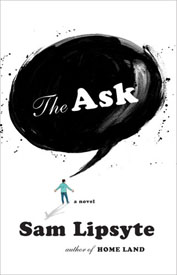
Something on The Ask

His wife cheats on him, he lacks the requisite affection for his own son, his employment as development officer at a third-tier university was recently terminated for bad behavior, and he's aging badly, quickly: Milo is a sad, bitter man. This unfit protagonist of The Ask knows his own insufferability, describing himself as the unsympathetic lead in some bad novel. But author Sam Lipsyte's rendering of Milo's self-loathing loserhood disarms the reader just enough, bypassing our hostility on a bridge of rickety empathy.

After college, Milo quickly traded in his aspirations in the art world for a rat-race life of quiet desperation and loud disappointment. His opposite is his estranged college buddy, Purdy, who's now a wealthy, enviable man whose stock has only risen since graduation. The memory of Purdy seems to figure in whenever Milo takes stock of his own failure. But Purdy does have one spot on his record: A son he didn't know he had and now wants to hide. The son turns out to be twice as bitter and resentful as Milo, and for better reason.

To those of us quick to blame others, the narrative encourages turning that critical eye inward, and taking a break from the self-hating and social criticism long enough to appreciate what we do have, which is often more than first imagined. If the novel has a point, that may be it. The Ask reads quickly but has a lot of flaws: Barely tolerable characters, a drawn-out plot structure, some unclear resolution points, and the author frequently employs one affected choice of syntax that bothered the hell out of me.

Sunday, October 30, 2011

A thing on the film Lars and the Real Girl

Socializing hurts Lars, but through a co-worker he learns of a website that sells life-like sex dolls, so he orders one and, upon her arrival, makes her his girlfriend. To him, she poses no threat. She can be his creation, and from her he creates a saintly Brazilian missionary immigrant named Bianca who, being wheelchair-bound and having a limited understanding of English, is completely dependent upon him.

But soon other townsfolk co-opt his creation, and they make Bianca more dynamic, resourceful, and, eventually, independent. Lars originally used Bianca to approximate intimacy; with her he could relate to the world the way he wanted to be related to--with patience and sensitivity, without possibility of rejection. But suddenly realizing he is no longer Bianca's only connection to this world, thereby feeling rejected, Lars defiantly sets out building connections of his own by going out with a young lady he works with. From there, we put Lars on the road to deliverance from the prison of his inhibitions.

The movie feels sweet, but underneath is a careful power struggle between Lars and the town. Lars' truth is dubbed a delusion, and soon others' truths are being imposed from all sides until Lars, having lost control of his creation, announces that Bianca has died--a final and dramatic act of self empowerment. What is it exactly that either pushes or inspires Lars to change, to conform to the town's normalizing desire for him to be more social?

Wednesday, October 19, 2011

Broken Flowers

In the film "Broken Flowers", Bill Murray plays Don Johnston. I'd guess that Murray's motivation when he plays Don is that he has no motivation at all. The woman leaving him in the film's opening describes Don as an over-the-hill Don Juan, but what's so Don Juan about him, we can't tell. Rather than impassioned and hungry, this aging man is listless and indifferent.

The stoical plot of "Broken Flowers" begins when an anonymous letter informs Don that he has a 19 year-old son who may be looking for him. This revelation leads Don's amateur sleuth neighbor to map out a quest to identify the mother. So Don reluctantly accepts this mission. On his road trip, Don reunites briefly with four women who may have sent the letter. They are his unknowing suspects; Don is their detached inquisitor. These women all respond differently: The first with familiar affection, the next with frigid nervousness, another with distanced suspicion, and the last with outward aggression. None of these encounters leads Don to identify the mother. But once back again in his home town, Don spots a young man loitering first at the bus station, then outside the diner where Don lunches. Don approaches the stranger for an impromptu sit down which ends with Don embarrassing himself and frightening off the apparently wrong young man. It may be that Don never chose to be a confirmed bachelor. It may be that he never chose anything at all. He simply stopped developing but kept being. When the film ends, we can wonder if Don has been stirred again, or we might think this fruitless search has only affirmed his negation. But wait--a strange happening just before the credits only deepens the uncertainty.

Other interpretations: (1) The amateur sleuth neighbor represents the seeker; he is one who searches for Truth. Don is the skeptic, a slightly cynical denier of Truth. But, when Don is faced with the possibility of Truth he reaches out to take hold of it, wanting. But what does it mean that Truth evades him? (2) Another interpretation (my preference): The amateur sleuth neighbor represents the person compelled to exercise power, to subject the world to his gaze and prescribe truths, thereby creating knowledge he uses as he wishes. Don neither wishes to exercise power and refuses to have power exercised on him. When he takes up the quest for power and knowledge, he finds nothing but a stretch of time that is uninterpretable and not to be used for the purposes of meaning, knowledge, and power.

"Broken Flowers" is a good film, if a little flat in its pacing. Bill Murray, of course, awards even this static character with soul.

Sunday, October 02, 2011

Jack Goes Boating

Philip Seymour Hoffman's performance as Jack in Jack Goes Boating reminds me of Wilson, his character in Love Liza. Jack is a stunted man just awakening to possibility, and the movie ends with him starting a new phase of life through a relationship with a woman who understands him; Wilson had a good relationship and professional life, but the movie begins when that phase abruptly ends, his wife having just committed suicide, wounding him indefinitely. Jack is getting up, whereas Wilson is falling, perhaps landing at the movie's end. These films resemble snapshots but unfold narratives every bit as epic as that of Star Wars or The Lord of the Rings.

Although Jack is painfully quiet, Hoffman broadcasts Jack's inhibitions and insecurity by prescribing a subdued nervousness to the character's bearing. But we also witness Jack's sweet, gentle spirit when he listens repeatedly to his favorite song, the limited soundtrack he's assigned to his compact existence. Philip Seymour Hoffman is the best actor we have.

Friday, September 23, 2011

A thought on the film No Country for Old Men

In No Country for Old Men, the killer Anton deals in consequences. He is the harbinger of the heartless world, a bringer of death who does not decide who lives and dies. To his mind, what you're doing and where you find yourself traces back to either chance or to some choice you made. He has no patience for ambiguity; fortunes hinge on the flip of a coin and once you call it, results are sure to follow. In this story, Anton's primary target is the hunter Llewellyn Moss.

Moss, now finding himself the prey, resists the inevitable, plotting his escape as best he can given what little wiggle room he has. He acts, and when acted upon, he counters. If ultimately the outcome falls to chance, he will throw his weight on the scale and make sure his chance is the fighting kind.

Sheriff Bell reflects on both men: Permanence and change, fate and self-determination weigh on his mind. He sees men like Anton as evidence the light is fading from this world. After fate claims Moss and untethered chance visits Anton, Bell is left awake in a world that's always been dark and cold, dreaming of the succession of humble men like him who can't do much about it.