Showing posts with label novel. Show all posts

Saturday, September 16, 2023

something about "Cold Spring" Harbor by Richard Yates

Evan is a strapping but slightly dull young man; he lacks confidence, discipline, and ambition. At 24, he already has a failed marriage behind him. His father, Charles, a retired army officer, feels unfulfilled, having missed his chance to shine in the fighting of World War I and married to a long-suffering, self-isolating alcoholic.

Evan remarries, this time to Rachel, a nice young woman who lives with her mother, Gloria, a nervous divorcee and compulsive talker, and Phil, Rachel's cynical 15-year-old brother. Cold Spring Harbor, the final novel by the stellar American author Richard Yates, handles the tepid, incongruous relationships between the two small families and the constellation of characters that orbit them.

Yates' characters grow quietly desperate as they stumble down any path that might lead them to what's missing. They are stung by resentment and disappointment, seemingly doomed to forever reckon with the disconnect between reality and the life they had imagined. Sexist and patriarchal norms blossom in the foreground of this novel, which was published in 1986.

Here are two of my favorite passages. First, after the Army rejects him because of his perforated eardrums, Evan begins to worry about his social standing as America prepares to enter World War II:

Well, but still, other men were saying goodbye to their wives all over the world. Other men were caught up in a profoundly hazardous adventure now, unable to guess how long it might last and not even caring. None of them were ready to die but they all knew their death was entirely possible; that was what would invigorate every waking moment of their lives.

And when they came back, these other men—or when most of them did they would all have a decided advantage over Evan Shephard. They might look at him as if he were scarcely worth bothering with, the way the cops had looked at him the night he was booked for disorderly conduct. If they talked to him at all it would be in tones of condescension, rarely waiting to hear his replies. And whatever elaborate peaceful structures they might manage to build in the world, after the war, would always seem to be there for no other purpose than to shut him out.

One thing, therefore, was clear; they had better not find him like this. Evan Shephard was damned if they'd find him punching a factory time clock, fondling his thermos bottle of coffee and his little brown paper bag of lunch, doing mindless, underling things all day then driving home in an absurdly cheap old car to this absurdly expensive place.
And, later in the novel, Evan and his brother-in-law, Phil, set out on a driving lesson. It is a chance to bond; Evan has always loved driving, and Phil is a lonely teenager eager to mature. But the lesson fizzles out in frustration.
That was how the lesson went until darkness began to fall—nothing really taught, nothing really learned—and when Evan drove them silently home he appeared to be sulking, as though he'd been offended by the afternoon. It was clear now that there would be no further driving lessons unless Rachel could find some agreeable way of encouraging them; it seemed too, from the set of Evan's handsome profile, that he might now be thinking of ways to let her know, tonight, what a hopeless fucking idiot her brother was.

And Phil knew there might not be much profit or future in hating your brother-in-law, but that didn't mean you couldn't figure him out and see him plain. This dumb bastard would never get into college. This ignorant, inarticulate, car-driving son of a bitch would never even be promoted to a halfway decent job. This asshole was going to spend the rest of his life on the factory floor with all the other slobs, and it would serve him right. Fuck him.

Phil also imagined how his approaching chance to enter the service and the war would give him the advantage over blue-collar Evan.

Phil Drake might not be much bigger or heavier at eighteen, but he'd be stronger and smarter and hardly ever silly any more. Except for a few widely scattered Irving School boys there would be nobody to remember what a jerk he'd been, and so the army might be the making of him; it might be the time of his life. Just before going overseas he would come home on furlough, wearing a uniform that could only make Evan Shepard weak with envy, and he'd say "Well, how're things going at the plant, Evan?"

Or, to be fair, Evan might have found his way into some second-rate engineering school by then, years older than any of his classmates, with Rachel at some menial daily work to make ends meet. But even a line like "How's college, Evan?" would be good enough, coming from a soldier in wartime. It would take care of the situation; it would do the job.

I first read this book in May 2021 and then reread it in May 2022. It was even better the second time.


Friday, June 23, 2023

something about “Other Voices, Other Rooms”

I had a decent review of “Other Voices, Other Rooms” by Truman Capote, but stupid Blogger lost it when I pressed Ctrl+z.

I think I talked about how The New York Times review was somewhat negative, and then I probably agreed with it. In any case, I remember reading this book and thinking that the richness of detail was overwhelming, and that it must be almost unbearable to be someone like Capote—someone so sensitive to one's surroundings, for so much of life to fall into your attention.


Saturday, June 25, 2022

something about "Of the Farm" by John Updike

In Of the Farm, a contrived little family engages in some emotional thrust and parry during a weekend on some property in rural Pennsylvania. Joey, a thirty-five-year-old Manhattan executive, his new wife, Peggy, and her smart pre-teen son, Richard, have come to visit Joey's widowed mother, who still lives on the family farmland. Feelings of resentment and self-pity frustrate the gathering.

This slim, 1965 novella by John Updike was the first I have read by the American author. I have mixed feelings about it. Although the emotional scab-picking can seem indulgent in moments, tender feeling comes in the balance—and Updike, with elegant prose, can be forgiven for lingering in anticipation of those little resolutions.


Friday, October 16, 2020

something about Ernest Hemingway's "A Farewell to Arms"


Ernest Hemingway's A Farewell to Arms looks back at a love that fought in World War I. The lovers are Frederic Henry and Catherine Barkley. Here is Fredric beginning his relationship with Catherine:
I thought she was probably a little crazy. It was all right if she was. I did not care what I was getting into. This was better than going every evening to the house for officers where the girls climbed all over you and put your cap on backward as a sign of affection between their trips upstairs with brother officers. I knew I did not love Catherine Barkley nor had any idea of loving her. This was a game, like bridge, in which you said things instead of playing cards. Like bridge, you had to pretend you were playing for money or playing for some stakes. Nobody had mentioned what the stakes were. It was all right with me.

This passage stuck with me. Through most of the novel, I wondered if Frederic and Catherine really loved each other—or, at least, whether each loved the other at the same time. I thought that maybe they were lonely and scared and just wanted to love and comfort someone. She seemed to doubt his sincerity, and he seemed to be either keeping his distance or trying to persuade himself she was something more than she was. Then, by the end, their lovewhich of course is borne of loneliness and fearbecomes painfully real.

Catherine may be crazy, but she is a great and complicated character. She knew all along that their relationship was doomed.

I held her close against me and could feel her heart beating and her lips opened and her head went back against my hand and then she was crying on my shoulder.
"Oh, darling," she said. "You will be good to me, won't you?"
What the hell, I thought. I stroked her hair and patted her shoulder. She was crying. "You will, won't you?" She looked up at me. "Because we're going to have a strange life."

And one of my favorite Hemingway passages is this exchange between Catherine and Frederic:

"We won't fight."
"We mustn't. Because there's only us two and in the world there's all the rest of them. If anything comes between us we're gone and then they have us." 
"They won't get us," I said. "Because you're too brave. Nothing ever happens to the brave."
"They die of course."  
"But only once." 
"I don't know. Who said that?"  
"The coward dies a thousand deaths, the brave but one?" 
"Of course. Who said it?" 
"I don't know." 
"He was probably a coward," she said. "He knew a great deal about cowards but nothing about the brave. The brave dies perhaps two thousand deaths if he's intelligent. He simply doesn't mention them." 


Note:  A Farewell to Arms was published in 1929.

Saturday, August 01, 2020

something about "To Have and Have Not" by Ernest Hemingway


Ernest Hemingway's To Have and Have Not, published in 1937, plays out the story of the destruction of Harry Morgan, an everyman fishing boat captain out of Key West, Florida. Harry, after being stiffed on a much-needed payment for chartering a private fishing cruise, finds himself with little choice but to recoup money through the black market, trafficking people and contraband between Cuba and Florida as opportunities to support his family dry up in the Great Depression Era.

I enjoyed parts of To Have and Have Not, but, most of the time, I was bored
. That is probably ignorance, I know.

I did, however, enjoy a movie adaptation, "The Breaking Point," starring John Garfield and Patricia Neal. Ms. Neal, as she always did, stole the show, and the dialog at times was brilliant.

My favorite passage in
Hemingway's text comes after a supporting character, American writer and expatriate, Richard Gordon, finds out his wife is cheating on him. Richard goes drinking. Here he is at the bar:
The whiskey warmed his tongue and the back of his throat, but it did not change his ideas any, and suddenly, looking at himself in the mirror behind the bar, he knew that drinking was never going to do any good to him now. Whatever he had now he had, and it was from now on, and if he drank himself unconscious when he woke up it would be there.


Note: I have not seen the other movie adaptations.

Friday, November 30, 2018

something about "Billy Budd, Sailor" by Herman Melville


Billy Budd, Sailor is Herman Melville's last novel. It tells us the story of a handsome, well-liked, naive young sailor, Billy Budd, who was drafted into the British Royal Navy in 1797. While at sea, the ship's master-at-arms, John Claggart, grows deeply envious of Budd and falsely accuses the young sailor of organizing a mutiny--an especially serious charge given that the recent mutinies in the Royal Navy have led to martial law at a time of ramped-up fears of French aggression. When confronted by his accuser in the presence of the ship's captain, Budd clocks Claggart, who drops dead. In the text, Budd's shocking, violent turn seems to erupt from a desperation born of his stutter, which renders him powerless to defend himself with words in the moment. A court martial ensues, and although nobody believes Budd was organizing a mutiny, the officers sentence the young sailor to death. To not execute him would risk encouraging actual mutiny and, therefore, national security. Melville's prose is characteristically and wonderfully eccentric, but the events and themes (law and reason?) in this very slim novel feel undercooked. It was published posthumously and should probably be considered unfinished. The book's latter portion reads like a coda rather than a conclusion.

Note: Is Claggart's accusation leveled out of maliciousness or out of a self-deceiving need?

Friday, September 07, 2018

something almost true


I was a member of a show-business family. We were in a movie that was nominated for the Best Picture Academy Award. I got blackout drunk at the awards ceremony. Early the next morning, I asked someone what happened. He answered, "You won!" I was disbelieving. He added, "Yeah, and you spoke! You gave a speech!" More disbelief; plus anxiety. He showed me a transcript of what I said, and, of course, it was incoherent. I felt ashamed; this would be my legacy.

Note: The ceremony included a great live performance of scenes from the movie version of Pink Floyd's The Wall.


Saturday, March 10, 2018

a hasty and uninvestigated thought on "The Hunger Games"


In the the movie, "The Hunger Games" (the first in the series), the worst violence does not happen during the games. The movie is half over before the games even begin. The worst violence occurs with the social destruction caused by commercial exploitationthe tearing apart of families and friends and the compromising of values for money.

Saturday, May 23, 2015

something about Urban Waite's "The Terror of Living"


Urban Waite debuts with The Terror of Living: A Novel, a story of a chase sparked by greed, desperation, cruelty, and chance. The Terror of Living resembles Cormac McCarthy's 1997 hit, No Country for Old Men. So much so that I found Waite's rendition a little tedious. Waite's dialect-saturated narrative relies on a calculated use of demonstrative pronouns to achieve rural down-home authenticity; it all rang false for me. Waite has been recognized for this novel and another titled The Carrion Birds. Here he just simulates the McCarthy experience badly.


Thursday, February 21, 2013

about "Knockmestiff" by Donald Ray Pollock


Now abandoned according to Wikipedia, Knockemstiff is the name of the small Ohio town where Donald Ray Pollock grew up. As he did with his subsequent book, The Devil All the Time, Pollock uses the area as the setting for a string of stories depicting a special kind of depravity considered unique to Appalachian parts steeped in extreme poverty. But whereas religion was a common theme in The Devil All the Time, here, drugs fuel and, alternately, dull much of the pain. Another difference is that The Devil All the Time is a more traditional novel, while Knockmestiff is a collection of shorts with very loose connections but no collective arc.

Pollock's favorite word is "rotten", and this repeated word choice attests to his laser focus on depravity. While this focus has to date permeated and made visceral his clear, true-to-life prose, I wonder now if he can tell a story outside a thoroughly rotted town. As a reader, Knockmestiff isn't necessarily the kind of place you want to come visit again and again. And again.


Note:
  • In his dedication at the end of the Knockmestiff, Pollock apologizes for running down the town so thoroughly, and stresses that people there are generous and not monsters.


Thursday, November 17, 2011

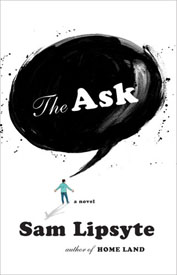
Something on The Ask

His wife cheats on him, he lacks the requisite affection for his own son, his employment as development officer at a third-tier university was recently terminated for bad behavior, and he's aging badly, quickly: Milo is a sad, bitter man. This unfit protagonist of The Ask knows his own insufferability, describing himself as the unsympathetic lead in some bad novel. But author Sam Lipsyte's rendering of Milo's self-loathing loserhood disarms the reader just enough, bypassing our hostility on a bridge of rickety empathy.

After college, Milo quickly traded in his aspirations in the art world for a rat-race life of quiet desperation and loud disappointment. His opposite is his estranged college buddy, Purdy, who's now a wealthy, enviable man whose stock has only risen since graduation. The memory of Purdy seems to figure in whenever Milo takes stock of his own failure. But Purdy does have one spot on his record: A son he didn't know he had and now wants to hide. The son turns out to be twice as bitter and resentful as Milo, and for better reason.

To those of us quick to blame others, the narrative encourages turning that critical eye inward, and taking a break from the self-hating and social criticism long enough to appreciate what we do have, which is often more than first imagined. If the novel has a point, that may be it. The Ask reads quickly but has a lot of flaws: Barely tolerable characters, a drawn-out plot structure, some unclear resolution points, and the author frequently employs one affected choice of syntax that bothered the hell out of me.