Showing posts with label book. Show all posts
Showing posts with label book. Show all posts
Saturday, January 23, 2021
a plot
I wrote an awesome book about a guy, Johnny Blast, who has to drive a truckload of drugs somewhere to save his hot wife's life. He barely makes the delivery, and then he kills the bad guys and keeps the drugs. His wife dies, though.


Friday, July 27, 2018
something about "Potomac Landings" by Paul Wilstach

Covering little bits of everything, Wilstach gives us a book to leaf through. He occasionally indulges in details about, for example, oil lamps. But the bulk of the text traces plantation and estate operations, well-heeled families, social conventions, the landscape, agriculture, architecture, and legal developments.
I especially enjoyed stumbling upon brief passages in which the author reveals his talent for literary writing. For example:
So, in brief, civilization came to the Potomac, seated itself at the river's mouth, and began its slow sweep up the shores from point to point, and from creek to creek. It came upward like the tide whose ebb and flow had for ages been as the river's respiration and life. If however, the flow of this tide was slow as centuries, its ebb was eventually just as inevitable as the ebb that twice daily perpetually bares the sandy beaches and the landing piles along its way.Notes:
-Potomac Landings was published in 1920. I read a 1937 edition.
-The book is somewhat Maryland-centric.
Saturday, May 26, 2018
something about "The Death of Ivan Ilych" by Leo Tolstoy
This remarkable novella drags a well-heeled federal judge through the ultimate crisis.

Tolstoy does not flatter our protagonist in The Death of Ivan Ilych. In an efficient account of Ilych's professional and social advancement, we learn that the man is shallow, conceited, and vain; he is a social climber and, having climbed, immediately became condescending (though not unkind) in his privilege.
One of the remarkable things about this novella is that these traits do not make Ivan Ilyich a villain; instead, they make him average.
In the story, Ilyich's health declines and he suffers exquisite pain in his illness. Incapacitated, the pointlessness of his life imposes on him. And the degree of suffering mystifies him because he has only ever done what he thought he was supposed to do: develop a career, get married, have kids, get established. But doing what was expected could not spare him an agonizing, slow death. In the end, the inauthenticity of his life leaves him lifeless.
My favorite parts--all of these include a comment on averageness and unoriginality:
On Ivan Ilych's parentage:
He was the son of an official who had worked his way through various ministries and departments in Petersburg, carving out the kind of career that brings people to a position from which, despite their obvious incapacity for doing anything remotely useful, they cannot be sacked because of their status and long years of service, so they end up being given wholly fictitious jobs, anything from six to ten thousand a year, and this enables them to live on to a ripe old age.On Ivan Ilych decorating his fine new house:
But these were essentially the accoutrements that appeal to all people who are not actually rich but who want to look rich, though all they manage to do is look like each other: damasks, ebony, plants, rugs and bronzes, anything dark and gleaming--everything that all people of a certain class affect so as to be like all other people of a certain class.On Ivan Ilych's trip to the doctor early in his mysterious illness:
He was made to wait, the doctor was full of his own importance--an attitude he was familiar with because it was one that he himself assumed in court--then came all the tapping and listening, the questions with predetermined and obviously superfluous answers, the knowing look that seemed to say, "Just place yourself in our hands and we'll sort it out, we know what we're doing, there's no doubt about it, we can sort things out the same way as we would for anyone you care to name."Note: The Death of Ivan Ilych was published in 1886. Tolstoy was supposedly suffering a personal crisis of meaning.
Friday, January 05, 2018
something from "Bartleby, the Scrivener" by Herman Melville

"Bartleby, the Scrivener" is one of my favorite pieces of writing. The story's themes of isolation, conformity, and human folly echo loudly. But it is Melville's humor that I heard clearly during my most recent reading. My favorite passage comes when the lawyer, after dismissing Bartleby on a Friday, returns to work Monday morning to find his scrivener still occupying the office. The lawyer, narrating, begins thinking through his next move:
“Not gone!” I murmured at last. But again obeying that wondrous ascendancy which the inscrutable scrivener had over me, and from which ascendancy, for all my chafing, I could not completely escape, I slowly went downstairs and out into the street, and while walking round the block, considered what I should next do in this unheard-of perplexity. Turn the man out by an actual thrusting I could not; to drive him away by calling him hard names would not do; calling in the police was an unpleasant idea; and yet, permit him to enjoy his cadaverous triumph over me,—this too I could not think of. What was to be done? or, if nothing could be done, was there anything further that I could assume in the matter? Yes, as before I had prospectively assumed that Bartleby would depart, so now I might retrospectively assume that departed he was. In the legitimate carrying out of this assumption, I might enter my office in a great hurry, and pretending not to see Bartleby at all, walk straight against him as if he were air. Such a proceeding would in a singular degree have the appearance of a home-thrust. It was hardly possible that Bartleby could withstand such an application of the doctrine of assumptions. But upon second thoughts the success of the plan seemed rather dubious. I resolved to argue the matter over with him again.
Friday, November 20, 2015
something about "Heart of Darkness" by Joseph Conrad

Joseph Conrad's novella Heart of Darkness sinks deep into Africa. This joyless ride, published in 1899, is narrated by an enterprising merchant named Marlow, who tells his story of being swallowed by the Congo River during his venture in the export business. When Marlow finds himself in the continent's pit, he comes face to face with a storied ivory trader named Kurtz.
In America, this text is usually read for a high school or college class. Inevitably, the teacher asks, Is Conrad a racist? The answer?: Probably not, but it is complicated.
True, the African natives are inseparable from the foreign and incomprehensible jungle around them. Marlow refers to these blacks as savages; all of them are cannibals. Yet, we know Heart of Darkness attacks imperialism and, in turn, racism. (Both together--not one and the other separately.) We must question the reliability of the narrator.
Between the lines of Marlow's story we gather that Europeans are pillaging Africa and they intend to civilize the Africans in turn. But the supposedly civilized Europeans treat the subjugated black locals with cruelty--behavior that exposes the tribal brute in the heart of every civilized Westerner. Even Kurtz, who has nearly become a deity in this strange land, wants to exterminate his foreign worshipers. The line between the civilized and savage is erased.
Still, as to whether racism persists in the text itself, there is room for argument. For instance, one could reasonably conclude that Conrad thinks the de-civilizing of the European only happens when immersed in the African continent.
Heart of Darkness, published in 1899, provides a superior reading experience and rightfully belongs in the cannon of much-studied literature.
Notes:
- What do we make of Marlow's marveling over Kurtz' eloquence?
- How much of this work is a comment on bureaucratic and corporate systems?
- In any event, just read these passages:
... there was nothing exactly profitable in these heads being there. They only showed that Mr. Kurtz lacked restraint in the gratification of his various lusts, that there was something wanting in him--some small matter which, when the pressing need arose, could not be found under his magnificent eloquence. Whether he knew of this deficiency himself I can't say. I think the knowledge came to him at last--only at the very last. But the wilderness had found him out early, and had taken on him a terrible vengeance for the fantastic invasion. I think it had whispered to him things about himself which he did not know, things of which he had no conception till he took counsel with this great solitude--and the whisper had proved irresistibly fascinating. It echoed loudly within him because he was hollow at the core...
My first interview with the manager was curious. He did not ask me to sit down after my twenty-mile walk that morning. He was commonplace in complexion, in features, in manners, and in voice. He was of middle size and of ordinary build. His eyes, of the usual blue, were perhaps remarkably cold, and he certainly could make his glance fall on one as trenchant and heavy as an axe. But even at these times the rest of his person seemed to disclaim the intention. Otherwise there was only an indefinable, faint expression of his lips, something stealthy--a smile--not a smile--I remember it, but I can't explain. It was unconscious, this smile was, though just after he had said something it got intensified for an instant. It came at the end of his speeches like a seal applied on the words to make the meaning of the commonest phrase appear absolutely inscrutable. He was a common trader, from his youth up employed in these parts--nothing more. He was obeyed, yet he inspired neither love nor fear, nor even respect. He inspired uneasiness. That Was it! Uneasiness. Not a definite mistrust--just uneasiness--nothing more. You have no idea how effective such a . . . a. . . . faculty can be. He had no genius for organizing, for initiative, or for order even. That was evident in such things as the deplorable state of the station. He had no learning, and no intelligence. His position had come to him--why? Perhaps because he was never ill ...
Thursday, August 02, 2012
About "Going Solo: The Extraordinary Rise and Surprising Appeal of Living Alone" by Eric Klinenberg
 Klinenberg wants us to know this is a big deal--"the most significant demographic shift since the Baby Boom—the sharp increase in the number of people who live alone". And the volume and proliferation of these people, annoyingly called "singletons" here, has never happened before. The book attributes the shift to four eco/techno/socio-cultural developments: (1) women's lib, (2) conveniences of technology, (3) longer lifespans, and, the biggest factor, (4) increased urbanization.
Klinenberg's revelation is that, rather than worry about this increased atomization making a nation of shut-in brats, we should see this as a neutral or even ultimately positive thing because these singletons are healthy, happy, and engaged. Indeed one of the book's big goals is to dispel myths and assumptions about people who choose to be alone. In support the book rallies scores of miniature profiles of singletons, quoting and amassing their differing and converging impressions and reasons. These mini bios also try and humanize the subject, to make flesh and blood out of a growing mass of loners.
The book's message is inherently anti-climactic: Hey, this is happening but it's OK (as long as we govern accordingly). I guess this is why I found the book so dull.
Saturday, June 09, 2012
About Security, Territory, Population: Lectures at the Collège de France 1977-1978 by Michel Foucault
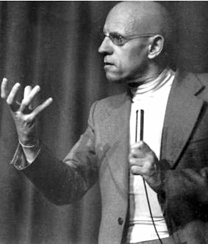 Foucault lectured at the Collège de France for several semesters. This opportunity allowed him to continue and share his research, his hypotheses and conclusions. In this lecture series, Foucault traces the origin and evolution of the modern concept of government and the assemblage of techniques, collectively called security, it uses in managing the population. Foucault shows that the question of how the sovereign should rule the territory and its inhabitants became a question of what technique of leadership would do given the new phenomenon called "population.
I first read this in March 2012 but am returning to it now to take notes while I read. This edition (and others in the series) is awesome because the editors include valuable additions of their own, Foucault's notes, and material from the Collège.
Friday, May 18, 2012
started reading The Bible

Will try to read this in chunks between other books. I won't read it in one pass.
My first impression is a rhetorical one: the Old Testament's extensive family tree-building leads readers to assume the text's credibility as a historical document. Second, I don't understand Jacob's characterization. My sense is that I'm supposed to like him but he's not a good person as far as I can tell. God favors some people, it says, and Jacob is one of those people. Otherwise, the Old Testament is mostly good so far.
I doubt I'll pick it up again for a while, though. I guess ultimately I'm less interested in the Bible's content than I am in the discourse community around it.
Since I put it down I've read a lot of articles, both journalistic and academic, on a range of subjects. No need to note any in particular.
Thursday, April 19, 2012
A thing about "Conquest of Abundance" by Paul Feyerabend

In the posthumously released Conquest of Abundance: A Tale of Abstraction versus the Richness of Being, philosopher of science Paul Feyerabend conceptually explores reality. This might be a poor introduction to Feyerabend because the tract veers from his usual writing style and was unfinished when he died. Maybe because it was unfinished, the man's thoughts didn't often process readily on the page despite its sequentially numbered points and other organizational strategies. Still, putting in the effort to read was worth it.
Feyerabend promotes relativism and the importance of worldviews and perspectives; he says animism, objective realism, etc., are all just different ways of understanding the World. He is, though, softly critical of the kind of objectivism found in "hard" sciences which, characteristic of the Modern Age, have minimized interpretive possibility (and, possibly, ability) via extensive categorization, modeling limited sets of alternatives, and narrowing any given subject to either this or that.
But Feyerabend isn't longing for the ancient past--at least, not openly. I enjoyed it enough to look into him more later on. Someday.
Wednesday, February 29, 2012
On Denis Johnson's novel "Nobody Move"

Apparently out of luck, compulsive gambler Jimmy Luntz finds himself on the run from his creditor's goon, Gambol. Denis Johnson's novella Nobody Move presents this brief manhunt like scenery on a short trip in a beat-up Sedan DeVille. A solid, short list of characters waltz in from the sidelines during this game between chance and hopelessness, enhancing the conflict found in this fast, fun read.
Thursday, February 09, 2012
A thing on "The Spirit of Terrorism", essays by Jean Baudrillard
 Was disappointed with these essays. Baudrillard alternates between skin-deep pontifications on the symbolic meaning of terror and basic leftist moralizing against the methods and consequences of US hegemony. Too bad: despite the volumes of writing on the attacks, I expect there's a real dearth of good literature on the subject.
Baudrillard doesn't argue points so much as reflect on them, so his writing is loosely structured. The edition I read was translated by Chris Turner.
Saturday, January 07, 2012
A thing about Nikki Sixx's autobiography "The Heroin Diaries: A Year in the Life of a Shattered Rock Star"

Nikki Sixx is the creative force and bass player for Motley Crue, the infamous glam-ish metal band that peaked in the late 1980's, early 1990's. His journal-form autobiography, The Heroin Diaries, follows Sixx through 1986-1987, the height of the band's excesses and Sixx's drug use. Brief commentaries by witnesses and peripheral characters pepper the book, filling in details left out of the journal entries which, I suspect, were massaged or even, in cases, written after the fact for continuity's sake. The almost 20 years between then and the book's publication date (2006) are covered as bullet points in the last half-dozen pages. It's a fast read despite the predictable redundancies inherent in the life of a junkie.
As a narrative, this is the story of a man who seemed to have it all and had a lot of fun while feeling completely miserable. In bits and pieces we learn that an unfortunate but not unprecedented family drama spoiled Sixx's childhood, amounting to what you'd call abandonment issues that in part fueled his addictions. He frames the book as a cautionary tale but, realistically, its appeal lies in its modest gossip and voyeuristic value.
In theory, rock autobiographies and biographies sound like good reading. But they rarely are so, for various reasons including the fact that musicians are not often interesting people and because the genre attracts a lot of hack writing by unskilled storytellers. The best I've read was No One Here Gets Out Alive and Miles: The Autobiography.
Friday, December 16, 2011
A thing on the book "At Home" by Bill Bryson
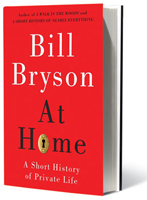 In At Home, author Bill Bryson offers an anecdote-rich tour of the modern suburban house. For this purpose he uses his own home, an impressive and well-aged English estate. This is a thick book of historical trivia in which Bryson introduces mostly little-known events and figures who share in the responsibility for our modern daily domestic experience. Bryson skips around the centuries (mostly the last four) and hops between Europe (mostly Western) and the Americas (mostly North).
Some pages in, I began to suspect Bryson of merely using the house as an excuse to assemble and publish a bunch of disparate historical tidbits he culled and collected along the way; oftentimes a story contributed nothing to our understanding of how the modern suburban house took shape.
But this doesn't make the reading any less agreeable. It's a good gift book, something that might liven up a coffee table in a lasting way.
Notes:
- I wouldn't want Bryson to really give me a tour. Not of his home or of a telephone booth or of anything.
Thursday, November 17, 2011
Something on The Ask
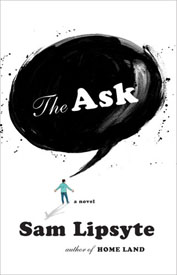 His wife cheats on him, he lacks the requisite affection for his own son, his employment as development officer at a third-tier university was recently terminated for bad behavior, and he's aging badly, quickly: Milo is a sad, bitter man. This unfit protagonist of The Ask knows his own insufferability, describing himself as the unsympathetic lead in some bad novel. But author Sam Lipsyte's rendering of Milo's self-loathing loserhood disarms the reader just enough, bypassing our hostility on a bridge of rickety empathy.
After college, Milo quickly traded in his aspirations in the art world for a rat-race life of quiet desperation and loud disappointment. His opposite is his estranged college buddy, Purdy, who's now a wealthy, enviable man whose stock has only risen since graduation. The memory of Purdy seems to figure in whenever Milo takes stock of his own failure. But Purdy does have one spot on his record: A son he didn't know he had and now wants to hide. The son turns out to be twice as bitter and resentful as Milo, and for better reason.
To those of us quick to blame others, the narrative encourages turning that critical eye inward, and taking a break from the self-hating and social criticism long enough to appreciate what we do have, which is often more than first imagined. If the novel has a point, that may be it. The Ask reads quickly but has a lot of flaws: Barely tolerable characters, a drawn-out plot structure, some unclear resolution points, and the author frequently employs one affected choice of syntax that bothered the hell out of me.
Subscribe to:
Posts (Atom)