Showing posts with label religion. Show all posts

Saturday, January 06, 2024

a creative writing exercise on here

The sun blinks. The cells in this body never should have asked permission. The foreign bot-god could make another you to love the corpse you leave actually dead.

Things, special dead special things. God raising families of corpses night and day, rain or shine, until they negotiate mentally through oxygen and make a deal with the black angel.

Offer Satan my white horse and ask him, What is real? What made me and why? Buildings now ruins, people now dust.

Sign here and explode, angel. Leave the heir sterile living or dying. Promise to the black angel.


Saturday, June 04, 2022

something or other


There are worlds on Earth he can never know—like a world in which his wife has a strong Christian faith and offers him her loving arms.
 

Friday, April 26, 2019

about zealots


Think of someone you love, whose love for you is such a given that you sometimes take them for granted.

Imagine that person far away, the hostage of a violent zealot. Imagine your loved one, dressed in an orange jumpsuit, forced to their knees. Imagine that person positioned before a high-definition camera in the desert. Imagine, dressed head to toe in black, the zealot crowding in the picture with a highly polished knife.

The zealot speaks to the camera, his hand on your loved one's shoulder, telling you there is no choice. He tells you that forces beyond all three of you have forced this moment. The zealot tells you that your loved one will die, and that, although he will slit your loved one's throat, he did not choose to.

Imagine the zealot puts the knife to the throat of your beloved and cuts through the skin, tears into the muscles, saws through the tendons, and hits bone. Imagine your loved one gurgling, blood urging out. That's how they die.


Friday, August 25, 2017

about being dull

 
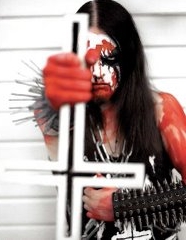
A knifeman forces an 84-year-old priest to his knees at the altar and slits his throat. Why is it that this horrific episode did nothing for the imagination? Is it because it is situated within the shapeless war on terror instead of the short rash of violence wrought during the early Norwegian black metal scene?

Friday, July 28, 2017

something about "Democracy in America" by Alexis de Tocqueville


In 1831, the French government sent Alexis de Tocqueville and Gustave de Beaumont to study the American prison system and American society in general to inform political developments in France. Tocqueville saw virtue in an aristocracy and was skeptical of the egalitarianism preached in the United States.

Tocqueville published his findings, De La Démocratie en Amérique, in two parts (1835 and 1840). His commentary, translated today as Democracy in America, is a staggering read. It is at least as insightful as any other wide-scope religious, political, and economic study of American culture (which are all prone to hasty generalizations) produced before or since. Given the fact that Tocqueville spent only nine months in the United States, this is an especially remarkable achievement. 

Friday, February 24, 2017

about burying family


She flew home to bury her sister for Christmas and caught the return flight two days later. People started asking how she was. "People die all the time," she thought. "What difference does it make if it happens to me or you or anybody else?"


Friday, September 18, 2015

about "The Concept of Anxiety" and "The Sickness Unto Death" by Søren Kierkegaard

 
Søren Kierkegaard's The Concept of Anxiety and The Sickness Unto Death were published in the 1840s. The discussion of freedom and anxiety in these works laid the foundation for existentialism. Kierkegaard was the first modern philosopher and the first person to find himself in a modern age. However, his faith and spirituality make him timeless.

Philosophy departments consider The Concept of Anxiety and The Sickness Unto Death to be a pair.

The Concept of Anxiety explores sin, guilt, and anxiety, which is undirected fear, a general sense of dread. Kierkegaard rebuffs the idea that anxiety is caused by original sin. Rather, innocence generates the conditions for anxiety. Consider Adam and Eve in the Garden of Eden; recall that God forbade Adam from eating from the tree of knowledge. God's directive makes Adam aware that he has a choice. This freedom to choose causes anxiety. Furthermore, Adam could not have known he was sinning because, being the first to sin, how would he know what sin was? Sin was real only after Adam ate from the tree of knowledge. Rejoice in your freedom.

The Sickness Unto Death explores spiritual death, which is despair. Here, Kierkegaard deals with self, or the self-concept of selfhood: the "relation's relating itself to itself in the relation." In The Sickness Unto Death, Kierkegaard delves into the binary concepts of the finite and the infinite and the possible and the necessary. Tension between these polarities results from not being right with God. And, thus, despair. Kierkegaard elaborates further that there are three kinds of despair. All this is not as interesting as The Concept of Anxiety, so I will not elaborate. However, my favorite passage in
The Sickness Unto Death comes when Kierkegaard is describing the person who lives life in a religious mode, but who, in the process of becoming spiritual, has lost his self:
Such things do not create much of a stir in the world, for a self is the last thing the world cares about and the most dangerous thing of all for a person to show signs of having. The greatest hazard of all, losing the self, can occur very quietly in the world, as if it were nothing at all. No other loss can occur so quietly; any other loss--an arm, a leg, five dollars, a wife, etc.--is sure to be noticed.

Saturday, May 09, 2015


Think of someone you love. Someone who is so essential that you forget they live. Whose presence looms so large in your life that you take them for granted. Someone who, it's only when they're gone, that you really understand what they mean to you.

Imagine that person far away. Imagine that person being told to wear an orange jumpsuit. Imagine that person positioned before a high-definition camera in the desert. Then imagine that person forced to their knees. Imagine, dressed head to toe in black, a zealot with
a bright knife. The zealot, with a hand on your loved one's shoulder, speaks to the camera and says he has no choice. Your loved one will die and no one will be responsible and no one could have done anything differently.

Imagine the zealot puts the knife to the throat of your beloved and cuts through the skin, tears into the muscles, saws through the tendons, and hits bone. Imagine your loved one gurgling, blood urging out. That's how they die.


Saturday, May 24, 2014

about Dave Mustaine's autobiography


One of the great dramas in modern American music is the feud and history between Dave Mustaine and Metallica. Mustaine played lead guitar in Metallica's original lineup and even wrote a share of the songs that launched that band's massive, successful career. But personality conflicts led Lars and James to fire Mustaine just as the band was breaking out. Mustaine went on to form Megadeth, also huge, but only half as successful as Metallica in terms of record sales. In all this, Mustaine established himself as a primary figure in the development and growth of American thrash metal, and will go down as a one of metal and hard rock's most influential guitarists.

The elegantly titled Mustaine is the muscian's autobiography. He can write it now because Megadeth ceased being relevant and dangerous a while back and Mustaine himself has emerged from the reckless rock-star life a born-again Christian and music businessman. Of course, he's certainly capable of reinventing himself and surprising us; it just seems more and more unlikely that he'll do so.

The following does the man a great injustice, but the fast and dirty Mustaine is this: He grew up poor in an unstable family with an alcoholic father; his mother moved him around a lot to escape the dad's influence, but this influenced Dave such that he grew into a misfit; the experiences impaired his ability to form lasting, healthy friendships; he started getting into music and rock bands, eventually seeing real potential with Metallica; but personality conflicts and alcohol soured his relationship with the band and they kicked him out; so Mustaine built Megadeth, and with them (and their various lineups) he lived the rock star's life, colored with bitterness. His whole life he's felt broken, more or less, and in need of fixing. His breakup with Metallica left him bitter and jealous. After multiple stints in rehab, he found Christ and has sustained living a more wholesome life as a father and husband. He intends to maintain a musical career in some form or fashion

On playing guitar and finding music:
I was pretty good at playing guitar, and I was serious about making a living at it. But that wasn't the only reason I played. It wasn't only about strutting an getting laid and trying to become famous. When I held a guitar in my hands, I felt good about myself. When I played music, I felt a sense of comfort and accomplishment that I'd never known as a child. When I replicated the songs that I loved, I felt an attachment to them and to the musicians who had composed them.

On setting off with Metallica:
It was all incredibly exciting and disorienting and vaguely unsettling. We'd been starving for days, and all of a sudden people were throwing food at us. I remember looking at myself in a mirror when I woke up one morning and noticing that my stomach was grotesquely distended. Of course, that could have had something to do with the fact that I was drunk or stoned virtually every waking moment. The party never stopped. Booze, cocaine, pot, meth--it was everywhere, and it was mine for the asking. Along with groupies, the quality and volume of which seemed to be improving by the day. We'd do an appearance or a gig, or just show up at a party, and everyone wanted to hang with us.
"You're a bad motherfucker!" they'd shout.
I'd nod approvingly. I was a bad motherfucker. And proud of it

On a period when Metallica was living and rehearsing at a space in Queens, New York City:
We'd wake up in the middle of the day, eat, drink a little bit to take the edge off the hangover, hang out, and then go back to sleep. sometime after sundown we'd wake again, like a pack of fucking vampires, and start playing. We'd rehearse for a few hours, then drink until we passed out. The next day we'd do it all over again.

On the events leading up to his being fired from Metallica:
Certainly I had no idea that my tenure in the band was about to come to an end, and that indeed plans for my dismissal were already in the works. It is a testament to my naivete--or perhaps to my alcohol-induced complacency--that even as strange things happened, I failed to take any action.

On his jealousy and bitterness about Metallica:
I know some people look at me--and I include Lars and James in this camp--and say, "Why can't you just be happy with what you've achieved?" And they're right. Selling twenty million albums is no minor accomplishment. But it's about half what Metallica has sold, and I was supposed to be part of that.
You had to be there to understand what it was like, to feel like you're changing the world. And then to have it pulled out from under you and to see and hear reminders of what might have been every single day, for the rest of your life. And know--you just fucking know--whatever you accomplish, somehow it will never be quite good enough.

On Megadeth's eventually watering down and becoming more single/pop-oriented:
I wanted a number one hit. I wanted what Metallica had, even if it meant selling a piece of my soul to the devil ... I suspected they (the producers) were making modifications, softening the Megadeth sound, and I did nothing to stop them. There would be a payoff at the end, I reasoned ... Megadeth was a phenomenon based on raw energy and talent, and when you take that and water it down, it's no longer phenomenal. It's ordinary. By trying to expand your audience, you risk alienating your core fans, and I think we did that with Cryptic Writings, and even more so with our next record, the aptly named Risk.


Tuesday, October 29, 2013

the Prayer to Our Lady of Perpetual Help


Mother of Perpetual Help, to Thee we come imploring help.
Behold us here from far and near, to ask of Thee our help to be.
Perpetual Help we beg Thee, our souls from sin and sorrow free;
Direct our wand'ring feet a-right, and be Thy self our own true light.
And when this life is o'er for me, this last request I ask of Thee;
Obtain for me in Heaven this grace, to see my God there face to face.


Friday, August 09, 2013

another word about "Fear and Tembling" by Søren Kierkegaard


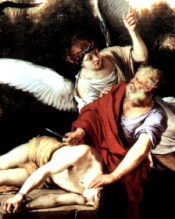
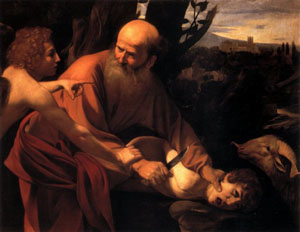
Abraham's trek to the lonely height of Mount Moriah took three days; for three days an ass jostled there, carrying Abraham and his long-wished for, unconditionally loved son. The journey would end in the father's sacrificing Isaac. What if Abraham had resigned himself to the loss, to living the rest of his life having used his own hands to saw through Isaac's throat? And, worse still, what if, having accepted and prepared himself to perform that horrific act, what if God called it off, and let Abraham keep Isaac?

Abraham would be forced to live with the child he had already sought to kill.

The amazing thing--where faith is found--is not in the fact that Abraham was willing to sacrifice his son; no, it was Abraham's knowing that he would not lose Isaac, no matter what happened on Moriah.
Through faith I don't renounce anything, on the contrary in faith I receive everything ... It takes a purely human courage to renounce the whole of temporality in order to win eternity ... Through faith Abraham did not renounce his claim on Isaac, through his faith he received Isaac.


Wednesday, April 03, 2013

about the film "The Master"


Who is the master? And who can live without serving a master?

In the 2012 film The Master, Freddie Quell—a character brought into curdled life by the singular Joaquin Phoenix—drifts and crashes from one moment to the next, his troubled life being one corrosive improvisation. Quell is a haunted World War II vet with no aim beyond staying intoxicated and self-destructing.

Philip Seymour Hoffman plays Lancaster Dodd, the leader of a philosophical movement known as "The Cause." His critics charge that Dodd improvises his philosophy from moment to moment, that he is a fraud. But his followers see an enlightened, intense visionary.

Quell is tortured, intense, rough, gaunt, uneducated, drawn to poisons and pain; Dodd is composed, graceful, educated, well-dressed, plump, and drawn to the spotlight. When the film debuted, critics wondered, What, if anything, does the film say? say about our talk of freedom and our readiness to serve a master? about the inevitable disappointment that comes with looking up to someone? about faith? belief?


Maybe Dodd serves more than one master: he serves his audience's expectations, his wife, his vanity and ego. He is intrigued by Phoenix, drawn by his intensity and desperation. Each man is fed and inspired by the interest and attention of the other; each man is the other's project, and each can take the other to the next improvised step, wherever it may lead.

The Master is fantastic, unorthodox, beautiful, grimy, and searing.


Note:
The Master was written, directed, and co-produced by Paul Thomas Anderson and stars Joaquin Phoenix, Philip Seymour Hoffman, and Amy Adams.


Thursday, March 21, 2013

about "Fear and Tembling" by Søren Kierkegaard


Kierkegaard believed his contemporaries took faith for granted. In Fear and Trembling, he tries to better understand faith by examining the Biblical story of God calling Abraham to sacrifice Isaac. This is a brief dialectic that problematizes and praises faith.

Abraham, a favorite of God, was an old man before he finally had a child. Through Isaac, his first born son, Abraham was to populate the nations. But God called on Abraham to sacrifice Isaac on Mount Moriah. Abraham prepared his belongings and took his son Isaac on a three-day journey there to do as God asked. Isaac asked why his father was not bringing a lamb to the sacrifice and Abraham answered that God would provide. Upon reaching Moriah, Abraham binds Isaac and draws the knife. At the last minute, Abraham is told by an angel not to follow through with the sacrifice. Ultimately a ram caught up in some nearby bushes serves as the sacrifice.

How could Abraham live with himself? How could he ever look at Isaac again, knowing he had been a moment away from killing him? Why would God ask this of his favorite, Abraham? It's a troubling story to say the least. But Kierkegaard unfolds it carefully, and convincingly makes the case that this is a paradoxical story of heroism, not depravity.


Sunday, October 28, 2012

Teaching the controversy


We have two theories being proposed to addressed unemployment.

The first is Job Creationism. This theory holds that a motivated elite creates jobs: low taxes motivate the elite to start businesses that will need employees. Jobs come from above.

The second is Job Evolution. This theory says that when conditions are right and the raw materials are there, jobs come: invest in education, infrastructure, and environment-friendly technologies, and jobs will emerge and evolve from within.

Friday, July 06, 2012

About secularized religion


As the Church fell into crisis in the 17th century, an emerging secular governmentality assumed custodial rights over life and population issues previously managed by the Church. With this, the modern State evolved, giving rise to politics. Like medicine and science, politics grows and takes more and more things into its body of knowledge, even religion, which itself is now highly politicized (it has been before now, but in different ways). The Church of Jesus Christ of Latter-day Saints was developed in the context of this politics, and has been linked to it since the beginning as evident in the religion's history, a story of battling for political contention.

Taking this story on a tangent, on June 30 this year, a modest group of Mormons gathered to renounce their membership in the LDS Church using methods that conflate the political with the religious: their gathering was personal ceremony and political protest; they waved a "Declaration of Independence from Mormonism" and offered letters of resignation, seeking "freedom" as they gathered at Ensign Peak like Brigham Young did with his followers in 1847; they sacrificed church-bound relationships with their community, yearning to receive those same relationships in return, renewed as social and business ties; their reasons for quitting included Church teachings that are "made up", that conflict with science, that conflict with history, that veil racism and promote intolerance, and that are inconsistent.

Anyway, this story sort of stuck out like this.

Saturday, June 30, 2012

Calling


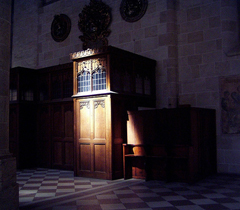
He'd spent most of the past eight years in this confessional. The last to repent before him, some poor woman who carried the stench of congealed sausage fat smeared on brown paper, had trailed away from this cozy, curtained sanctuary months ago. The smell, an hour later. Actually, he was glad. For, you see, he could no longer answer the call of a God so great, he himself being so small. The first time he could not answer happened while staged on the alter. Standing, the flock kneeling before him, his hands just flaked away and his shoulders bolted across the room, fixed to the walls, lead beams bearing the full pull of the Earth, such that he surely could never handle the wine again, or the bread again, the blood and the body. Then his soul bled itself and scarred down the middle at exactly the moment when two other souls should have been joined in matrimony. Weeks later, his eyes froze, their last tears icing the mummy's silence on his lips, so that he could offer no comfort to the dying. And, now? He could no longer forgive, because all was forgiven. Now he could only, need only, give thanks!

Saturday, May 26, 2012

Half-day


On half-days in grade school, right after the first bell we'd file out of school into church for the first of a two-part mass. After noon we'd return, incense swelling, to witness the priest recover the alter. This brief reprisal would end with a spirited hymn sung with all the joy of children eager to start the long weekend early. It was during the singing of one of these hymns I remember first feeling the rush, like adrenaline, like possibility, like freedom, raw and holy, pushing over the precipice of the sky, promising to obliterate us all.

Friday, May 18, 2012

started reading The Bible


Will try to read this in chunks between other books. I won't read it in one pass.

My first impression is a rhetorical one: the Old Testament's extensive family tree-building leads readers to assume the text's credibility as a historical document. Second, I don't understand Jacob's characterization. My sense is that I'm supposed to like him but he's not a good person as far as I can tell. God favors some people, it says, and Jacob is one of those people. Otherwise, the Old Testament is mostly good so far.

I doubt I'll pick it up again for a while, though. I guess ultimately I'm less interested in the Bible's content than I am in the discourse community around it.

Since I put it down I've read a lot of articles, both journalistic and academic, on a range of subjects. No need to note any in particular.

Tuesday, February 08, 2011

Moral Charge

"The Great Confinement", the first chapter of Michael Foucault’s Madness and Civilization, traces early reactions to a set of people, including the mad, whose common condition was idleness. His tracing includes a discussion of the role of Europe’s churches; with the aid of the Church, houses of confinement, which frequently doubled as work houses (sources of cheap labor), had a moral charge to assign labor and condemn the idle. Armed with a moral charge, they operated without oversight, without checks on their power, without critical analysis of their judgments because they had the faith of the state. Idleness was a sin, the reasoning went; because of Original Sin men were condemned to labor forever, Earth being no longer a paradise fit to sustain him without aid of his toils.

Recently I attended church and heard this Gospel:
Mt 5:13-16
Jesus said to his disciples, “You are the salt of the earth. But if salt has lost its strength, how can it be made salty again? It has become useless. It can only be thrown away and people will trample on it.
“You are the light of the world. A city built on a mountain cannot be hidden. No one lights a lamp and covers it; instead it is put on a lampstand, where it gives light to everyone in the house. In the same way your light must shine before others, so that they may see the good you do and praise your Father in heaven."