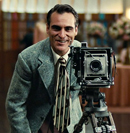
In
the last scene with both Lancaster Dodd (Philip
Seymour Hoffman) and Freddie Quell (Joaquin Phoenix),
Dodd tells Freddie to leave him forever, saying, "Go to that landless
latitude, and good luck—for if you figure a way to live without serving a
master, any master, then let the rest of us know, will you? For you'd be the
first person in the history of the world."
Lancaster
and Freddie are drawn to each other. Lancaster suggests a few times that he and
Freddie are cosmically connected, that they knew each other in a previous life. Both Freddie Quell and Lancaster Dodd improvise in life.
But Lancaster feels the pressure of his followers'
expectations, their fragile devotion, and his determined spouse, Peggy (Amy Adams).
Freddie represents something like freedom. He is
wild. He gets out of control and does not try to control others. He seems to
have no views. And he claims to do what he wants.
His
relationship with Dodd is Freddie's only meaningful one since before the war
when he courted a young girl. The relationship with Dodd gave Freddie a taste
of intimacy.
But
Dodd cannot pursue life with Freddie. Freddie is too damaged, too unstable, too
uncontrollable, and Lancaster has too many commitments. Moreover, Peggy will
not allow it. So Lancaster will carry on without him, and Freddie will drift
away alone.
Notes:
- Peggy
is an ominous, constant source of pressure. She immediately puts a stop to
nudity at meetings of The Cause, and she pushes him away from Freddie.
- Freddie
experiences intimacy when Doris (Madisen Beaty) sings to him. And he experiences
intimacy again during the Lancaster-Freddie processing scene, among others. And early in the movie, we see Freddie pretending to have sex on the
beach with a woman shaped from sand; the movie ends with a shot of Freddie
lying still, almost sweetly, next to the sand woman on the beach.
- Now I am patting myself on the back for my 2013 post, "about the film "The Master," noting something that is beautifully expanded on in this piece in The New Yorker: “The Astonishing Power of ‘The Master’” by Richard Brody, September10, 2012.