Showing posts with label slavery. Show all posts

Friday, July 27, 2018

something about "Potomac Landings" by Paul Wilstach


Paul Wilstach shares with us the life of the the lands pinning in the Potomac River. The encyclopedic Potomac Landings is written with care and traces of affection. Much of national importance in America is rooted in the D.C., Maryland, and Virginia area (also known as the DMV) along the river. Bits that I found particularly interesting include how many wealthy people settled the area, the plantations, the way children of rich men established estates near each other, and the way those estates became counties.

Covering little bits of everything, Wilstach gives us a book to leaf through. He occasionally indulges in details about, for example, oil lamps. But the bulk of the text traces plantation and estate operations, well-heeled families, social conventions, the landscape, agriculture, architecture, and legal developments.
 

I especially enjoyed stumbling upon brief passages in which the author reveals his talent for literary writing. For example:
So, in brief, civilization came to the Potomac, seated itself at the river's mouth, and began its slow sweep up the shores from point to point, and from creek to creek. It came upward like the tide whose ebb and flow had for ages been as the river's respiration and life. If however, the flow of this tide was slow as centuries, its ebb was eventually just as inevitable as the ebb that twice daily perpetually bares the sandy beaches and the landing piles along its way.
Notes:
-Potomac Landings was published in 1920. I read a 1937 edition.
-The book is somewhat Maryland-centric.


Wednesday, February 27, 2013

about 2012 films: I see black people


At the Oscars, Daniel Day-Lewis won Best Actor.

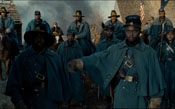
Both the films "Lincoln" and "Django Unchained" concern African American slavery in the US--an issue that in ways big and small plagues the US still. But "Lincoln" portrays and conveys black people differently--I think with a greater truth, the kind of truth only realized in art.

How so?

"Lincoln" doesn't have any main black characters. It has hardly any black people at all. Sure, it's about that President at a specific moment, and not about slaves. But what and who is Lincoln? Why do we honor him today? States' rights were at stake, but the civil war was fought over slavery, and that is Lincoln's legacy.

All during the film, black people are peripheral, somewhere on the edges, rarely seen, rarely on screen. And aside from gentle scenes of dialog at the beginning and end of the film, they are never confronted. Their captivity and freedom is debated with a little input from those most affected.

But though they are invisible, black Americans are everywhere in the themes and culture and gravity of the moments being enacted. They are the thing referred to but never spoken of; they are exchangeed but never valued. They are marginalized in the film, reflecting their existence in America, and the racially collective experience of their existence here for some time.


Notes:
* The only other film I saw is "Flight".


(Also, the President now is black.)


Thursday, November 29, 2012

something about the movie "Lincoln"


"Lincoln" focuses on the President's efforts to pass the Thirteenth Amendment while negotiating the end of the Civil War. A superb Daniel Day-Lewis evokes a gifted but earthen man veiled in melancholy, defending the bloody and nightmarish warring to save the Union, the Emancipation Proclamation, and his push to eradicate slavery via the Constitution immediately, while the battle still rages. All of the supporting players more than hold their own--Sally Field included.

In all that's already been written about this film, only one point could still be made: this entry from The New Yorker--one of a couple excellent comments on the film found there--claims
It can’t be said too often, or too clearly, that the whole point of Lincoln is that he—and the Republican Party he then represented—marked the end of the policy of conciliation and compromise and cosseting that had been the general approach of Northern Presidents to the Southern slavery problem throughout the decades before. When the South seceded, Lincoln chose war—an all-out, brutal, bitter war of a kind that had never been fought until then.
According to the film, Lincoln felt the 13th Amendment was a compromise. Had they not compromised, the radical faction of the Republican Party (and their abolitionist constituents) would have enfranchised black men immediately, given them the vote, legalized interracial marriage, etc. A huge portion of the film is dedicated to Lincoln's pissing off those radicals. (But this "compromise" means little when it obliterates an entire region's economic way of life, which is probably The New Yorker writer's point.)