Showing posts with label interpretation. Show all posts
Showing posts with label interpretation. Show all posts
Friday, September 29, 2017
about a dream that sticks with me
One Sunday morning I was sleeping late and dreamed of lying in bed with X. Lying there, dressed in sleepwear, comfortable in each other's presence, talking. Not about anything in particular—just current events, passing thoughts, and so on. For a moment, my feeling wandered from intimacy to romance, but that feeling passed and I relaxed again. In real life, I would go out of my way to avoid her. And yet, what a treat was this Sunday morning spent together. I wondered later how I could dream something so in conflict with my better judgment. The reason is probably as simple as loneliness. There are few people further away from me than X, so her being so close meant that everyone else was that much closer.


Saturday, October 15, 2016
about how "words matter" (part 1)

In August 2016, presidential candidate Donald Trump said the following at a campaign rally:
Hillary wants to essentially abolish the Second Amendment. If she gets to pick her judges, there's nothing you can do, folks. Although the Second Amendment people--maybe there is. I don't know.Many people accused Trump of implying that "Second Amendment people" could react with violence if Hillary Clinton, the Democratic Party candidate, won the election. Clinton acknowledged and condemned the allegedly veiled threat, using the phrase "words matter." (Trump, of course, denied he was making any allusion to violence; he claimed he was referring to the National Rifle Association's considerable lobbying power.)
In August Trump accused President Barack Obama of being the founder of ISIS. These words drew criticism because they were, interpreted literally, untrue. Trump later said that if Obama had not mishandled foreign policy in the Middle East, then ISIS would not exist. So, for Trump, calling Obama the founder of ISIS is an incendiary way of saying the President, because he withdrew American forces and left a vacuum in the region, bears responsibility for the terrorist group's genesis.
In the second example, the problem seems to be that others might only hear what Trump said and would not infer any meaning beyond his words. In the first example, the problem seems to be that the language Trump used was too open to interpretation. What mattered was the words he did not use but others possibly could hear.
In one example, words matter because people take Trump literally. In the other, words matter because people might not take Trump literally enough.
Notes:
- This post is sophistry.
- The phrase "words matter" seems to be popping up a lot lately. Is it?
- The bit about Hillary wanting to abolish the Second Amendment drew no criticism even though that statement, interpreted literally, is also untrue.
- Explore how the phrase "words matter" relates to the concept of "political correctness."
- Explore the example of using the term "illegal" versus "undocumented immigrant" when discussing immigration.
Friday, April 04, 2014
"The Wizard of Oz" and "Mad Men"
The classic film "Wizard of Oz" depicts a young farm girl journeying through the fantasy land of Oz; the highly rated TV show "Mad Men" follows Don Draper, a highly successful executive in the golden age of advertising. What do the two have in common?

Advertising in 1960s-era New York City is widely considered the industry's golden age. Don Draper starts life as dirt-poor Dick Whitman, a farm boy who spent much of his formative years meekly in a whorehouse. But during the Korean War, he takes up the identity of a fellow soldier who, unbeknownst to most of the world, actually died in combat. With this identity, and entering the world of advertising, the new Don has the chance to escape his troubled, humble past and build a new life with his confident good looks and intelligence. But the business of advertising, while high in status and flush with cash, hides a competitive world of illusion, promising a life of fulfillment and happiness that can never be delivered. Don's journey on "Mad Men" is proving to also be one of self discovery in which our protagonist returns to his roots and his family.

So Oz and advertising are both worlds of illusion. Both Dorothy and Don are thought of as something they are not. Both characters journey though a land seeking something that ultimately they had all along. Etc ... you can figure out the rest.
Notes:
- There could be (and probably are) more specific correspondences between the film and TV show. For example, Don's partners could fit the roles of the talking lion, tin man, and scarecrow; Pete Campbell is the Cowardly Lion, Roger Sterling is the Tin Man, and Peggy Olson (and maybe Joan Holloway) is the Scarecrow.
- When we last saw Don Draper, he had returned with his family to the whorehouse-home Dick Whitman grew up in. Similarly, at the end of her journey, Dorothy ends up back home in Kansas, surrounded by the family who loves her.
Friday, July 12, 2013
about Cormac McCarthy's "The Road"
We join a father and son journeying down a desolate but dangerous road cut through postapocalyptic America. They, suffering, were just trying to get to the end. I felt the same, reading this story in Cormac McCarthy's The Road.
We're the good guys, the father says. But in time the boy begins to doubt, then grows wholly disbelieving. Through his seared-in allegiance to his son's preservation, the man abandons his capacity to trust, and so loses his humanity.
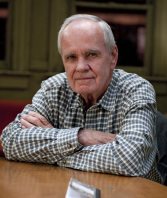 After figuring this out, the boy sees that, though he is his father's burden, he is the one shouldering the world. His humanity still budding, the boy worries for each damned soul they pass.
Having reached the coast and been turned back around, The Road finally concludes with father-protector dying, and son taking the hand of a stranger; whether this show of desperate hope and resigned trust will be rewarded is unknown.
Cormac McCarthy links hope and trust; and those, with youth. So what does this futuristic tale, published in 2006, say about our fate?
Unlike Cormac McCarthy's one-dimensional dustbin of days, our terrain grows more and more complicated, but also more open, with more people connected and more isolated and stratified at the same time. And here, again, we see that caution and the drive for self-preservation is as indispensable as the capacity for hope and trust. But, moreover, in Cormac McCarthy's world, both persist with us until our dying day. Cynical, pointless doom.
I appreciated that McCarthy's sparse prose reflected the desolate world he created, but I never got into this, and did not enjoy it in any sense.
Thursday, June 21, 2012
Billy Corgan on Billy Corgan and music today
Billy Corgan has caught a little hell for talking shit about Radiohead. But now, having read what he said in this interview, I think folks have misunderstood him. Here is the controversial part (parentheses mine):
From ’89 on I’ve had people tell me who I am. And they pick my personality as if it’s a one or two-dimensional thing, and I’m more like a tetrahedron. I can’t think of any people outside of Weird Al Yankovic who have both embraced and pissed on Rock more than I have. Obviously there’s a level of reverence, but there’s also a level of intelligence to even know what to piss on. ‘Cause I’m not pissing on Rainbow. I’m not pissing on Deep Purple. But I’ll piss on fuckin’ Radiohead, because of all this pomposity. This value system that says Jonny Greenwood (Radiohead) is more valuable than Ritchie Blackmore (Deep Purple). Not in the world I grew up in, buddy. Not in the world I grew up in.
So I find myself defending things. Is Ritchie Blackmore a better guitar player than me and Jonny Greenwood? Yes. Have we all made contributions? Yes. I’m not attacking that. I’m attacking the pomposity that says this is more valuable than that. I’m sick of that.
 I don't think Corgan is attacking Radiohead. He's using them as an example of a popular band that critics deify while trashing other artists, himself in particular. The "pomposity" is the pompousness of critics who fawn over select bands and citicize those whom its safe to criticize. Corgan's predictably irreverent response would be to "piss on fuckin’ Radiohead" because no one else will--not because Radiohead deserves to be pissed on.
In answering a different question, Corgan expands on this:
Look, we’re all insecure in our own ways, most of us. You’ve got a Facebook with a few hundred friends. If you do something truly radical, are you ready to withstand the forty negative comments? Most people aren’t. So they’re getting peer pressured at levels they don’t even realize. It’s what you don’t say.
It’s like the government spying on us. Right? Now it becomes about what we don’t say. The same thing with culture. I’m just willing to say it, and deal with the forty negative comments.To the extent that anything can be interesting, Corgan sort of can be because he's a bit of a paradox. He's trying to be a rock star but he thinks we have none, can have none, and that it's pointless and vain. As he did during the 90's early alt-rock scene, he's the champion of zeroes and outcasts because he is not accepted as cool (anymore); but he's also the antithesis of that guy because he makes a spectacle of himself by dating porn whores, shaving his head, saying inflammatory crap and whatnot. This paradox is him now.
He approaches all this later in this same interview:
And the funny thing is that I’ve been playing with conceptual identities all along. And I’ve watched each turn, as I’ve adapted to each cultural identity, how I’m attacked for not being this or that, or too much of this or too little of that. Meanwhile the real me is standing behind it all noting where the deflector shield works and where it doesn’t. And what gets through. Now I’m actually strong enough where I don’t need a mask. I’m just myself.And then he brings this back to the original point--that he gets criticized unfairly (unfair because the playing field isn't even):
Well what I’m saying is rather than be celebrated as a radical who’s continually subverted the system and turned his back on much greater commercial realities than I’ve embraced, I’m celebrated as this fucking weirdo who just won’t go away!Is he an ass? Oh yeah. And maybe he's wrong, too, but he might as well be understood before he gets shit on for being so.
Sunday, December 18, 2011
Something on the film "Blue Valentine"

First, during a discussion between Cindy and her ailing, aged grandmother, the elder recalls her own ill-fitted marriage to a man who didn't appreciate her, then she cautions Cindy not to choose a man who doesn't have regard for her as a person. Cindy asks herself how she can trust her feelings when so many people have bad marriages. This Cindy is practical, pragmatic, and ambitious. Second, during a discussion with his co-workers, Dean colors himself an unapologetic romantic as he laments so many women choosing stable guys with good jobs instead of their true loves, their hearts' desire. This Dean thinks with his heart, not his head.
The couple meets and soon marries, Cindy pregnant with her ex-boyfriend's child and Dean accepting it. We don't see the next eight years of their life, but find them at the other end of those years suddenly facing the irreparable harm done after what was likely a long, slow, almost imperceptible decline. They now live a latent, settled life in the boonies that revolves around their little girl who, like Dean, is sweet but stubborn, with Cindy acting as the stressed working mother and Dean, the resignedly content husband and father. Cindy wanted more for herself, more from Dean and the years. Dean lived the years, taking what comes. Ultimately it is Cindy who discovers her love and their marriage are gone, passed from this life like the dead family dog found on the side of the road.
Friday, October 14, 2011
Bias in prisoner swap story

Incidentally, the ratio of prisoners being freed (1000 Palestinians to 1 Israeli) is interesting because it lends itself to either of two diametrically opposed conclusions: (1) 1000 to 1? How many warmongering Palestinians are there?, or (2) 1000 to 1? How could the Israelis imprison so many Palestinians?
Sunday, September 25, 2011
Poem by Rainer Maria Rilke
 A poem--can't swear to the translation or line breaks:
For Hans Carossa
-by Rainer Maria Rilke
Losing too is still ours; and even forgetting
still has a shape in the kingdom of transformation.
When something's let go of, it circles; and though we are
rarely the center
of the circle, it draws around us its unbroken, marvelous
curve.
Tuesday, September 13, 2011
Last night

Justin Vernon thanked opening act Kathleen Edwards and described himself years ago listening to her records and drowning his pain in whiskey. He said that tracing the thread in this life is hard but music was his thread and it lead him there and to her and to a better place. He was in a wonderful place.
Thursday, September 01, 2011
Song lyrics: Love Knows How to Fight
Monday I got hooked on M. Craft's song "Love Knows How to Fight." With repeated lines omitted, here are the lyrics:
Love knows how to fight
Like darkness wrapped in light
And the sky is a roof made of tin with a million holes for the light to get in
Beyond, there's an endless sea of lucidity, and infinity of light
And tonight for the first time in my life I'm gonna believe something is out there
And there's somewhere I'm going to
Cause all of the satellites which circle way up high won't save me now
And all of the meteorites that shoot across the sky won't save me now
All of the galaxies that turn before my eye won't get me out
Out of this mess I'm in now, no nothing can save me now
So if you wanna fuck up with a beer bottle in your hand well so do I
And if you wanna cut up the blueprints and the plans well so do I
You wanna get messed up, and make a final stand? well so do I
Cause I look around me and I see, nothing can save me now.
Love knows how to fightMy interpretation:
And fight it will right up until the end
Like darkness wrapped in light
Love knows how to fight
- First, the singer considers the human-centric view: The night sky and known universe are subordinated by man's conceptualizations of them (a tin roof with a million holes). Everything known becomes a thing to be studied and dominated. This is man's world of self-determination. The singer feels helpless, powerless, and, probably, desperate.
- In his desperation, he feels ready to open himself up to the possibility of destiny or some force greater than himself (I'm gonna believe something is out there) because he has no other recourse (nothing can save me now). When he says "Nothing can save me now" he means literally that no thing in the known universe--not even a meteorite--can help him. Only destiny can help--destiny not being a "thing" so much as the possibility of some thing else, some thing not known that is beyond understanding.
- Being without recourse in the human-centric world dominated by the concept of self-determination, he feels free to act out against the rules, the laws, and the plans set and enforced by other men. So he welcomes the opportunity to act out in defiance ( ... if you wanna cut up the blueprints and the plans well so do I ...)
- At the beginning and end of the song he says the "something" "out there" is love. He sets up a binary relationship between self-determination and love, dark and light.
Tuesday, August 30, 2011
Generalized vapidity
 An NPR music blog called The Record includes a recent entry about summer songs. The author, a music critic, writes about a certain kind of summer kind of summer song: "Instead of invoking an endless, idealized beach day, such a song resonates within a specific time and place." And then she gets specific:
Not intentionally topical, such songs collide with current events in unexpected ways: a simmering bass line might reflect the oppressiveness of a heat wave, or a confrontational chorus could connect with kids forming a grassroots movement in the street.
What if the moment's prevailing mood is hard to pin down — sometimes voluble, sometimes glum? I'd call that floating anxiety, the Red Bull-and-vodka delirium of a culture seriously in flux. That's what this summer feels like to me, with the tensions inspired by economic woes, political skirmishes, tragic accidents and true-crime sprees never quite alleviated by the distractions Kardashian weddings and Harry Potter finales provide. It's not a breezy, easy time, even when the weather's nice enough to put the top down.This does not describe the shared experience of Summer 2011. NPR aired an audio segment on this blog entry today and online I found a short write-up about the segment. This write-up, credited to NPR Staff, negates the original blog entry with this: "Still and all, a summer song is personal. It matters where you spent the past few months, with whom and what kind of memories got made." Exactly.
Thursday, June 16, 2011
Any case
 Citing the War Powers Resolution, dissenters in Congress yesterday challenged President Obama's authority to engage in hostilities in Libya without their authorization. Legality here hinges on interpreting the vague resolution which, despite having been ignored time and again since its inception, seems to heartily support the current challenge: § 1543 defines applicable circumstance as, among other things,
... any case in which United States Armed Forces are introduced—(1) into hostilities or into situations where imminent involvement in hostilities is clearly indicated by the circumstances; (2) into the territory, airspace or waters of a foreign nation, while equipped for combat, except for deployments which relate solely to supply, replacement, repair, or training of such forces ...Any case? Points for critics of the administration.
But Harold Koh, State Department legal adviser, counters that "the limited nature of this particular mission is not the kind of ‘hostilities’ envisioned by the War Powers Resolution.” Moreover, this is NATO's mission now--since at least April 7--and the US only lends support and not manned armed force.
The decades-long trend shows the Executive branch gaining power. Hard to imagine any check on that now.
Tuesday, June 14, 2011
Electronic Music
 Imagine the Casiotone (with other higher-end synthesizer-oriented electronic musical instruments) begatting modern electronic music. The story of this genre would be a story about technology turning in on itself through the medium of music wherein it expresses something essential about itself: That it must evolve or risk dying. When a technology reaches some perceived peak, such as the printing press and paper, that technology, it is thought, risks and awaits eradication. If it cannot be improved upon, it eventually will be outmoded. This truth is expressed at the micro-level in electronic music--a genre in which the triumph is to achieve a seamless transition from one piece of music into another piece, eventually rendering the first piece unrecognizable and forgotten, its sonic identity at once consumed and carried on in subsequent arrangements.
I don't like or listen to this music.
Monday, May 23, 2011
How wonderful when meanings evolve
M. Craft's song "I Got Nobody Waiting For Me" won me over. The lyrics:
Consider the verse starting with "All that money grows out on the trees". How is money relevant to how a guy feels about being alone? To a guy, money does seem to go quicker when you're dating. But money itself isn't the point. The point is about corrupting influences: "And all those wages we make for our sins / Become the cages we lock ourselves in / Become the age that is marked on our skin".
When you're alone, you are often more susceptible to being corrupted. By anything. For example, you have only yourself to lavish attention on. This could corrupt, breeding self-absorption and selfishness. And money-wise, you might be impressed with how much you're saving alone; but soon enough you learn its never enough.
The pitying for lack of intimacy is the last verse of the song, followed by the refrain "Nobody's waiting for me". So Craft--or his character in the song--seems to feel that aloneness is bittersweet at best, though its often worse.
I've got nobody waiting for me
There's no one that I have to see
Anytime, anyplace that I said I would be
Finally I'm free and I'll be anywhere

I'll chase my tail till I fall in a heapSuch a good song. The author seems to celebrate aloneness ("Finally I'm free and I'll be anywhere"), while duly noting his managed pitying for the loss of intimacy ("No neck for my lips to caress"). But the celebration is maybe not so celebratory.
Now all that I have to lose is some sleep
And I'll give away all of the hours you keep
Finally I'm me and I'll be anywhere
I'll stay out until the sun makes a play
For the sky and a new day's begun
I'll sit up the back of the bus
And without any fuss I will travel
'Cause I've got no one to weigh on my mind
No footsteps are dragging behind
As fingers reach out for the feeling in mind
I got nobody waiting for me
All that money grows out on the trees
Notes float along like seeds on the breeze
And they're easy to catch but they hatch a disease
That eats away the soul of you, the whole of you
And all those wages we make for our sins
Become the cages we lock ourselves in
Become the age that is marked on our skin
But I'm not gonna worry 'bout all that 'cause
I'll live on the taste of the air
This is life without care and I like it this way
I'll lie across the whole of the bed
In the world in my head, I will travel
But I've got nobody left to impress
No neck for my lips to caress
As I work out the buttoned up back of a dress
I got nobody waiting for me
Nobody's waiting for me
No, nobody's waiting for me
Consider the verse starting with "All that money grows out on the trees". How is money relevant to how a guy feels about being alone? To a guy, money does seem to go quicker when you're dating. But money itself isn't the point. The point is about corrupting influences: "And all those wages we make for our sins / Become the cages we lock ourselves in / Become the age that is marked on our skin".
When you're alone, you are often more susceptible to being corrupted. By anything. For example, you have only yourself to lavish attention on. This could corrupt, breeding self-absorption and selfishness. And money-wise, you might be impressed with how much you're saving alone; but soon enough you learn its never enough.
The pitying for lack of intimacy is the last verse of the song, followed by the refrain "Nobody's waiting for me". So Craft--or his character in the song--seems to feel that aloneness is bittersweet at best, though its often worse.
Subscribe to:
Posts (Atom)