Showing posts with label analysis. Show all posts

Saturday, November 10, 2018

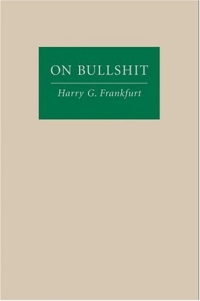
something about "On Bullshit" by Harry G. Frankfurt


Frankfurt begins this meditation on bullshit by examining the definition offered in Max Black's 1985 essay, "The Prevalence of Humbug": bullshit is the "deceptive misrepresentation, short of lying, especially by pretentious word or deed, of somebody's own thoughts, feelings, or attitudes." Frankfurt gets his footing here, but says this definition fails to adequately capture "the essential character of bullshit." Frankfurt next mines a few bullshit-related anecdotes and quotes to uncover his theoretical understanding of bullshit. The somewhat oversimplified synopsis of that understanding is that what is essential about bullshit is that (1) the bullshitter cares not for what is true or false, like the liar and the honest man (in fact, the bullshitter could be saying things that are more or less true and still be bullshitting) and (2) the bullshitter says whatever suits him at the moment in an attempt to deceive his audience about what he is up to and who he is.

The prose in "On Bullshit" is crisp and graciously plain; Frankfurt's essay, an exploratory philosophical analysis, manages to avoid philosophy jargon and name dropping.

Note: This is good:

One who is concerned to report or to conceal the facts assumes that there are indeed facts that are in some way both determinate and knowable. His interest in telling the truth or in lying presupposes  that there is a difference between getting things wrong and getting them right, and that it is at least occasionally possible to tell the difference. Someone who ceases to believe in the possibility of identifying certain statements as true and others as false can  have only two alternatives. The first is to desist both from efforts to tell the truth and from efforts to deceive. This would mean refraining from making any assertion whatever about the facts. The second alternative is to continue making assertions that purport to describe the way things are but that cannot be anything except bullshit.

Friday, April 04, 2014

"The Wizard of Oz" and "Mad Men"


The classic film "Wizard of Oz" depicts a young farm girl journeying through the fantasy land of Oz; the highly rated TV show "Mad Men" follows Don Draper, a highly successful executive in the golden age of advertising. What do the two have in common?

Oz is a magical place; when she first awakes there, Dorothy is dazzled by all the rich color and imagination-defying people and places. But soon she encounters Oz's darker passages, the bends in the road populated by witches and angry trees. Dorothy herself is believed by the populous to be a witch capable of and gifted with extraordinary ability. But, of course, she's really just a simple farm girl. Her journey through--and eventually out of--Oz is a a journey of self discovery. The land of Oz proves to be a dream, a world of false promise. Dorothy tries to find her heart's desire only to discover she had it all along back home with her family.

Advertising in 1960s-era New York City is widely considered the industry's golden age. Don Draper starts life as dirt-poor Dick Whitman, a farm boy who spent much of his formative years meekly in a whorehouse. But during the Korean War, he takes up the identity of a fellow soldier who, unbeknownst to most of the world, actually died in combat. With this identity, and entering the world of advertising, the new Don has the chance to escape his troubled, humble past and build a new life with his confident good looks and intelligence. But the business of advertising, while high in status and flush with cash, hides a competitive world of illusion, promising a life of fulfillment and happiness that can never be delivered. Don's journey on "Mad Men" is proving to also be one of self discovery in which our protagonist returns to his roots and his family.

So Oz and advertising are both worlds of illusion. Both Dorothy and Don are thought of as something they are not. Both characters journey though a land seeking something that ultimately they had all along. Etc ... you can figure out the rest.

Notes:
  • There could be (and probably are) more specific correspondences between the film and TV show. For example, Don's partners could fit the roles of the talking lion, tin man, and scarecrow; Pete Campbell is the Cowardly Lion, Roger Sterling is the Tin Man, and Peggy Olson (and maybe Joan Holloway) is the Scarecrow.
  • When we last saw Don Draper, he had returned with his family to the whorehouse-home Dick Whitman grew up in. Similarly, at the end of her journey, Dorothy ends up back home in Kansas, surrounded by the family who loves her.


Tuesday, April 09, 2013

one of many things about Camus' "The Stranger"

(aka "The Outsider" or "L’Étranger")

Albert Camus' The Stranger begins with the main character, Meursault, attending to his mother's funeral. He resumes his life the day after the funeral, but quite soon kills a man in cold blood, apparently, and stands trial. It is not so much his murderous act, but rather his earlier callousness and inexplicable behavior after his mother's death that are used as evidence to convict him.

It's boilerplate to say Camus' The Stranger depicts a brand of existentialism. But even so, Meursault is not readily understood, though, oddly enough, he's completely relatable. Maybe this is because he also personifies another philosophy--one we all have but hate to admit to, a way of life that does not always seem conventionally noble: Pragmatism. 

The novella first casts pragmatism as universal, a view everyone adopts at one time or another.* Then, pragmatism, in all its beauty and brutishness, is contrasted with and convicted by lofty, often unrealistic ideals like nobility and justice.

Here are examples of how pragmatism is depicted as a quite ordinary mode of life, as universal: In accepting his mother's death, Meursault says, "The funeral will bring it home to me, put an official seal on it, so to speak ... " (p. 2). When he arrives at the retirement home chapel, the caretaker is too busy to greet him right away; then, when he arrives, Meursault immediately asks to see mother's body, but the caretaker has already rested the lid on the coffin. When asked, Meursault declines to have the lid removed for viewing. Here, the "official seal" is already on, and he need not see the body for repeated closure. His not viewing the body is later deemed criminal. But, meanwhile, the warden denies the other retirement home residents access to much of the ceremony because death, he says, puts them "in a nervous state for two or three days. Which means, of course, extra work and worry for our staff" (p. 4). The whole sequence goes on like this, Meursault just going through motions and the staff joining him and cutting corners of their own. In this way pragmatism is first cast as universal--everyone seeks their own convenience much of the time.

When retold in the courtroom, it is Meursault's behavior, not everyone else's, that is reexamined--reexamined out of context. And behavior that was previously all too human is on second thought deemed inhumane.


* Pragmatism may be easily confused with, and, in a sense, interchangeable with selfishness.

Notes

  • On the matter of mourning: Meursault doesn't give much sign of mourning for his mother. But the novel shows that mourning is usually centered on oneself rather than the deceased--you mourn your own loss, not the death of the other. For example, when an elderly woman cries at the wake, the caretaker explains, "She was devoted to your mother. She says your mother was her only friend in the world, and now she's all alone" (p. 12). This is the only person who cries throughout. Compare this scene to one later in the novella in which Meursault's neighbor loses his dog and suffers for it; on the suggestion that the pound might euthanize the mutt, the neighbor, Salamano, is quoted as saying, "'They won't really take him from me, will they, Monsieur Meursault? Surely they wouldn't do a thing like that. If they do, I don't know what will become of me'" (p. 50). Then, after Meursault and Salamano return to their respective rooms, we hear Meursault thinking, "Through the wall there came to me a little wheezing sound, and I guessed that he (Salamano) was weeping. For some reason, I don't know what, I began thinking of mother" (p. 50). And, on the astonishing final page, Meursault speaks again of this mourning, judging it so: "With death so near, Mother have felt like someone on the brink of freedom, ready to start life all over again. No one, no one in the world had any right to weep for her" (p. 154). 
  • The murder is still a bit of a mystery, though not entirely. 

A favorite line:

On leaving another neighbor's apartment drunk on wine:
After closing the door behind me I lingered for some moments on the landing. The whole building was quiet as the grave, a dank, dark smell rising from the well hole of the stairs. I could hear nothing but the blood throbbing in my ears, and for a while I stood still, listening to it. Then the dog began to moan in old Salamano's room, and, through the sleep-bound house the little plaintive sound rose slowly, like a flower growing out of the silence and the darkness (p. 42).


Friday, August 03, 2012

Gore Vidal, 1925–2012


A few months ago I wrote of a trend in which people write critically of the newly dead. With Gore Vidal now gone, one such item appears in Salon with the clever title "Stop Eulogizing Gore Vidal". But this writer gets it all wrong. He accuses Gore of aristocratic WASP-ish snobbery. Well, yeah, but that's not a damnable offense. The writer's main charge is antisemitism. Gore clearly took a political stance against Zionists; that is not antisemitism. Moreover, in the early eighties Gore urged American Jews to team up with gays and work together to get mainstream acceptance.

Anyway, knocking Gore for condemning a people is like accusing water of hydrating Nazis during World War II. Condemning is what he did. Criticism was one of Gore's biggest talents and he practiced it most of the time. Hell, he looked down on anyone he didn't hate.

This was not a good anti-eulogy.

Notes:
  • "Stop Eulogizing Gore Vidal" wins the gold for most crusty, crotchety title.

Tuesday, May 22, 2012

Siri and iPhone 4S (or whatever it is) commercial


See the two commercials for the iPhone 4S: one with Samuel L. Jackson and the other with a "Zooey Deschanel". Note the repartee between actor and phone. What are they selling?

Most immediately, they are selling Command. Command requires a commander, someone who controls, who navigates, who regulates; in this case, the phone owner. Command also requires the attention of another, someone willing to take as her will the will of the commander; she is the audience--in this case, the phone.

But what need does Command satisfy? What common desire are the marketers exploiting?

We're buying the license to indulge our own personality. To indulge, to express the self to the machine for the benefit of the self. Notice how the characters run a commentary, as if entertaining the phone; but really they are entertaining themselves.

When we narrate for and "interact" with Siri, we can act obnoxious or cute, voice whatever witticism, drivel, passing thought and fancy that would otherwise shrivel and die as things do when they are unfit for survival. But now such behavior is legitimized because now you have a (captive) audience, which, in your mind, makes you a star, a sovereign without territory, holding court with your first and only servant.

But that is the illusion. What is the actual effect?

Man, obliterated again and again by technologies since the industrialized age, seeks yet again to actualize himself through more technology, this time through the validation that comes with getting recognized by the machine--the machine that consumes him.

He doesn't speak to a person through the phone; he speaks to the phone, and the phone answers him. But it answers not the way a patient parent answers her insufferable child. Rather, he merely hears the mechanized echo of his own voice and mistakes it for contact. And rather than grow up, he grows even more dependent until he can't function without it. He is obliterated in his discourse with the machine that tolerates him, for, in this discourse, no one is learning about him, growing to like to him (or hate him), getting used to him, making him more compassionate or better or more patient--indeed, probably the opposite is true. He regresses into infancy.

But now he is old.

Notes:
  • I don't know who a "Zooey Deschanel" is but judging by an images search it's a professional face maker.

Friday, April 27, 2012

About "Understanding Media: The Extensions of Man" by Marshall McLuhan


As much as an intellectual can, Marshall McLuhan caused a stir when he proposed that "the medium is the message" in Understanding Media (1964), the thorough analysis of media--not its content but media itself and its effects on how we think and act and make culture. It's a big, heavy subject, and McLuhan chips away at it on a great many fronts. Too many. For me, Understanding Media reads like a brilliant, nearly consumed man's mind dump rather than an organized argument. Gets tiresome.

Not to mention that often terrible writing style so prominent in the 1960's when authors of all stripes employed a scientific-ish vocabulary, needlessly obscuring their ideas in the bid for legitimacy. (Lots still do this!) For example: "Clothing, as an extension of the skin, can be seen both as a heat-control mechanism and as a means of defining the self socially" (chapter 12). But sometimes one of McLuhan's many crackerjack wisdoms splash water on your face, like this gem: "Language extends and amplifies man but it also divides his faculties. His collective consciousness or intuitive awareness is diminished by this technical extension of consciousness that is speech" (chapter 8).