Showing posts with label World War II. Show all posts

Saturday, October 19, 2024

something about Richard Yates's "A Good School"

A Good School is a coming-of-age story set in a Connecticut prep school in the early 1940s. Students, teachers, and school officials all struggle as World War II looms in the distance.

Richard Yates based the fictional Dorset Academy on a school he attended, Avon Old Farms School, and 15-year-old William Grove is Yates's stand-in. Dorset, like Avon, is not an elite school.

Grove struggles in every class except English. His talent for writing eventually leads to a role as editor-in-chief of the school paper. Through work, he builds confidence and gains purpose. He also earns some respect and makes some complicated but meaningful friendships.

Yates includes personal notes in a foreword and afterword. He writes in the afterword that his time at Avon "taught me the rudiments of my trade." He also mentions his and his father's skepticism of the school and each other:

And is there no further good to be said of the school, or of my time in it? Or of me?

I will probably always ask my father such questions in the privacy of my heart, seeking his love as I failed and failed to seek it when it mattered; but all that—as he used to suggest on being pressed to sing "Danny Boy," taking a backward step, making a little negative wave of the hand, smiling and frowning at the same time—all that is in the past.


Notes:
A Good School was published in 1978.
See my other posts about Yates: something about “Revolutionary Road” by Richard Yates, something about Richard Yates, and something about Richard Yates’s “Liars in Love.”

Friday, June 21, 2024

about "A Special Providence" by Richard Yates

A Special Providence folds the rite-of-passage experiences of young infantry solder Robert Prentice between scenes from his anxiety-sprained youth.

Alice Prentice drags her son, Bobby, through her unstable life. They survive mostly on alimony as she chases artistic success she can never have.

After high school, Robert enlists and finds himself overseas during the last days of World War II. He makes a pitiful soldier, getting sick on the line and overwhelmed with confusion when fighting starts.

The novel's end made an impression on me. Spoiler: Alice starts drinking a lot and pins all hope on Robert returning and working so she can start sculpting again. But Robert decides not to return to America. He sends her a little money and wishes her luck.

The novel is no comedy, but I laughed at Yates's telling of some of Robert's struggles in the war. I related to his attempts, all vain and hopeless, not to look foolish. I laughed on a crowded train when I read this part—Robert struggles to follow his platoon and make sense of the action around him:

They were in a plowed field: the ridged, uneven earth gave like sponge beneath their feet. Prentice followed the sounds of voices into the darkness, running again, while the shells rushed overhead to explode well behind him, back on the other side of the canal. And it was there in the field, slightly behind him and to the right, that he heard Sam Rand’s voice:

“Prentice? That you?”

“Sam! Jesus, where’ve you—”

“Where the hell you been?”

“Where’ve I been? My God, I’ve been looking all over hell for you!”

It was still bad, but Robert had felt a little less confused in this firefight. So when his platoon leader inevitably reprimands him, Robert fires back. But doing so only makes matters worse.

This book has so many golden moments. The proseevery humiliation, whether in the chaos of the battlefield or during a childhood encounter with neighborhood kidsswells with sensitivity.

Several years ago I read a Yates short story collection and The Easter Parade. I knew he was special, but I guess I waited a few years before reading everything else he wrote. I knew he was my favorite author probably after reading this or Revolutionary Road.

Notes: A Special Providence, published in 1969, is Yates' third book. The cover image chosen for this Vintage Books/Random House edition does not fit the books contents or themes.


Friday, October 13, 2017

something about "The Naked and the Dead" by Norman Mailer


In Norman Mailer's weighty The Naked and the Dead, we join the US Army 112th Cavalry Regiment in the Philippines during World War II. I was drawn to the emotionally resistant character, Red Valsen. And though I struggled to connect with the rest of the cast, I appreciated the way Mailer captures and layers the emotional and physical struggles of these young men. 

This novel, written in 1948, is probably Mailer's best-known book-length work other than The Executioner's Song. I read the fiftieth anniversary edition of The Naked and the Dead; in it, Mailer includes an introduction in which he credits Leo Tolstoy's Anna Karenina as his inspiration at the time. I enjoyed parts of The Naked and the Dead. Mailers technique of splicing in flashbacks and interludes lends his story a film-like quality. Like his characters, Mailer was in the 112th Cavalry in the Philippines during The War. Years ago I read and was much impressed by his novella The Gospel According to the Son, so I was eager to read another by the multivalent American.

Friday, January 01, 2016

something about "Dangling Man" by Saul Bellow

 
Our Dangling Man keeps a journal in which he agonizes over the gaps between his past and present selves. His encounters with people sound largely antagonistic.

The voice of the journal belongs to Joseph, a young man living in Chicago. At this moment in his life, Joseph is unemployed, and
1942 America is at war. Joseph's voice captures truths that are universal (or, at least national), temporal, and personal. Frustration over his compulsion to drill and drill himself for value taint Joseph's reflections. Although determined to unleash these thoughts, Joseph is an unwilling participant in a culture that increasingly casts every self in the lead role.

At the time of his writings, Joseph, Canadian by birth, has been waiting for word on his acceptance into the American army during World War II. He surrenders his personal freedom to end this suffering. He closes his journal with the words,

Hurray for regular hours!
And for the supervision of the spirit!
Long live regimentation!

Notes:
Dangling Man, written in 1944, is Saul Bellow's first published work. I thought
Dangling Man had interesting moments, but I did not enjoy reading it.

Friday, May 02, 2014

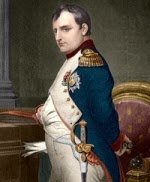
something about "The French Revolution and Napoleon"


The French Revolution and Napoleon distills with flourish the fiery, priority years of French, Western, and arguably world history from about 1789 to 1815. The bulk of those years encompass the reign of Emperor Napoleon Bonaparte; but in his book, Charles Downer Hazen gives equal time to the relatively brief epochal years of the French Revolution.

When this history begins, monarchies exercised feudal rulership over Europe, mostly. Francenine-tenths of which was peasantswas suffering the mismanagement of Louis XVI and massive class inequalities of wealth, privileges, rights, and justice. By 1789, the treasury runs dry and a series of national assemblies, constitutional conventions, and emergency committees gather in Paris. Political factions spring up, feuds begin, and revolutionaries quarrel with each other and with the keepers of the status quo. At one point, a draft of the constitution incorporates the Catholic Church with the State, sparking another feud, this time between the elected clergy and the old faithful. This is how the French Revolution begins.

King Louis XVI, of course, is an immediate underdog. But before the revolution reaches his doorstep, France finds itself at war with a Europe full of worried kings and French expatriate clergy and nobles agitating abroad for counter-revolution. Despite a bad start, France somehow manages to fend off and actually beat the primary aggressors, Austria and Prussia.

Fighting this war keeps France from total dissolution and buys King Louis XVI some time. But the war also spurs some of the first ultra-violence, as panicking nationalists find and kill any suspected domestic traitors and terrorists. From here, the feuds between political factions bring France to a boil. As the balance of power tips, the majority at once begins imprisoning and executing its enemies. This so-called Reign of Terror (also known as simply The Terror) ultimately discredits the radical majority, allowing some sense to emerge from the bloody chaos enough so that a functional, albeit ultimately temporary government and constitution are established.

Meanwhile, having fended off domestic mobs from the convention halls at home and then leading French soldiers to victory abroad, Napoleon steps up center stage. He makes use of any time he gets in Paris, networking and then organizing a coup d'etat. Of course, his version of the constitution makes Napoleon Emperor of France. Now head of the state, Napoleon establishes a new norm and order. This order honors the revolutionary principle of equality, more or less, but not liberty, and for the people this is enough for awhile.

But the temporary peace that allowed Napoleon to take the throne dissipates, and France is once again at war with everyone in Europe and Russia. Under Napoleon's direction, France somehow keeps winning against them all except for England, whose Navy has the definite edge. Napoleon feuds with the Pope in Rome, but forms an alliance with Czar Alexander I in Russia, with whom some of France's spoils are shared. Trying a different tactic, Napoleon aims to bleed England of its wealth by declaring a boycott of English goods across the expanded French Empire. But ultimately this causes as much or more hardship for France's subordinate kingdoms, whose peasant class needs the English trade.

So the relative peace in the expanded French Empire withers under this hardship, and again the French expatriate clergy and nobles agitate abroadincluding those in Russiaagainst Emperor Napoleon. Czar Alexander I violates the boycott and Napoleon invades Russia. The Russian military retreats but the Russian climate fights the battle with France and Napoleon, his forces decimated, is forced to withdraw and then struggle to maintain control of rebelling occupied German states. Russia and England join Austria and Prussia in the fight, and Napoleon loses Germany. His determination to keep the remainder of his empire proves hopeless, however, and Napoleon abdicates rule of France and is banished to the island of Elba.

All that, Napoleon's rule from 1804 to 1814, would be a great enough story. But Napoleon authors a powerful final chapter when he raises an army on Elba and embarks on a sequel. Evading the English Navy, the ousted Emperor sails to France and marches to Paris where he is welcomed a hero. The order established in his absence, headed by the installed King Louis XVII, dissatisfies the people. The European alliance that defeated him last time, feuding amongst themselves over how to split up the defeated French Empire, resolve to put a stop to Napoleon once and for all. Napoleon rushes an army to Belgium to beat the allies to the punch, but there he is met by the Duke of Wellington, who defeats Napoleon at Waterloo. Napoleon is banished this time to the island of St. Helena in the South Atlantic where he dies six years later.

The French Revolution and Napoleon was published in 1917 when European rivals were still burying millions in World War I. Author Charles Downer Hazen uses his preface to recognize this, urging that "there is much instruction to be gained from the study of a similar crisis." Of course, in its way, WWI begot WWII so, if there were any lessons to learn at all, nobody learned them.


Notes:
At one point, King Louis XVI's attempt to flee the palace in Versailles turns into a freakish parade, the heads of his guards hoisted high on pikes by mocking crowds.