Showing posts with label Europe. Show all posts

Friday, February 27, 2026

something about “Heart of Darkness”

I read Heart of Darkness as an undergraduate in college. The class was asked if the book was racist. I have no idea what academia thinks of this question now (I have my suspicions), but I recently reread the book and thought it pretty obvious that it is an indictment of European colonial rule in Africa. And, furthermore, the story told in the novella, published in 1899, is narrated by a third character, sailor Charles Marlow, and this simple storytelling technique distances the author, Joseph Conrad, from the narrator’s views and language.

Marlow’s descriptions of Africans are ugly. They are savages. But the Africans appear ugly and often inhuman because they are being dehumanized. Marlow sees the white European bureaucrats as brutal, and Kurtz is the ultimate company functionary-inflictor. Kurtz was the worst savage of them all, and no doubt.

The story Marlow tells his listeners is about his experience assigned as a steamer captain for a Belgian trading company in Africa. When he sets out, Marlow is advised about Kurtz, an ivory trader working far upriver (probably the Congo River), and the possibility that Kurtz is sick. Kurtz has reportedly "gone native" and is the object of Marlow's expedition. Marlow suffers a hellish journey and discovers the horror of European colonization.

The prose throughout Heart of Darkness is great, although Marlow waxes philosophically during his narration, which can fray the thread.

‘You know I hate, detest, and can’t bear a lie, not because I am straighter than the rest of us, but simply because it appalls me. There is a taint of death, a flavour of mortality in lies—which is exactly what I hate and detest in the world—what I want to forget. It makes me miserable and sick, like biting something rotten would do. Temperament, I suppose. Well, I went near enough to it by letting the young fool there believe anything he liked to imagine as to my influence in Europe. I became in an instant as much of a pretence as the rest of the bewitched pilgrims. This simply because I had a notion it somehow would be of help to that Kurtz whom at the time I did not see—you understand. He was just a word for me. I did not see the man in the name any more than you do. Do you see him? Do you see the story? Do you see anything? It seems to me I am trying to tell you a dream—making a vain attempt, because no relation of a dream can convey the dream-sensation, that commingling of absurdity, surprise, and bewilderment in a tremor of struggling revolt, that notion of being captured by the incredible which is of the very essence of dreams...’

He was silent for a while.

‘… No, it is impossible, it is impossible to convey the life-sensation of any given epoch of one’s existence,—that which makes its truth, its meaning—its subtle and penetrating essence. It is impossible. We live, as we dream—alone …’

He paused again as if reflecting, then added—

‘Of course in this you fellows see more than I could then. You see me, whom you know …’


Notes:

  • Conrad drew on his own experience working for a Belgian trading company, taking a steamer up the Congo River.
  • Heart of Darkness inspired Francis Ford Coppola's 1979 masterpiece “Apocalypse Now.” That film is might be the better work—the director’s cut, anyway.

Friday, September 02, 2016

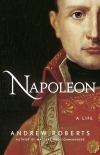
something about "Napoleon: A Life" by Andrew Roberts


The conventional title of Andrew Roberts' Napoleon: A Life underscores the unconventional greatness of its subject. Napoleon's was not just any life.

With this, Roberts takes a stab at claiming the privilege of having written the definitive Napoleon biography. And though it weighs in at 800 pages, this is an efficient document. Napoleon's rise and fall are chronicled with context. The French political landscape; the international theater; and the military maneuvers of Napoleon, his collaborators, and his adversaries--all of this is included. (The only supplemental reading I would suggest is a decent book on the entirety of the French Revolution.)

I especially enjoyed reading about Napoleon's leadership. I had always assumed that leadership was about the makeup of the leader: his charisma, confidence, courage, and competence. Napoleon had all of that in spades, to be sure. But after reading about how Napoleon treated his men, it seems clear that one can demonstrate leadership by recognizing and celebrating the personality of the team (as opposed to drawing on his own personality and character).

Monday, November 03, 2014

about "Travels in Siberia" Ian Frazier


Ian Frazier, humor contributor to The New Yorker, developed a Russia fetish traveling there and, in 2010, published Travels in Siberia. This hefty travel log relays all kinds of details about Frazier's experiences with his guides, with locals, the climate, terrain, and culture. As made clear by the title, this book focuses on his times in Siberia, the massive symbol that accounts for the bulk of Russian territory (about three quarters of it). The travel-log part that makes for most of the book plodded aimlessly, and the narrative's pace stalled; the best parts relate some fascinating history lessons.

Friday, August 29, 2014

about "The Course of French History" by Pierre Goubert


In this tidy one-volume history, Pierre Goubert fairly encapsulates the social, political, and economic evolution of France, from the blurry edges of the monarchy in 987 to the present (about 1980). More fluid and narratively organized than a textbook, but too sweeping to fit neatly with most modern nonfiction historical works, The Course of French History maintains enough momentum to avoid drying out, but never approaches being a page-turner. Goubert, who has done his research, tempers and delivers his own informed judgements passively. This volume suits anyone doing independent study of French, European, or even World History, giving you all the basics with just a taste of the details.


Note
Recounting the contents here would be pointless.


Friday, May 02, 2014

something about "The French Revolution and Napoleon"


The French Revolution and Napoleon distills with flourish the fiery, priority years of French, Western, and arguably world history from about 1789 to 1815. The bulk of those years encompass the reign of Emperor Napoleon Bonaparte; but in his book, Charles Downer Hazen gives equal time to the relatively brief epochal years of the French Revolution.

When this history begins, monarchies exercised feudal rulership over Europe, mostly. Francenine-tenths of which was peasantswas suffering the mismanagement of Louis XVI and massive class inequalities of wealth, privileges, rights, and justice. By 1789, the treasury runs dry and a series of national assemblies, constitutional conventions, and emergency committees gather in Paris. Political factions spring up, feuds begin, and revolutionaries quarrel with each other and with the keepers of the status quo. At one point, a draft of the constitution incorporates the Catholic Church with the State, sparking another feud, this time between the elected clergy and the old faithful. This is how the French Revolution begins.

King Louis XVI, of course, is an immediate underdog. But before the revolution reaches his doorstep, France finds itself at war with a Europe full of worried kings and French expatriate clergy and nobles agitating abroad for counter-revolution. Despite a bad start, France somehow manages to fend off and actually beat the primary aggressors, Austria and Prussia.

Fighting this war keeps France from total dissolution and buys King Louis XVI some time. But the war also spurs some of the first ultra-violence, as panicking nationalists find and kill any suspected domestic traitors and terrorists. From here, the feuds between political factions bring France to a boil. As the balance of power tips, the majority at once begins imprisoning and executing its enemies. This so-called Reign of Terror (also known as simply The Terror) ultimately discredits the radical majority, allowing some sense to emerge from the bloody chaos enough so that a functional, albeit ultimately temporary government and constitution are established.

Meanwhile, having fended off domestic mobs from the convention halls at home and then leading French soldiers to victory abroad, Napoleon steps up center stage. He makes use of any time he gets in Paris, networking and then organizing a coup d'etat. Of course, his version of the constitution makes Napoleon Emperor of France. Now head of the state, Napoleon establishes a new norm and order. This order honors the revolutionary principle of equality, more or less, but not liberty, and for the people this is enough for awhile.

But the temporary peace that allowed Napoleon to take the throne dissipates, and France is once again at war with everyone in Europe and Russia. Under Napoleon's direction, France somehow keeps winning against them all except for England, whose Navy has the definite edge. Napoleon feuds with the Pope in Rome, but forms an alliance with Czar Alexander I in Russia, with whom some of France's spoils are shared. Trying a different tactic, Napoleon aims to bleed England of its wealth by declaring a boycott of English goods across the expanded French Empire. But ultimately this causes as much or more hardship for France's subordinate kingdoms, whose peasant class needs the English trade.

So the relative peace in the expanded French Empire withers under this hardship, and again the French expatriate clergy and nobles agitate abroadincluding those in Russiaagainst Emperor Napoleon. Czar Alexander I violates the boycott and Napoleon invades Russia. The Russian military retreats but the Russian climate fights the battle with France and Napoleon, his forces decimated, is forced to withdraw and then struggle to maintain control of rebelling occupied German states. Russia and England join Austria and Prussia in the fight, and Napoleon loses Germany. His determination to keep the remainder of his empire proves hopeless, however, and Napoleon abdicates rule of France and is banished to the island of Elba.

All that, Napoleon's rule from 1804 to 1814, would be a great enough story. But Napoleon authors a powerful final chapter when he raises an army on Elba and embarks on a sequel. Evading the English Navy, the ousted Emperor sails to France and marches to Paris where he is welcomed a hero. The order established in his absence, headed by the installed King Louis XVII, dissatisfies the people. The European alliance that defeated him last time, feuding amongst themselves over how to split up the defeated French Empire, resolve to put a stop to Napoleon once and for all. Napoleon rushes an army to Belgium to beat the allies to the punch, but there he is met by the Duke of Wellington, who defeats Napoleon at Waterloo. Napoleon is banished this time to the island of St. Helena in the South Atlantic where he dies six years later.

The French Revolution and Napoleon was published in 1917 when European rivals were still burying millions in World War I. Author Charles Downer Hazen uses his preface to recognize this, urging that "there is much instruction to be gained from the study of a similar crisis." Of course, in its way, WWI begot WWII so, if there were any lessons to learn at all, nobody learned them.


Notes:
At one point, King Louis XVI's attempt to flee the palace in Versailles turns into a freakish parade, the heads of his guards hoisted high on pikes by mocking crowds.