Bill is a soft-spoken man, but his soothing tone and cadence fail to hide the bite of his mind. He is driven, and he’ll drive you. He has power, and his ideas, right or whimsy, come with an official stamp. He arrives early each day, a withdrawn soul always shooing validation farther down the path.
Showing posts with label military. Show all posts
Showing posts with label military. Show all posts
Saturday, May 30, 2026


Friday, October 13, 2017
something about "The Naked and the Dead" by Norman Mailer
 In Norman Mailer's weighty The Naked and the Dead, we join the US Army 112th Cavalry Regiment in the Philippines during World War II. I was drawn to the emotionally resistant character, Red Valsen. And though I
struggled to connect with the rest of the cast, I appreciated the way Mailer
captures and layers the emotional and physical struggles of these young
men.
In Norman Mailer's weighty The Naked and the Dead, we join the US Army 112th Cavalry Regiment in the Philippines during World War II. I was drawn to the emotionally resistant character, Red Valsen. And though I
struggled to connect with the rest of the cast, I appreciated the way Mailer
captures and layers the emotional and physical struggles of these young
men. This novel, written in 1948, is probably Mailer's best-known book-length work other than The Executioner's Song. I read the fiftieth anniversary edition of The Naked and the Dead; in it, Mailer includes an introduction in which he credits Leo Tolstoy's Anna Karenina as his inspiration at the time. I enjoyed parts of The Naked and the Dead. Mailers technique of splicing in flashbacks and interludes lends his story a film-like quality. Like his characters, Mailer was in the 112th Cavalry in the Philippines during The War. Years ago I read and was much impressed by his novella The Gospel According to the Son, so I was eager to read another by the multivalent American.
Friday, September 02, 2016
something about "Napoleon: A Life" by Andrew Roberts
The conventional title of Andrew Roberts' Napoleon: A Life underscores the unconventional greatness of its subject. Napoleon's was not just any life.
 With this, Roberts takes a stab at claiming the privilege of having written the definitive Napoleon biography. And though it weighs in at 800 pages, this is an efficient document. Napoleon's rise and fall are chronicled with context. The French political landscape; the international theater; and the military maneuvers of Napoleon, his collaborators, and his adversaries--all of this is included. (The only supplemental reading I would suggest is a decent book on the entirety of the French Revolution.)
I especially enjoyed reading about Napoleon's leadership. I had always assumed that leadership was about the makeup of the leader: his charisma, confidence, courage, and competence. Napoleon had all of that in spades, to be sure. But after reading about how Napoleon treated his men, it seems clear that one can demonstrate leadership by recognizing and celebrating the personality of the team (as opposed to drawing on his own personality and character).
Thursday, August 01, 2013
Pictures of him as a boy
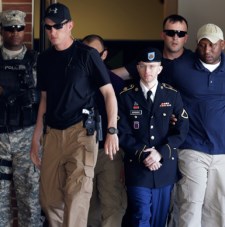 For leaking classified US government information to the website Wikileaks, on July 30, 2013, Army Private First Class Bradley Manning was convicted of 17 charges, including five
counts of espionage and theft. On the heels of this verdict, The New York Times published an article titled "Loner Sought a Refuge, and Ended Up in War". Here, Manning is described as a lifelong outcast. The article further reveals that it was not his crimes that he was being tried for, but his identity:
For leaking classified US government information to the website Wikileaks, on July 30, 2013, Army Private First Class Bradley Manning was convicted of 17 charges, including five
counts of espionage and theft. On the heels of this verdict, The New York Times published an article titled "Loner Sought a Refuge, and Ended Up in War". Here, Manning is described as a lifelong outcast. The article further reveals that it was not his crimes that he was being tried for, but his identity:As prosecutors accused Private Manning of being a self-promoting “anarchist” who was nothing like the tortured man of principle portrayed by his lawyers, supporters around the world celebrated him as a martyr for free speech. But the heated language on both sides tended to overshadow the human story at the center of the case.The article does the sense-making for us. In its narrative, Manning's online connections--first with Wikileaks founder, Julian Assange, then with computer hacker Adrian Lamo--that led to this conviction follow a pattern, and add the apparently unfortunate conclusion to his coherent life's story. However, contrary to what the article says, it is precisely the human story that has been at the center of the case and the center of media coverage from day one: international outlaw, Julian Assange; guilty martyr, Bradley Manning; narcissistic fugitive, Edward Snowden--these are the characters, and they are the story.
Tuesday, February 12, 2013
Warfighter
Warfighter. What does it mean? Who is a warfighter? What is a warfighter?
Circa WWII America, people often spoke of soldiers with admiration, depicting competent men of bravery, or, alternately, innocent sons away in foreign lands. Then, during early 1990's military campaigns in the Persian Gulf, speakers urged the public to "Support our troops". Now, the US Department of Defense introduced into use the term warfighter.

Using the term warfighter shifts the emphasis from the soldier's service to his time in combat. So a veteran is not a warfighter; a soldier is not necessarily a warfighter; and a warfighter is not necessarily a soldier from one of the branches of the US armed forces.
Soldiers have already become somewhat ubiquitous--we see them honored routinely on television and at sporting and political events. Finding yourself in public in the presence of a soldier in uniform is not unusual. Using the term warfighter takes that a step further; it normalizes the condition of war. If a soldier (or contractor) is overseas, he is at war. His presence is war. He is present in war. He is war.
Wednesday, December 21, 2011
In trial's coverage, large issues are ignored
 Today The Washington Post included the Associated Press article "Army private’s defense team to make its case over leaked trove of government materials" which briefly sets the stage for the defense team's argument in the military trial of Pfc. Bradley Manning, accused of "releasing a trove of secret information to the WikiLeaks website" and facing 21 charges, including aiding the enemy.
Based on early trial statements, the article says the defense will argue that (1) Manning was of unsound mind and (2) other personnel had access to the machine(s) on which the alleged crimes were committed. Then, later, a contrast within the gallery is made:
A half-dozen buttoned-down, mostly young men and women favoring charcoal-colored suits have come and gone from gallery seats behind the prosecutor’s table, declining to identify themselves to journalists but apparently representing the Justice Department, the CIA or other government agencies.
Across the room are Manning’s supporters, including a long-haired young man from the Occupy Wall Street movement and a pony-tailed, elderly military veteran wearing a “Free Bradley Manning” T-shirt.Why does Manning have supporters? And what does the Occupy "movement" have to do with it? Some explanation would have been beneficial; these are not fans of insanity defenses and arguments of reasonable doubt. No, these supporters presumably value transparency and whistleblowing (nevermind whether Manning embodies either). But as such, the story is incomplete. Furthermore, by focusing on the contrast between the suits and long hair, the article gives the impression that Manning's supporters are unserious. Were any of his supporters in suits? Did any of them not have long hair?
Monday, July 04, 2011
National myth

In America, myths about the Founding Fathers abound. America also has many myths about its soldiers. A primary myth revolves around the story of the young soldier--a boy, really--who goes off to war and returns a man, stronger than he was when he left.
Ideally, some young woman waits for him. This is the story of the journey, but focused and particular to the American soldier. These myths come to life in movies, books, and video games. But they take deep root in the public psyche when perpetuated through news media. The media's promotion and America's subsequent embrace of the so-called "Greatest Generation" exemplifies many of our military myths, including this one. Military sacrifice thus becomes the highest honor affordable to the middle and lower classes.
That returning soldiers often face unemployment, alcoholism and addiction, shrinking benefits, and physical and mental trauma goes unmentioned.
NPR is engaging in some myth making with their series "Who Serves". Here is an exemplary installment: "For Some, The Decision To Enlist Offers Direction"
Wednesday, April 20, 2011
The revolution that surprised the world, and then was quickly forgotten
 Just a few weeks ago a pro-Democracy revolution in Egypt successfully ousted dictator Hosni Mubarak. The military then assumed power and its leaders who before served faithfully under the autocrat have since ruled the population heavy-handed, jailing the same protesters the press and government so recently and so reluctantly supported. I struggled to find an article about this in the mainstream press, but eventually stumbled on an April 14 article in The New York Times headlined "Egyptian Military to Review Cases of Jailed Protesters".
The treatment in this article is representative of mainstream coverage. First, the story is buried. Second, it includes portions of each side's statements, but doesn't bother looking into either. Third, the title serves the ends of the favored party in the dispute--in this case, the bought-and-paid-for Egyptian military, whose statement is treated as fact. The meat of the story is this line, however, which lies hidden in the article's waistband: "More than 200 protesters have been detained, tortured or put on trial before military courts in the past several weeks, rights advocates said." This statement is not given the same benefit of the doubt.
The article discussed: http://www.nytimes.com/2011/04/15/world/middleeast/15egypt.html
Tuesday, March 08, 2011
Speech Act
 In Snyder vs. Phelps the Supreme Court ruled 8-1 in favor of Westboro Baptist Church members' right to protest at a military funeral. In this case, "at" means something like 1,000 yards away and possibly in accordance with other locally devised and enforced rules. The issue was evaluated by the Justices in terms of free speech, and whether the speech was injurious or injury was only the fallout.
I agree with the majority. The protesters intended to hijack one rhetorical situation--a military funeral--and introduce a second rhetorical situation in which state policy is the target. They did not silence or prevent the funeral. And while their speech act insults the mourners, the inflammatory signage is tactical first and foremost.
The policy under attack concerns gays serving in the military. The soldier being buried was not a homosexual. What if he had been? Could the protesters' intent to injure then be more easily argued?
Subscribe to:
Posts (Atom)