Showing posts with label dialog. Show all posts

Saturday, February 11, 2023

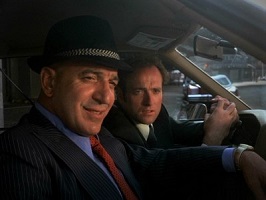
about a scene from the Columbo episode, “Any Old Port in a Storm”

“Any Old Port in a Storm” aired October 7, 1973, and guest starred Donald Pleasence as Adrian Carsini, a wine connoisseur who murders his half-brother to prevent him from selling the family winery. Peter Falk is, of course, Lieutenant Columbo.

Adrian Carsini's anxiety grows with each encounter with the amiable detective. In the just-one-more-thing scene (a staple of every episode), Carsini is almost begging to be caught and relieved of the pressure when Columbo mentions the detail that first triggered his suspicion: the dead man's sports car—which Carsini staged at the beach where he dumped the bodywas spotless even though it had supposedly been parked there in the rain. Columbo yells his apparent afterthought—turning the screw even morefrom the end of the winery's long driveway:

Columbo: Oh, Mr. Carsini! Sir! I just remembered one of the reasons they’re not releasing your brother’s body. I forgot to tell you the other day. Well, you know your brother’s car? It stayed out on that cliff for a week. During that time, it rained, and then we had some sun. But when we saw the car the morning we found the body, it looked like it just came off a showroom floor.

Carsini: What’s your point?

Columbo: No water marks. Can you explain that?

Carsini: No, I can’t.

Columbo: Well, there must be a reason for it. There always is!

Carsini: When you find it, will you tell me!?

Columbo: Believe me, sir, you’ll be the first to know!

Pleasence makes an excellent wine snob. His half-brother is handsome, athletic, an adventurer. But Adrian—short and prissy—has only wine, and his vulnerability is that his world is so small. It makes him desperate.
 
Note: 
- Peter Falk was on Johnny Carson right before the episode aired and expressed his great admiration and appreciation of Pleasance. 
- Dana Elcar has a nice little role as Falcon, a sweet-natured wine enthusiast from Texas.


Saturday, November 02, 2019

something about "The Sweet Hereafter" by Russell Banks


I am a fan of the 1997 film, Affliction. In that film, Nick Nolte and James Coburn deliver rich performances depicting stricken men. The film is based on a book, published in 1989, by Russel Banks. Seeking other works by Banks, I found The Sweet Hereafter, which was published in 1991.

The Sweet Hereafter is divided into a series of first-person narrations of a fatal school bus crash and the devastation it brings on lives in a small town in rural Upstate New York. Most of the children on the bus die, but a few survive, along with the bus driver and a father whose daily commute follows the bus route. Lawyers, news media, and deep pain visit the town in the aftermath. The narratives are focused and contained, and the stories never get entangled. A gritty, emotional realism characterized by resignation imbues the novela feeling that is also prominent in the film adaptation of Affliction. This was a very good read.


Notes: 

The Sweet Hereafter is loosely based on an actual bus crash in Alton, Texas.
 

The film Affliction was directed by Paul Schrader and costarred Sissy Spacek and Willem Dafoe, who, as one would expect, were also great. I have always particularly enjoyed this short exchange in the film:
Rolfe Whitehouse (Dafoe): I was always careful around Pop. I was a careful child. And I'm a careful adult. But at least I was never afflicted with that man's anger.
Wade Whitehouse (Nolte): That's what you think.

Friday, March 15, 2019

dialog from Kojak, "Tears for All Who Loved Her"


Kojak: You know, in a way, I admire her. A little kid, out of the sewers by her fingernails. No father, a lush for a mother.

Crocker: Why did you walk away from her?

Kojak: (Laughs) You know, I remember seeing a picture once. About this guy, came out of the streets, made it big. When he was a kid, used to have holes in his soles. So now he's got 200 pairs of shoes, he's rich. But he'd still cut a guy's heart out for a pair of shoes. That's why.


Note: 20 November 1977

Saturday, April 25, 2015

Saturday, July 16, 2011

This means war

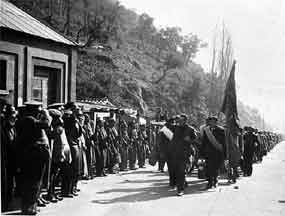
Midway through Ernest Hemingway's The Sun Also Rises, two young guerrillas named Andres and Primitivo probe American expat Robert Jordan about politics and wealth in the US. Andres asks, "Do you have any big proprietors?" Then, "But there are not great estates that must be broken up?" The narrative goes on with Jordan answering,
"Yes. But there are those who believe that taxes will break them up."
"How?"
Robert Jordan, wiping out the stew bowl with bread, explained  now the income tax and inheritance tax worked. "But the big estates remain. Also, there are taxes on the land," he said.
"But surely the big proprietors and the rich will make a revolution against such taxes. Such taxes appear to me to be revolutionary. They will revolt against the government when they see that they are threatened, exactly as the fascists have done here," Primitivo said.

Thursday, March 10, 2011

Talking about conversation

This week's Washington Post article "Rep. Peter King's Muslim hearings: A key moment in an angry conversation" shows an example of news creating news. Such articles argue a point, create information, and fabricate historical record. This is big media's privilege, done in service of privilege.

There is something particularly egregious about this article, too. Offering a slight elaboration on their bizarre headline, authors Farenthold and Boorstein offer this:

On Thursday, the discussion about Muslims' place--and Muslims' obligations--in American society will move to Capitol Hill. The hearing, called by Rep. Peter T. King (R-N.Y.), could be a key moment in one of the country's angriest conversations.

Who is having this angry conversation? Not me. Not most people. And, of those who are regularly discussing the place and "obligations" of Muslims, only a fraction of them have it angrily. But the article goes on:

Public opinion about Muslims hasn't changed much in recent years. In the fall, a Washington Post-ABC News poll asked whether mainstream Islam "encourages violence." Among all respondents, 31 percent said yes, slightly less than the recent high of 34 percent in 2003.

What's different now is the tone of the discussion--in Congress and across the country.

As evidence, the article cites comments made by Representative King, as well as a "string of incidents"--which means two incidents within eighteen months--and an increase in arrests of "violent jihad suspects from May 2009 to November 2010".

This is a non-issue made into an issue. To my mind, the real story here is the rhetorical social and political function of articles like this and hearings such as King's. They get people talking about terrorism again. And at a time when politicians want to cut spending on public pay and services, and on the same day a mass of public workers in Wisconsin are stripped of bargaining rights, terror talk helps keep defense cuts off the table, and public attention directed towards a meaningless sideshow.

The Post article: http://www.washingtonpost.com/wp-dyn/content/article/2011/03/09/AR2011030905750.html