
I thought I smelled Grandmother today. This made me feel far away for the first time in awhile. There was winter, now it's summer, and there was no interruption.
 Billed as "The Uncensored Oral History of Punk", Please Kill Me testifies to punk rock's NYC birth in the mid-1970's. The book organizes quotes from a cast of people who were there--participants and witnesses, and these people describe the scene, say who's who, and, of course, talk about the sex and drugs. But noticeably missing in these quotes is elaboration on the rock and roll.
... while the Court is correct to note (ante, at 8–9) that there are instances in which we have permitted searches without individualized suspicion, “[i]n none of these cases. . . did we indicate approval of a [search] whose primary purpose was to detect evidence of ordinary criminal wrongdoing.” Indianapolis v. Edmond, 531 U. S. 32, 38 (2000).Just how intrusive is the cotton swab? Maybe that's beside the point, as Scalia notes:
And could the police engage, without any suspicion of wrongdoing, in a “brief and . . . minimal” intrusion into the home of an arrestee—perhaps just peeking around the curtilage abit? See ante, at 26. Obviously not.
 And what of the purpose of identifying people? Is identifying someone really so innocent? No, Scalia argues:
At points the Court does appear to use “identifying” in that peculiar sense—claiming, for example, that knowing “an arrestee’s past conduct is essential to an assessment of the danger he poses.” Ante, at 15. If identifying someone means finding out what unsolved crimes he has committed, then identification is indistinguishable from the ordinary law enforcement aims that have never been thought to justify a suspicionless search. Searching every lawfully stopped car, for example, might turn up information about unsolved crimes the driver had committed, but no one would say that such a search was aimed at “identifying” him ...But what if the State really is just identifying people without intending to solve crimes for which no probable cause to search exists?
The truth, known to Maryland and increasingly to the reader: this search had nothing to do with establishing King’s identity.So, all that said, what does the majority's errant ruling promise for the future?
...
DNA testing does not even begin until after arraignment and bail decisions are already made. The samples sit in storage for months, and take weeks to test. When they are tested, they are checked against the Unsolved Crimes Collection—rather than the Convict and Arrestee Collection, which could be used to identify them.The Act forbids the Court’s purpose (identification), but prescribes as its purpose what our suspicionless-search cases forbid (“official investigation into a crime”). Against all of that, it is safe to say that if the Court’s identification theory is not wrong, there is no such thing as error.
The Court disguises the vast (and scary) scope of its holding by promising a limitation it cannot deliver. The Court repeatedly says that DNA testing, and entry into a national DNA registry, will not befall thee and me, dear reader, but only those arrested for “serious offense[s].” Ante, at 28; see also ante, at 1, 9, 14, 17, 22, 23, 24 (repeatedly limiting the analysis to “serious offenses”). I cannot imagine what principle could possibly justify this limitation, and the Court does not attempt to suggest any. If one believes that DNA will “identify” someone arrested for assault, he must believe that it will “identify” someone arrested for a traffic offense. This Court does not base its judgments on senseless distinctions. At the end of the day, logic will out. When there comes before us the taking of DNA from an arrestee for a traffic violation, the Court will predictably (and quite rightly) say, “We can find no significant difference between this case and King.” Make no mistake about it: As an entirely predictable consequence of today’s decision, your DNA can be taken and entered into a national DNA database if you are ever arrested, rightly or wrongly, and for whatever reason.

 With seven hollow vibrations, Our Lady of Sorrows' bell sank into the still-salty street and patched grass yards. I crossed into the big lot, passed the gym and Big Lots, then pulled the door. After grabbing a box each of sandwich and freezer bags--four dollars for both--and waiting the requisite two minutes in line, my turn. The young cashier, a girl no more than 17, here working at Family Dollar, rang me up, taking a five and exact change to cover the $4.36. Hands me my change, then speaks,
Thanks for putting the money in my hand. A lot of people just throw it on the counter.
That's how the big shots do.She comes around and recollects a bunch of mops for sale by the door. Says,
Even though my hand be right here, she adds.She returns to the register. The next has already lined up behind me.
Thank you.
Have a good night, I hear, pushing back into the big lot.Concrete sinks beneath me. Cool air lends the hush.

Most of the big shore places were closed now and there were hardly any lights except the shadowy, moving glow of a ferryboat across the Sound. And as the moon rose higher the inessential houses began to melt away until gradually I became aware of the old island here that flowered once for Dutch sailors' eyes--a fresh, green breast of the new world. Its vanished trees, the trees that had made way for Gatsby's house, had once pandered in whispers to the last and greatest of all human dreams; for a transitory enchanted moment man must have held his breath in the presence of this continent, compelled into an æsthetic contemplation he neither understood nor desired, face to face for the last time in history with something commensurate to his capacity for wonder.
And as I sat there, brooding on the old unknown world, I thought of Gatsby's wonder when he first picked out the green light at the end of Daisy's dock. He had come a long way to this blue lawn and his dream must have seemed so close that he could hardly fail to grasp it. He did not know that it was already behind him, somewhere back in that vast obscurity beyond the city, where the dark fields of the republic rolled on under the night.
Gatsby believed in the green light, the orgastic future that year by year recedes before us. It eluded us then, but that's no matter--tomorrow we will run faster, stretch out our arms farther. . . . And one fine morning----
So we beat on, boats against the current, borne back ceaselessly into the past.
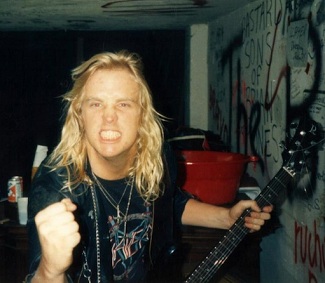
 The sleeve and press around Dry calls it a memoir, but the book reads more like fiction. Burroughs aptly boosts his addiction-oriented narrative with wit and crisp prose. Result, the pages turn quickly.
 Foucault took an interest in how concepts of visualization become embedded in institutional practices, and how ethical and moral judgements of things and people changed with those concepts. It is hard to imagine now that people asked different questions in the past; we tend to think we've always been "logical", that being logical is part of our nature. But being "logical" used to be a moral exercise.
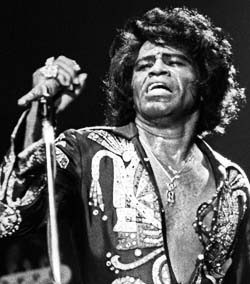 Brown was born, barely, into extreme poverty, and grew up motherless, at the mercy of a hardscrabble father. His affinity for music and singing and his seemingly innate start quality got him followers and fellow musicians from early on. During the first half of his career, James Brown busted ass, working musicians into the tightest band alive, and wielding that band as his own, personal instrument. Year-round, he left it all on the stage.
 It's boilerplate to say Camus' The Stranger depicts a brand of existentialism. But even so, Meursault is not readily understood, though, oddly enough, he's completely relatable. Maybe this is because he also personifies another philosophy--one we all have but hate to admit to, a way of life that does not always seem conventionally noble: Pragmatism.
 * Pragmatism may be easily confused with, and, in a sense, interchangeable with selfishness.
After closing the door behind me I lingered for some moments on the landing. The whole building was quiet as the grave, a dank, dark smell rising from the well hole of the stairs. I could hear nothing but the blood throbbing in my ears, and for a while I stood still, listening to it. Then the dog began to moan in old Salamano's room, and, through the sleep-bound house the little plaintive sound rose slowly, like a flower growing out of the silence and the darkness (p. 42).
 Quell is tortured, intense, rough, gaunt, uneducated, drawn to poisons and pain; Dodd is composed, graceful, educated, well-dressed, plump, and drawn to the spotlight. When the film debuted, critics wondered, What, if anything, does the film say? say about our talk of freedom and our readiness to serve a master? about the inevitable disappointment that comes with looking up to someone? about faith? belief?
 If a contestant sings well but looks unconventional, she can pass the first round. But then comes the problem: you have to be believable; the audience must think you are believable as a pop star, a pop idol. And that believability, no matter your personal preferences, depends on your preconceptions of what a pop star is.
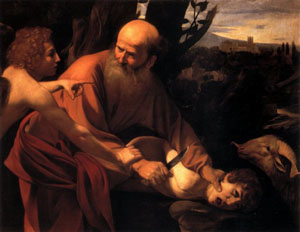 Abraham, a favorite of God, was an old man before he finally had a child. Through Isaac, his first born son, Abraham was to populate the nations. But God called on Abraham to sacrifice Isaac on Mount Moriah. Abraham prepared his belongings and took his son Isaac on a three-day journey there to do as God asked. Isaac asked why his father was not bringing a lamb to the sacrifice and Abraham answered that God would provide. Upon reaching Moriah, Abraham binds Isaac and draws the knife. At the last minute, Abraham is told by an angel not to follow through with the sacrifice. Ultimately a ram caught up in some nearby bushes serves as the sacrifice.
 When you move somewhere new, you might find a lot of the people there are nice. This is because you are more likely to ask people for help
and information and, naturally, they oblige best they can. Where you're from, you rarely
had to ask people for help because you knew the area, the
weather patterns and expectations, the laws and ordinances, and so on. So people there were just people you had to share the city with. Your new neighbors are people you try to get along with.
When you move somewhere new, you might find a lot of the people there are nice. This is because you are more likely to ask people for help
and information and, naturally, they oblige best they can. Where you're from, you rarely
had to ask people for help because you knew the area, the
weather patterns and expectations, the laws and ordinances, and so on. So people there were just people you had to share the city with. Your new neighbors are people you try to get along with. Both the films "Lincoln" and "Django Unchained" concern African American slavery in the US--an issue that in ways big and small plagues the US still. But "Lincoln" portrays and conveys black people differently--I think with a greater truth, the kind of truth only realized in art.
