
The race is not to the swift, nor the battle to the strong, neither yet bread to the wise, nor yet riches to men of understanding, nor yet favour to men of skill; but time and chance happeneth to them all.
―Ecclesiastes 9:11
The race is not to the swift, nor the battle to the strong, neither yet bread to the wise, nor yet riches to men of understanding, nor yet favour to men of skill; but time and chance happeneth to them all.
―Ecclesiastes 9:11

"I go to war for my family, for my country," Amin said. "Because (Assad) has killed everyone. He killed my cousin. He destroyed my village. He destroyed my home."

Fans will find this assessment offensive. Stewart and Colbert, they will argue, are comedians, offering late-night entertainment in the vein of David Letterman or Jay Leno, but with a topical twist. To expect them to do anything more than make us laugh is unfair. Besides, Stewart and Colbert do play a vital civic role—they’re a dependable news source for their mostly young viewers, and de facto watchdogs against media hype and political hypocrisy.

It is well known that a whole train of thought can pass through one's mind in a flash in the form of some kind of feeling, without being translated into human language, let alone into writing ... Because many of our feelings, put into ordinary words, would appear quite implausible, would they not? That is why they are never revealed, but remain locked up within us.-from "A Disgraceful Affair" by Fyodor Dostoevsky


 Taking
this story on a tangent, on June 30 this year, a modest group of Mormons gathered to renounce their membership in the LDS Church using methods
that conflate
the political with the religious: their gathering was personal ceremony
and political protest; they waved a "Declaration of Independence from
Mormonism" and offered letters of resignation, seeking "freedom" as they
gathered at Ensign Peak like Brigham Young
did with his followers in 1847; they sacrificed church-bound
relationships with their community, yearning to receive those same
relationships in return, renewed as social and business ties; their
reasons for quitting included Church teachings that are "made
up", that conflict with science, that conflict with history, that veil
racism and promote intolerance, and that are inconsistent.
Taking
this story on a tangent, on June 30 this year, a modest group of Mormons gathered to renounce their membership in the LDS Church using methods
that conflate
the political with the religious: their gathering was personal ceremony
and political protest; they waved a "Declaration of Independence from
Mormonism" and offered letters of resignation, seeking "freedom" as they
gathered at Ensign Peak like Brigham Young
did with his followers in 1847; they sacrificed church-bound
relationships with their community, yearning to receive those same
relationships in return, renewed as social and business ties; their
reasons for quitting included Church teachings that are "made
up", that conflict with science, that conflict with history, that veil
racism and promote intolerance, and that are inconsistent.


From ’89 on I’ve had people tell me who I am. And they pick my personality as if it’s a one or two-dimensional thing, and I’m more like a tetrahedron. I can’t think of any people outside of Weird Al Yankovic who have both embraced and pissed on Rock more than I have. Obviously there’s a level of reverence, but there’s also a level of intelligence to even know what to piss on. ‘Cause I’m not pissing on Rainbow. I’m not pissing on Deep Purple. But I’ll piss on fuckin’ Radiohead, because of all this pomposity. This value system that says Jonny Greenwood (Radiohead) is more valuable than Ritchie Blackmore (Deep Purple). Not in the world I grew up in, buddy. Not in the world I grew up in.
So I find myself defending things. Is Ritchie Blackmore a better guitar player than me and Jonny Greenwood? Yes. Have we all made contributions? Yes. I’m not attacking that. I’m attacking the pomposity that says this is more valuable than that. I’m sick of that.
 I don't think Corgan is attacking Radiohead. He's using them as an example of a popular band that critics deify while trashing other artists, himself in particular. The "pomposity" is the pompousness of critics who fawn over select bands and citicize those whom its safe to criticize. Corgan's predictably irreverent response would be to "piss on fuckin’ Radiohead" because no one else will--not because Radiohead deserves to be pissed on.
Look, we’re all insecure in our own ways, most of us. You’ve got a Facebook with a few hundred friends. If you do something truly radical, are you ready to withstand the forty negative comments? Most people aren’t. So they’re getting peer pressured at levels they don’t even realize. It’s what you don’t say.
It’s like the government spying on us. Right? Now it becomes about what we don’t say. The same thing with culture. I’m just willing to say it, and deal with the forty negative comments.To the extent that anything can be interesting, Corgan sort of can be because he's a bit of a paradox. He's trying to be a rock star but he thinks we have none, can have none, and that it's pointless and vain. As he did during the 90's early alt-rock scene, he's the champion of zeroes and outcasts because he is not accepted as cool (anymore); but he's also the antithesis of that guy because he makes a spectacle of himself by dating porn whores, shaving his head, saying inflammatory crap and whatnot. This paradox is him now.
And the funny thing is that I’ve been playing with conceptual identities all along. And I’ve watched each turn, as I’ve adapted to each cultural identity, how I’m attacked for not being this or that, or too much of this or too little of that. Meanwhile the real me is standing behind it all noting where the deflector shield works and where it doesn’t. And what gets through. Now I’m actually strong enough where I don’t need a mask. I’m just myself.And then he brings this back to the original point--that he gets criticized unfairly (unfair because the playing field isn't even):
Well what I’m saying is rather than be celebrated as a radical who’s continually subverted the system and turned his back on much greater commercial realities than I’ve embraced, I’m celebrated as this fucking weirdo who just won’t go away!Is he an ass? Oh yeah. And maybe he's wrong, too, but he might as well be understood before he gets shit on for being so.
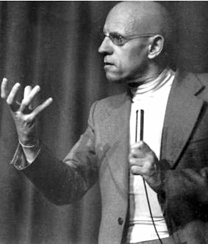 Foucault lectured at the Collège de France for several semesters. This opportunity allowed him to continue and share his research, his hypotheses and conclusions. In this lecture series, Foucault traces the origin and evolution of the modern concept of government and the assemblage of techniques, collectively called security, it uses in managing the population. Foucault shows that the question of how the sovereign should rule the territory and its inhabitants became a question of what technique of leadership would do given the new phenomenon called "population.

 The
CBS News article "In Texas, a rising conservative star takes on the establishment" covers the Congressional primary race between two
poll-leading conservative candidates in Texas: David Dewhurst and Ted
Cruz. The article calls Cruz the anti-establishment candidate. Compared
to Dewhurst, most people would be. But Cruz, according to the article,
The
CBS News article "In Texas, a rising conservative star takes on the establishment" covers the Congressional primary race between two
poll-leading conservative candidates in Texas: David Dewhurst and Ted
Cruz. The article calls Cruz the anti-establishment candidate. Compared
to Dewhurst, most people would be. But Cruz, according to the article,has racked up considerable support from high-profile conservatives in his bid for the Republican nomination. Last Thursday, former Republican presidential candidate Rick Santorum gave Cruz his backing, citing what he called his "wow factor." Earlier this month, former Alaska Governor Sarah Palin endorsed Cruz, as has Texas Rep. Ron Paul, S.C. Sen. Jim DeMint, and Pennsylvania Sen. Pat Toomey. In the Washington Post, George Will called him "a candidate as good as it gets".
The son of Cuban refugees, Cruz attended Princeton, Harvard Law School, and then clerked for Chief Justice William Rehnquist.


